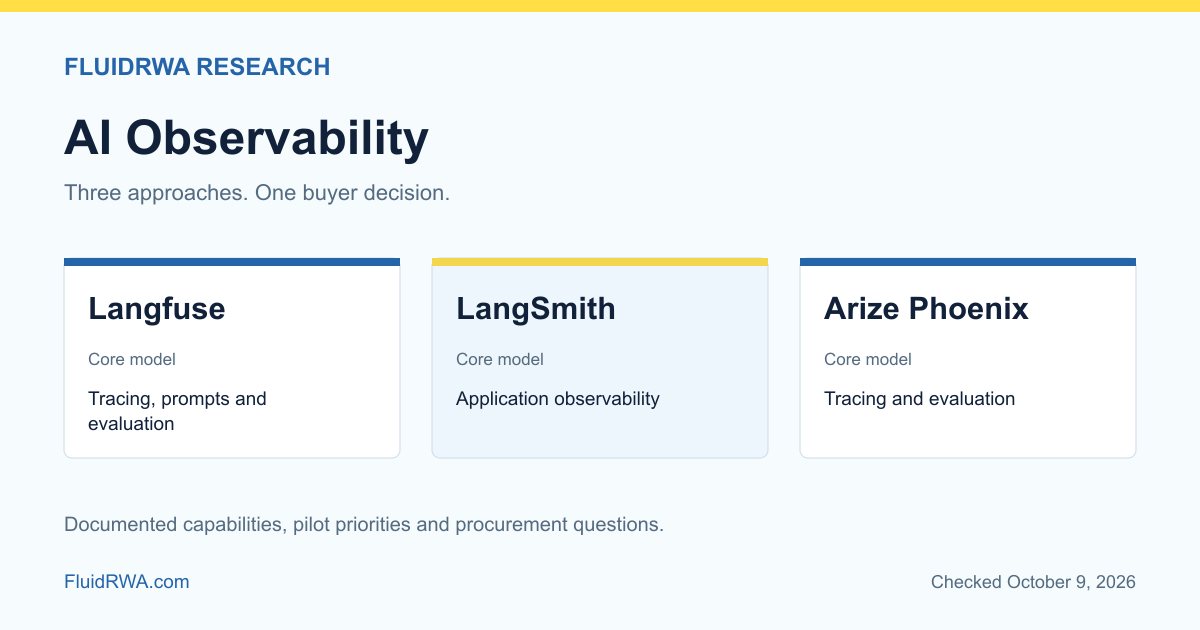
Langfuse documents an integrated tracing, prompt-management and evaluation platform. LangSmith documents tracing through SDKs and framework integrations. Arize Phoenix documents OpenTelemetry-based tracing, evaluation and experiments. Select by the evidence your team needs to diagnose failures and approve changes; tracing alone does not establish answer quality.
What should an observability tool help you decide?
When an AI assistant cites a withdrawn document, a tokenization platform needs to know which source was retrieved, which prompt was used and whether the error followed a recent deployment. A trace is useful only if it supports a decision: fix retrieval, change a prompt, roll back a release or send the case to a reviewer.
This comparison targets tracing and evaluation infrastructure, not general AI assistants. It does not duplicate our ChatGPT, Claude and Gemini comparison.
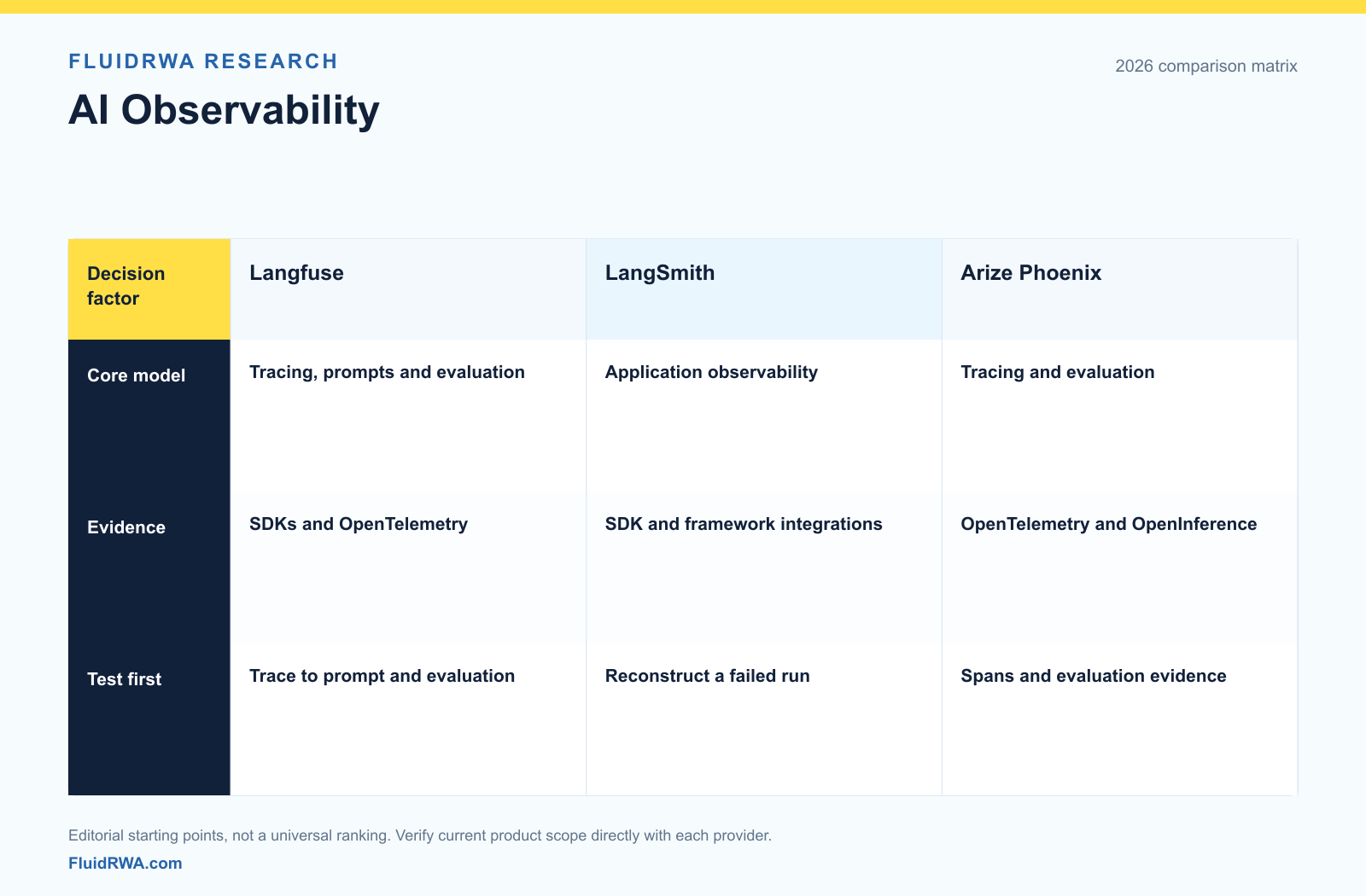
Comparison table: documented starting points
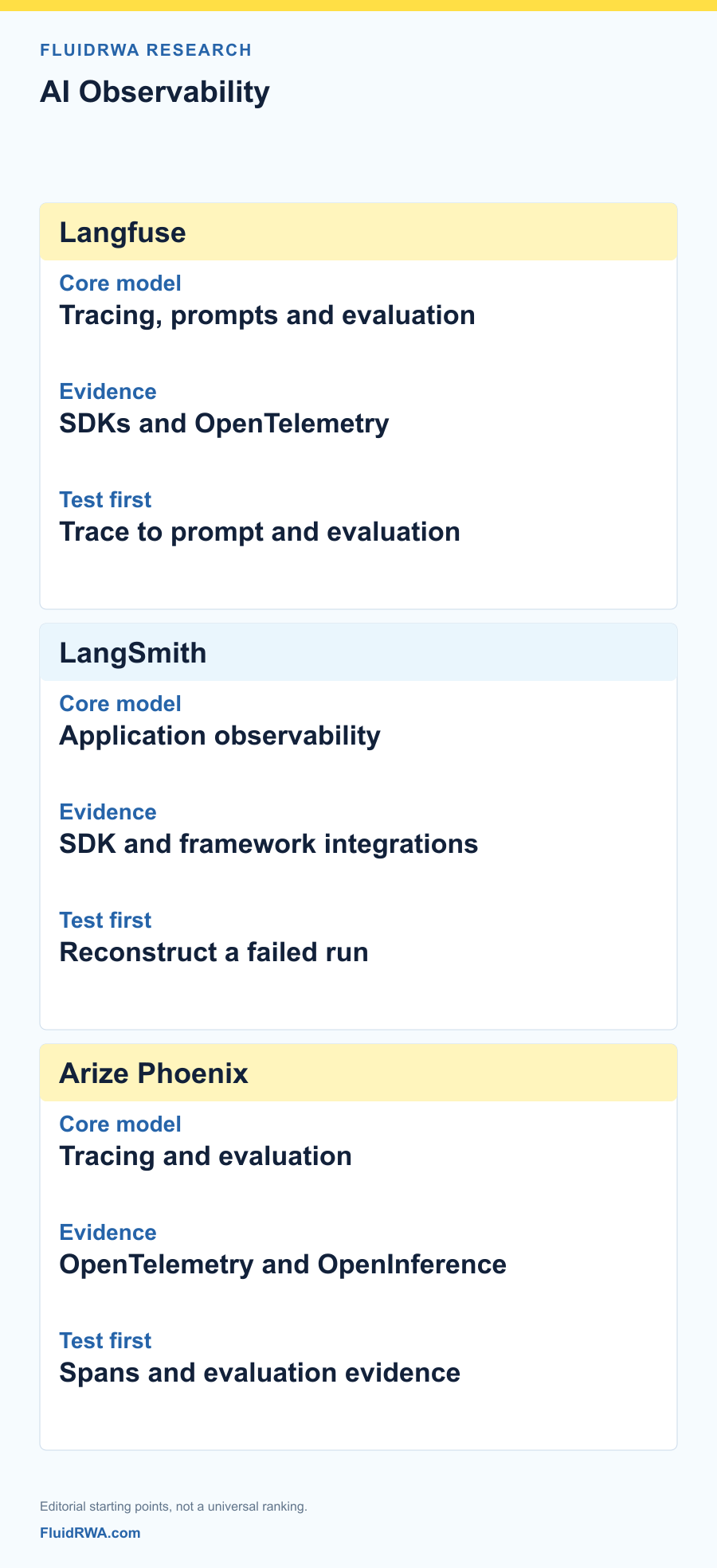
| Decision | Langfuse | LangSmith | Arize Phoenix |
|---|---|---|---|
| Documented orientation | Tracing, prompts and evaluation | Application tracing and observability | Tracing, evaluation and experiments |
| Instrumentation evidence | SDKs, integrations and OpenTelemetry | SDK and framework tracing integrations | OpenTelemetry and OpenInference |
| Product boundary | Confirm selected deployment and feature scope | Confirm observability and evaluation scope | Do not conflate Phoenix with Arize AX |
| First pilot | Trace linked to prompt and evaluation | Reconstruct a failed application run | Inspect spans and evaluation evidence |
| Common procurement check | Sensitive-data handling | Sensitive-data handling | Sensitive-data handling |
This is a documentation-based cohort, not an independent ranking. Recommendations below describe what buyers should test, not capabilities guaranteed by every plan or deployment.
Langfuse
Langfuse's documentation describes tracing, prompt management, datasets and evaluation within a self-hostable AI engineering platform. It documents SDK and OpenTelemetry-based instrumentation.
Evaluate when: your team wants to link execution evidence with prompt changes and evaluations. Verify the actual deployment and administration scope before assuming that self-hostability eliminates operational work or licensing differences between features.
LangSmith
LangSmith's observability documentation describes tracing using environment variables, framework integrations and SDKs. Its evaluation documentation provides the separate evaluation entry point.
Evaluate when: your application team wants a trace workflow it can integrate and inspect. Test the framework and tool calls you actually use. Do not assume that adding instrumentation proves completeness across external services or asynchronous work.
Arize Phoenix
The Phoenix overview describes tracing, evaluation, datasets and experiments, built around OpenTelemetry and OpenInference. It explicitly distinguishes Phoenix from Arize AX. The official repository supplies additional deployment and instrumentation context.
Evaluate when: open instrumentation and an inspectable evaluation workflow are important to your team. Request a product-specific proposal if you are considering a managed enterprise arrangement rather than treating Phoenix and AX as interchangeable.
A trace should explain a business failure
Take an illustrative investor-support workflow: the application retrieves a notice, summarizes it and drafts a response. Add a known failure such as an outdated notice. Require the pilot to connect the request, retrieved passages, model call, tool result and final output.
Then remove one dependency, slow another and deny a tool permission. Can an operator distinguish missing evidence, provider failure, latency and an authorization refusal? Record which information must be instrumented by your team. Do not count a dashboard screenshot as proof of complete coverage.
Evaluate quality separately from telemetry
Build a held-out set with correct source passages and acceptable answers. Include questions that should be refused because evidence is missing or the user lacks permission. Use explicit measures such as citation correctness, unsupported claims, retrieval relevance and policy adherence.
Compare a proposed prompt or model change against the same protected set. Review disagreements between human labels and automated evaluators. An LLM judge is another model, not an independent authority; validate it against human examples before using its score as a release gate.
Privacy is part of the architecture
Traces may contain prompts, documents, identifiers and tool outputs. Decide what you need before collecting everything. Use references and redacted snippets where they are sufficient; keep the authoritative document in its controlled system.
Test redaction before transmission, reviewer access, export and deletion. Obtain written retention and subprocessor information for the exact deployment. An observability platform's existence does not make the application compliant with a particular regulation.
Procurement checklist
- Which services and asynchronous steps are instrumented, and which are not?
- Can a run be linked to prompt, dataset and application versions?
- Can evaluators and reference labels be exported for independent review?
- How are secrets and personal information removed from traces?
- Which retention, access and regional options apply to the quoted product?
- What happens when the observability service itself is unavailable?
Prices, contractual service levels and security assurances for a specific customer deployment were not verified. Confirm them directly. There is no performance winner in this public-documentation review.
Connect monitoring to the underlying pipeline
For retrieval failures, start with the vector database comparison; for document fidelity, use the ingestion comparison. Share an AI infrastructure brief through FluidRWA requirements, or email contact@fluidrwa.com.
Verification and scope
Last checked: October 9, 2026. Reviewed by FluidRWA Research Team. Company documentation supports the product observations; pilot design and procurement questions are editorial recommendations. This is not a tested assurance of AI safety or financial suitability.
FAQ
Does tracing tell us whether an AI answer is correct?
No. A trace records execution evidence. Correctness requires appropriate reference answers, checks or human review; a model-based evaluator can also make mistakes.
Is Arize Phoenix the same product as Arize AX?
No. Arize distinguishes Phoenix from its managed enterprise platform, Arize AX. Do not transfer AX feature or service claims to a Phoenix deployment without checking.
Should we log complete investor documents?
Not by default. Define what evidence is necessary, redact unnecessary personal information and verify access, retention and deletion before collecting production traces.
Can these tools guarantee that an agent is safe?
No guarantee is established here. Observability and evaluation help diagnose and measure behavior; authorization, approval and transaction controls belong in the wider application.
Define your AI monitoring requirements
Share your application, evaluation needs and data-handling constraints. Direct enquiries: contact@fluidrwa.com.