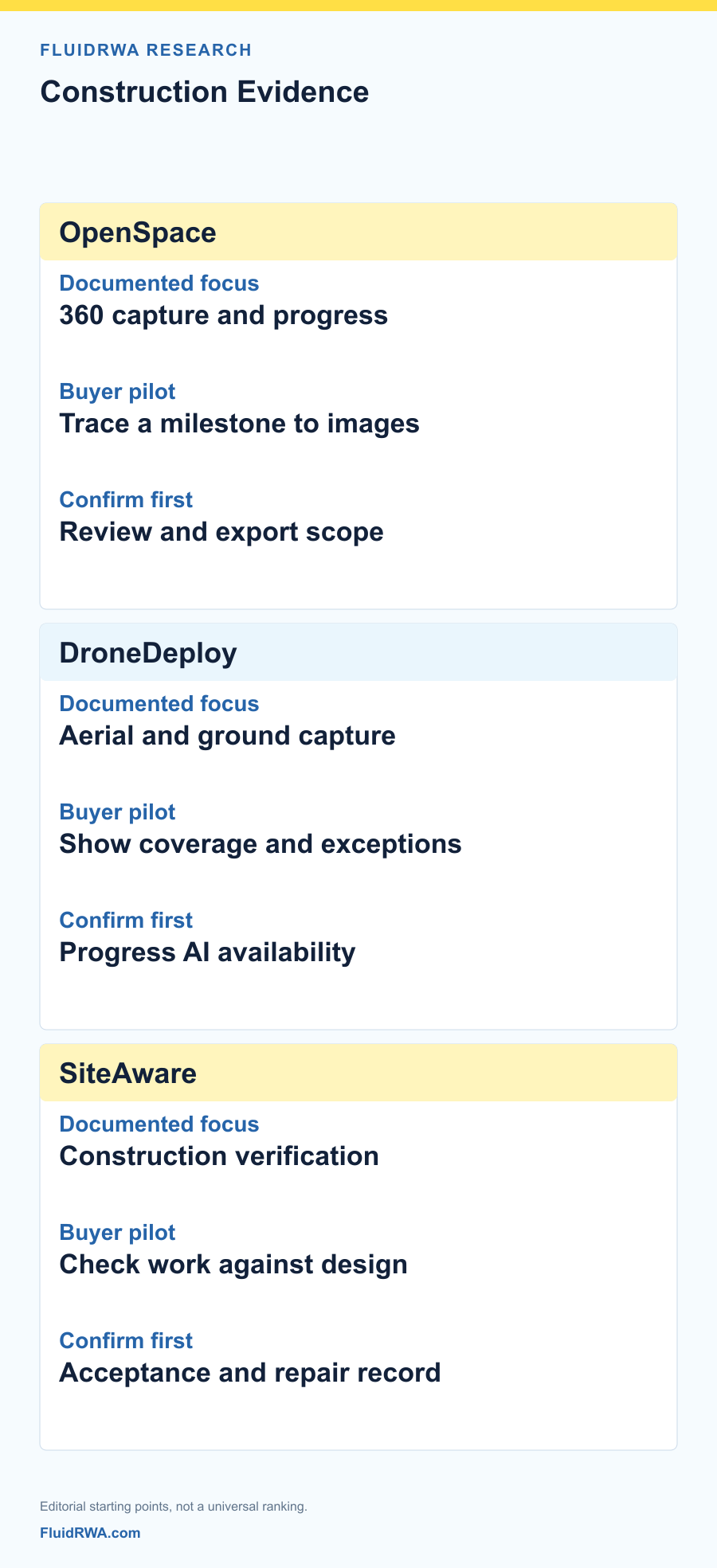
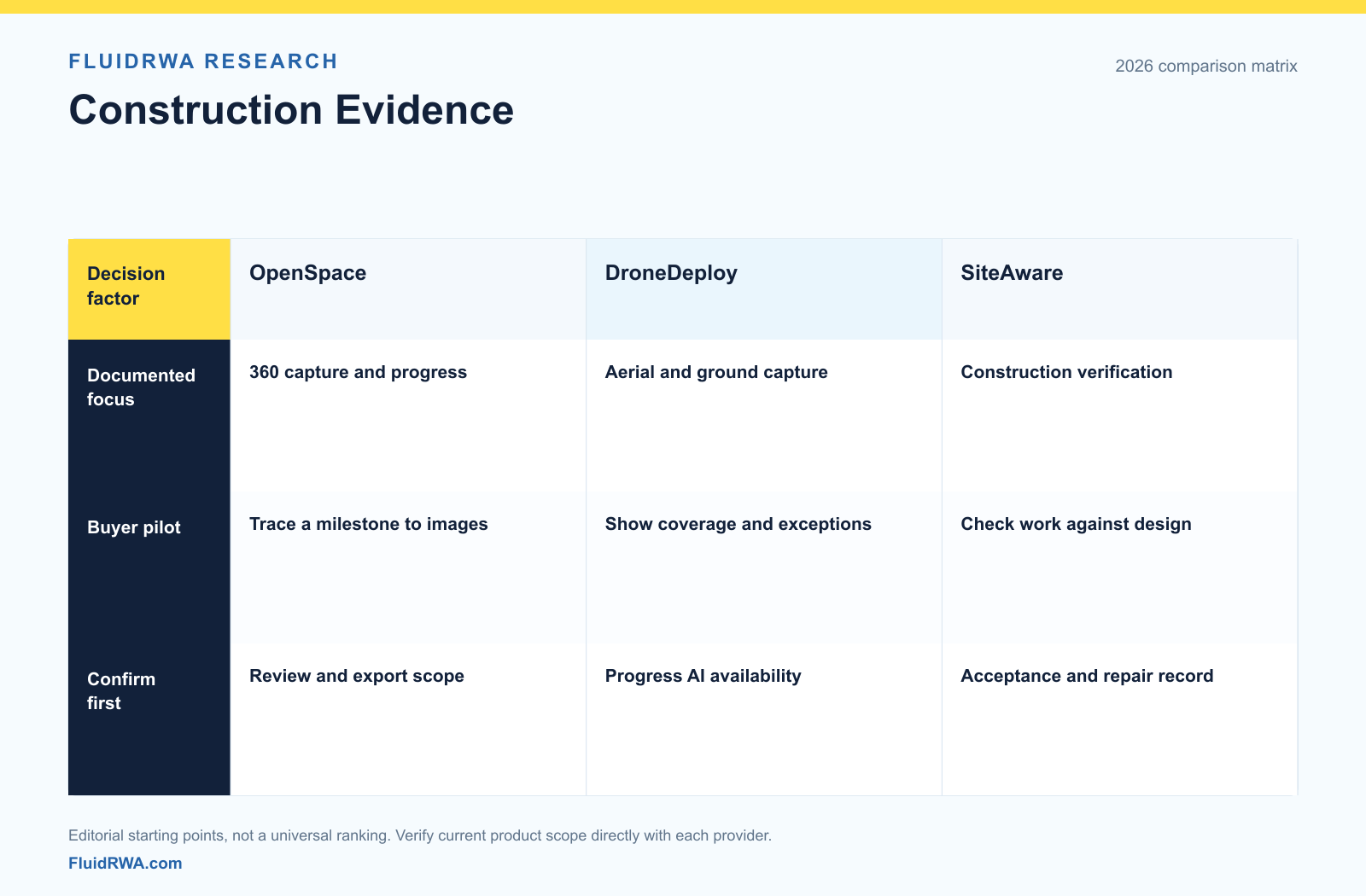
OpenSpace documents 360-degree capture and progress tracking, DroneDeploy combines aerial and ground reality capture with a separately scoped Progress AI offering, and SiteAware focuses on digital construction verification against design intent. For a lender or tokenized-property operator, the decision is which evidence question must be answered, who validates it and whether the output can support an investment or draw decision.

One site, three different evidence questions
A property-backed financing team may want to know whether work was completed, whether it matches approved plans, and whether today's site record can be shown to an investor months later. Those are related questions, but they do not call for the same product or professional judgment. This comparison is about documented construction evidence, not a claim that any vendor independently values property or verifies the legal rights behind a tokenized asset.
We selected these three companies because they already appear in FluidRWA's physical-asset-verification directory and each publicly describes a different way to capture or assess construction conditions. It is not a market-wide ranking.
Compare by the decision you need to make
| Buyer question | OpenSpace | DroneDeploy | SiteAware |
|---|---|---|---|
| Documented center of gravity | 360-degree site capture and progress analysis | Aerial and ground reality capture; Progress AI is separately described | Digital construction verification against design and site conditions |
| Evidence to inspect in a pilot | Dated image trail linked to locations and progress milestones | Repeat aerial/ground captures, reporting and the precise Progress AI scope quoted | Deviations, approvals and reinspection record for a specified building element |
| Good first buyer task | Explain what changed in one area between two site visits | Monitor a distributed site and compare capture coverage over time | Test whether installed work matches a chosen design requirement |
| Still needs separate proof | Legal title, independent valuation and complete hidden-condition inspection | Coverage of obstructed work, product availability and independent sign-off | Ownership, valuation and the full loan-draw decision |
| Commercial terms and implementation | Not verified for a common project | Not verified for a common project | Not verified for a common project |
The pilot tasks and missing-proof row are FluidRWA's proposed evaluation method. They are not vendor performance measurements. Not verified means the public evidence reviewed does not support a comparable conclusion; it does not mean a capability is absent.
OpenSpace: trace progress back to its visual record
OpenSpace Capture describes 360-degree imagery mapped to floor plans with time-based comparison and export. Its progress-tracking product adds analysis of planned versus actual work. The useful procurement question is whether a project reviewer can drill from a claimed completion percentage to the capture, location, date and reviewer that support it.
Request a pilot covering one trade in two areas across three capture dates. Ask for both the summary and the underlying images, plus a correction process when a milestone is marked complete before a defect is resolved. Do not equate an image-rich record with a qualified engineer's acceptance certificate.
DroneDeploy: establish capture coverage before relying on automated progress
DroneDeploy's construction page describes aerial and ground site capture and analysis. Its Progress AI help article says image coverage is necessary and describes the feature as early access at the time of review. This distinction matters: do not promise progress automation merely because the wider capture platform is available.
Pilot a site with areas that are easy to photograph and areas that are hidden or visually ambiguous. Request a coverage map, exceptions where progress could not be inferred, the current product entitlement and the human review step. A lender needs to know where the evidence stops.
SiteAware: test an installation against a requirement
SiteAware's operating description presents digital construction verification as a process for comparing built work with design requirements. Its service terms identify a digital construction verification service and repository, while leaving purchased scope to the order. Treat the proposed scope, capture frequency and acceptance threshold as contract questions, not facts inferred from a headline.
Give the provider one specified component with a documented tolerance, a change order and a repair. Ask how the finding is identified, reviewed, closed and exported. For asset finance, require a link from the verification output to the approved design revision used in the draw decision.
The evidence pack a lender should request
Regardless of provider, ask for the capture date and location, the unedited source, analysis version, reviewer identity, any manual override, unresolved exceptions and a durable export. Match these to the draw schedule and the work certified by the independent professional. The platform should also demonstrate what happens if captures are missing for a week or a subcontractor disputes a finding.
This is where physical evidence meets tokenized real-estate fund operations: the site record can inform an investment or servicing decision, but it does not turn an image into title, NAV or a legally binding entitlement.
Sources and review scope
The linked company pages and help documentation were checked 24 October 2026. Company descriptions are evidence of stated product scope, not independent validation. No common-project price, accuracy benchmark, lender acceptance or RWA-specific integration has been established. Send corrections or a procurement brief to contact@fluidrwa.com.
FAQ
Which platform proves a property is suitable collateral?
None of these product descriptions alone establishes valuation, legal title or lender eligibility. They can supply different forms of site evidence. An independent valuer, engineer or lender may still need to assess that evidence.
Is DroneDeploy Progress AI generally available?
The product help page reviewed on 24 October 2026 described Progress AI as early access and an add-on. Confirm current contractual availability for your configuration directly before relying on it.
Can visual capture replace a physical inspection?
Not automatically. Specify which defects, hidden conditions and certifications require a qualified physical inspection and which can be supported by remote imagery.
Source the right evidence stack
Describe the asset, construction stage and decision the evidence must support. Prefer email? contact@fluidrwa.com.