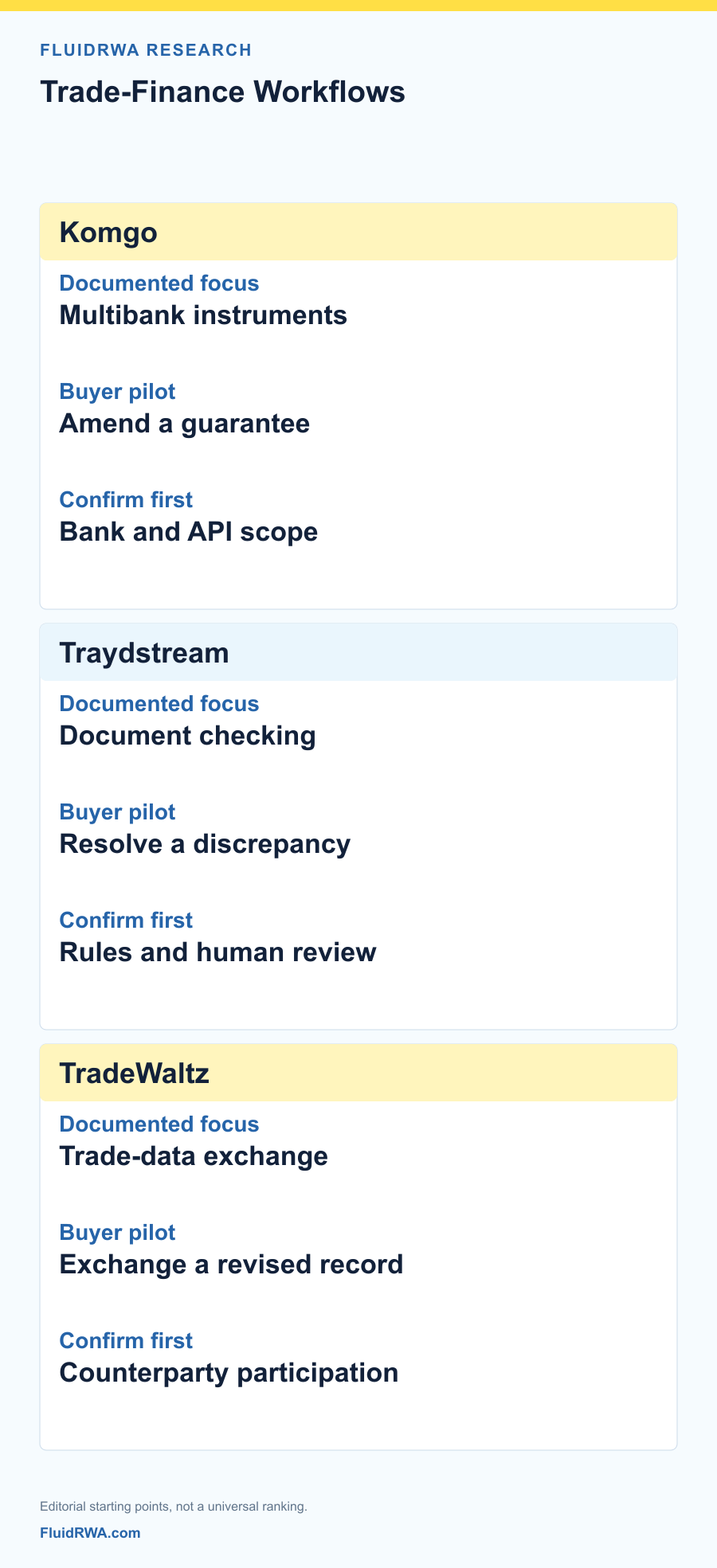
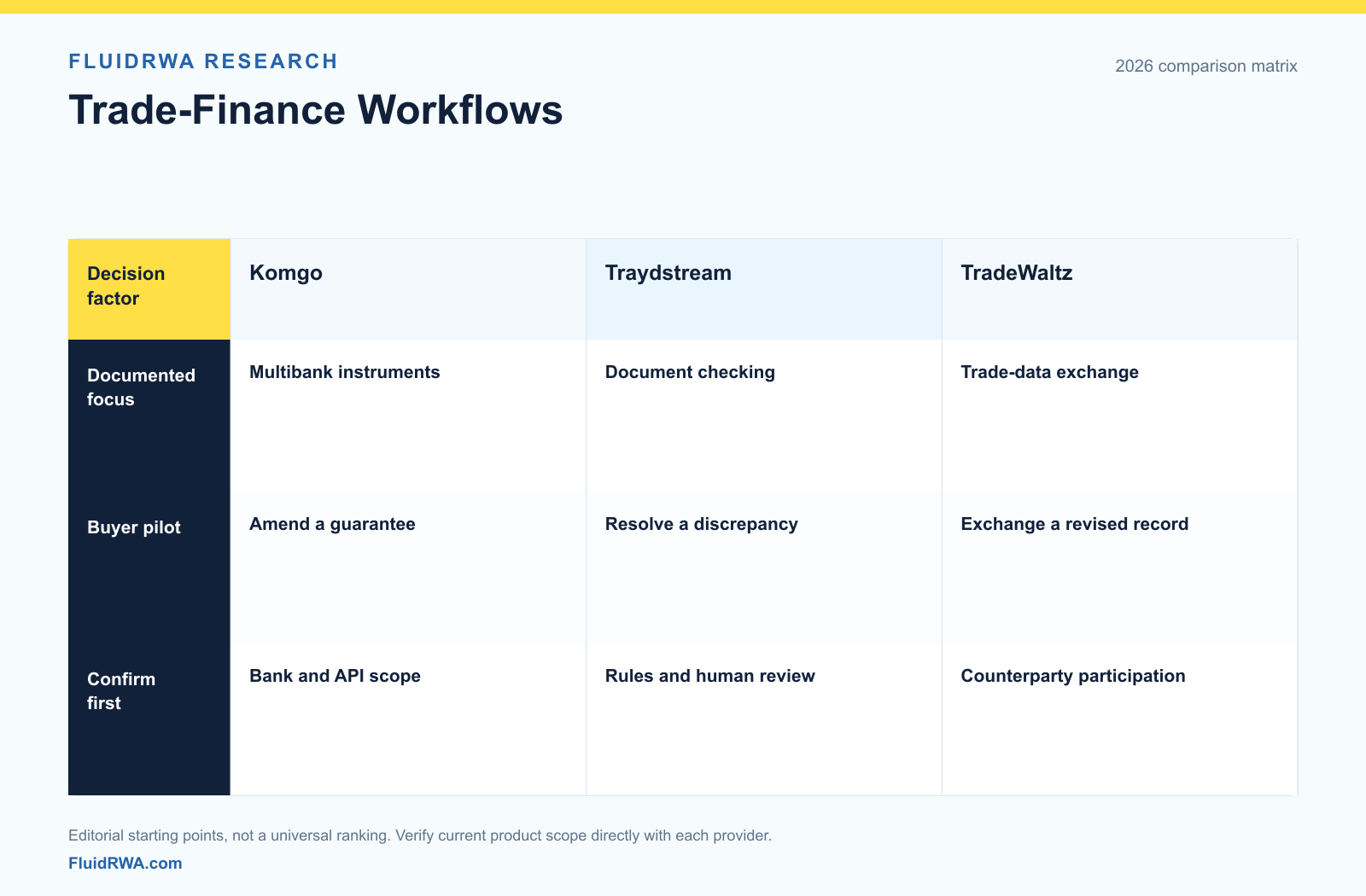
Komgo documents multibank trade-finance instrument management and communications; Traydstream documents automated checking of trade documents and compliance information; TradeWaltz describes a shared digital trade-information platform. They solve adjacent problems. Choose the workflow and legal documents first, then compare integrations, exception handling and the parties who must join.

Start with the broken handoff
Trade finance is often described as one market, but a corporate treasury team managing guarantees, a bank checking letter-of-credit documents and a shipper sharing origin records are buying different capabilities. The useful comparison is therefore which handoff each product changes, not which company has the longest feature list.
All three companies appear in FluidRWA's trade-finance and supply-chain directory. We selected them to explain distinct documented workflows, not to rank a complete market or suggest that all are interchangeable.
Documented scope and buyer test
| Buyer question | Komgo | Traydstream | TradeWaltz |
|---|---|---|---|
| Publicly described focus | Corporate trade-finance management and structured bank communications | Automated trade-document and rules checking | Shared trade-information and document exchange among participants |
| Named product or layer | GTK and Konsole | TraydCheck | TradeWaltz platform |
| First pilot | Issue, amend and reconcile one guarantee across two banks | Review one discrepancy-heavy document set and its human disposition | Exchange a revised trade record across named counterparties |
| Critical dependency | Bank participation and systems integration | Document quality, rule scope and expert exception review | Counterparty participation, data rights and legal document acceptance |
| Common-project price and deployment outcome | Not verified | Not verified | Not verified |
The first-pilot and dependency rows are FluidRWA buyer criteria. Not verified indicates missing comparable public evidence, not an assertion that a provider cannot deliver a feature.
Komgo: manage instruments and bank communication
Komgo's product FAQ distinguishes GTK, a corporate trade-finance management application, from Konsole, the communication layer between corporates and financial institutions. Its descriptions include guarantees, standby letters of credit, letters of credit and bank connectivity. That is a different purchase from automating the inspection of every field in a submitted shipping document.
Ask Komgo to demonstrate a guarantee issued through one bank, amended through another workflow and reconciled to the treasury system. Require the exact bank, entity and channel configuration in the proposal. A network description alone does not prove that the buyer's banks have agreed to the intended workflow.
Traydstream: make document discrepancies reviewable
TraydCheck is described by Traydstream as automated trade-document verification and compliance checking. Its page refers to documentary rules, including UCP 600 and ISBP 745, and to sanctions checks. These are company claims about scope, not an independent accuracy test or a replacement for a bank's legal and compliance decisions.
Use a historical but appropriately sanitized letter-of-credit presentation containing a real discrepancy, a scanned low-quality document and an amendment. Ask to see extracted data, rule references, analyst override, approval history and an export of the final determination. A high-level automation percentage from a vendor page is not a customer-specific business case.
TradeWaltz: coordinate cross-party information
TradeWaltz describes a digital trade platform for exchanging documents and status information among participants. Its company profile identifies the platform as a SaaS trade-information-sharing service. Before treating a cross-party record as an electronic transferable document, ask which parties have joined, which version is authoritative and whether the specific document and jurisdiction are supported.
Pilot a document that changes after issuance. Show which participant can amend it, which prior version remains visible, when a bank or carrier recognizes the change and what happens when an outside participant remains on paper. An electronic workflow only delivers network value when the required counterparties actually use it.
Buying across the layers
These products can be complementary. A corporate may manage its bank instruments in one system, check submitted documents in another, and exchange a transferable record through a network. Map the source of truth for each status before purchasing any integration. Define a shared transaction identifier and responsibility for the final discrepancy decision.
For electronic-transferable-record questions, UNCITRAL's model law describes the concept of reliable exclusive control. It is a model, not universal enacted law. Our warehouse-receipt guide explores the physical-goods end of that issue; the electronic trade-documents comparison focuses on a different provider cohort and buyer task.
Sources and review scope
The linked company and UNCITRAL pages were checked 24 October 2026. This comparison has not audited the platforms, tested interoperability or verified production availability for a particular country or transaction. No fee, accuracy or time-saving number is inferred across the three providers. Corrections and scoped buyer enquiries: contact@fluidrwa.com.
FAQ
Are these three platforms direct substitutes?
Not generally. Their public positioning emphasizes different layers: instrument management and communication, document checking, and cross-party trade-data exchange. A buyer may need more than one layer.
Does digitizing a bill of lading or letter of credit make it legally effective everywhere?
No. The transaction's documents, applicable law, participating institutions and control method determine legal effect. Validate each jurisdiction and instrument with counsel and counterparties.
Which one is cheapest or fastest to implement?
The reviewed public evidence does not provide comparable quotations or implementation outcomes for one common buyer scope. Issue the same workflow brief and acceptance test to each relevant provider.
Map a digital-trade project
Share the instruments, counterparties, jurisdictions and systems involved. Prefer email? contact@fluidrwa.com.