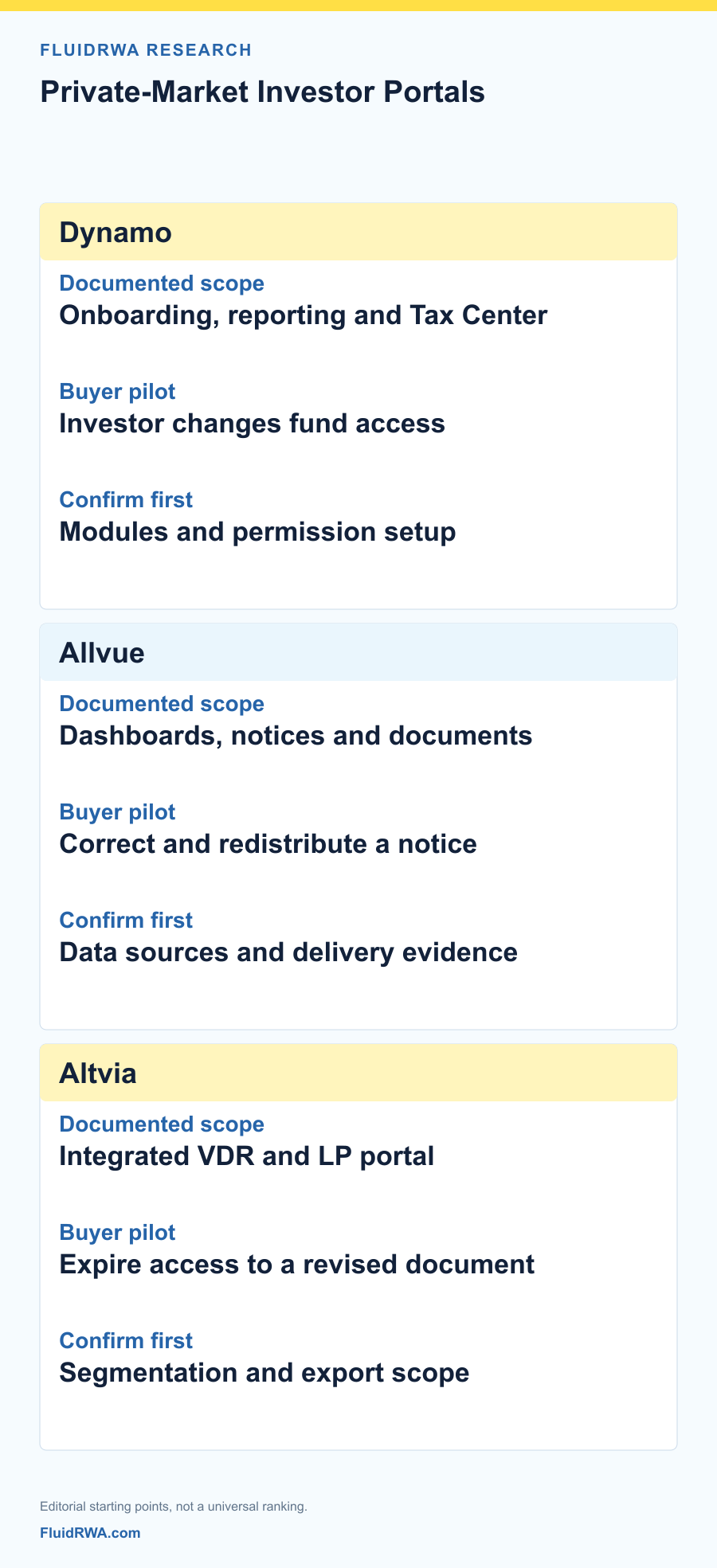
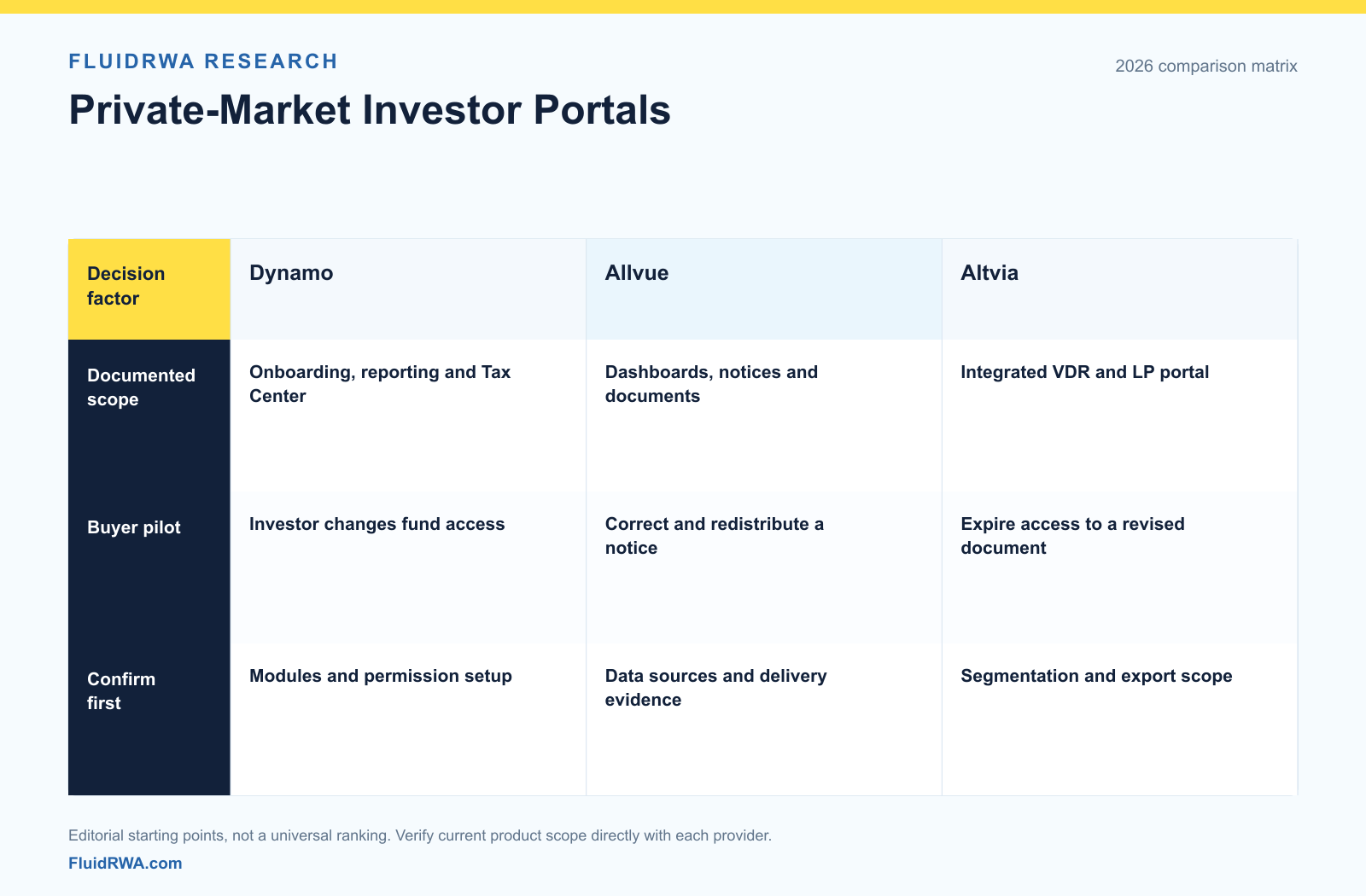
Dynamo describes a portal linked to fundraising, onboarding, reporting and a tax-document center. Allvue describes configurable dashboards, investor notices and document distribution. Altvia describes an integrated virtual data room and LP portal with segmentation and document controls. Choose through an investor-access and reporting pilot, not branding alone; token ownership and wallet controls require separate evidence.

The difficult part is who can see what
An attractive portal is easy to demonstrate with one investor and one fund. The harder test is a family office investing through two entities, an adviser with limited authority and a former employee whose access must end immediately.
That is the procurement problem here: delivering the right information to the right person, with reliable reporting and a record of changes. This comparison is about private-market investor servicing, not a replacement for a tokenization platform, identity-verification provider or transfer agent.
Limited partners (LPs) are the fund investors using these portals. Their experience should be tested alongside the staff workflows, especially when one person represents several investing entities.
Comparison table: documented portal workflows
| Buyer question | Dynamo | Allvue | Altvia |
|---|---|---|---|
| Product page reviewed | Investor Portal | Investor Portal | Integrated VDR & Portal |
| Documented workflows | Onboarding, document sharing, investor reporting and Tax Center | Configurable dashboards, investor notices and report distribution | Branded document sharing, segmentation and LP communications |
| Specific controls described | Access control and configurable information collection | Investor interaction monitoring and preference settings | Two-factor authentication, watermarking, expiry and permissions |
| Common pilot | Change an investor's access without exposing another fund | Correct a notice while preserving the delivery trail | Replace a document and revoke a former user's access |
| Native token/register connection | Not verified from the reviewed page | Not verified from the reviewed page | Not verified from the reviewed page |
Descriptions reflect the particular pages reviewed, not an exhaustive inventory of each company. An undocumented feature is not verified, not necessarily unavailable. The common pilot is our recommendation.
Dynamo: follow the investor across onboarding and reporting
Dynamo's Investor Portal page describes document sharing, investor onboarding, reporting and a Tax Center with electronic-consent workflows. It also describes connections with fundraising and marketing tools.
Start the demonstration with a person who represents two investing entities. Ask how those entities, their documents and their permissions are separated. Then change the person's role and verify what they can still view, download or edit.
For onboarding, request a clear distinction between gathering information and completing the actual checks. A portal accepting KYC material does not, by itself, establish who makes the decision or which service supplies the verification. Ask how incomplete cases return to the investor and how operations staff track them.
Allvue: trace a notice back to its approved data
Allvue's Investor Portal page describes configurable dashboards, branding, automated document distribution, preference settings and interaction monitoring.
Use a capital-call or distribution notice as the test. Begin with approved source data, publish the notice, correct an input and produce a replacement. Ask where the approval happens and how the investor can distinguish the current notice from the superseded one.
A dashboard is only as useful as its inputs. Confirm whether figures are loaded from the fund-accounting system, another Allvue module or a manual file. Ask which integration and reconciliation tasks are included in the quoted scope rather than treating the wider product suite as one purchase.
Altvia: test the transition from diligence to ongoing access
Altvia's Integrated VDR & Portal page describes a branded portal, segmentation by fund or investor type, document notifications, two-factor authentication, watermarks, expiry and custom permissions.
Use a prospective investor who becomes an admitted investor. The documents and permissions needed before admission may differ from those needed afterwards. Ask the provider to demonstrate that transition, including what happens to old data-room links.
Then replace a document and expire access for a former representative. Check the ordinary user journey as well as the administrator's view. A permission change is not useful if the wrong person retains a working link or receives a later notification.
A portal does not automatically settle ownership
For a tokenized fund, map four separate records: the investor's account, legal investing entity, wallet association and authoritative ownership register. A portal login is not a wallet signature, and a wallet signature is not proof that the individual has authority for the investing entity.
Treat token integrations as a separate acceptance item. Request the exact connector, direction of data flow, refresh schedule and behavior when records disagree. Do not allow a portal balance to quietly become the official ownership record without the appropriate legal and operational arrangement.
For that wider workflow, use our investor-onboarding guide and transfer-agent RFP.
If an existing portal is being replaced, include the platform-migration records checklist in the change plan.
The evidence to request before signing
Give shortlisted providers the same permission matrix and reporting pack. Test on a phone as well as a desktop. Include a representative of several entities, a corrected statement, a revoked user, a failed notification and a request for a complete export.
Ask for:
- A distinction between views, downloads, acknowledgements and delivery failures.
- The identity and access options included in the proposed subscription.
- Approval controls for changing payment instructions.
- Retention, export, deletion and administrator-access terms.
- A documented route to resolve a mismatch between portal and accounting data.
Price, support arrangements and configuration effort were not verified on a like-for-like basis. Ask for a scoped proposal rather than inferring that the shortest feature list is the least expensive option.
Sources and review scope
The three official product pages were checked 22 October 2026. Product descriptions are company evidence. The tests above are proposed procurement exercises, not tests FluidRWA has performed. For a shortlist, email contact@fluidrwa.com with your fund structure, investor groups and reporting needs.
FAQ
Can these portals maintain a tokenized fund's ownership register?
The reviewed portal pages do not establish that function for a specific tokenized fund. Confirm the legal register, transfer agent and any wallet or token integrations separately.
Is an investor portal the same as a virtual data room?
They can overlap, but the buyer tasks differ. A data room supports diligence and controlled document access; an investor portal may also serve continuing reporting, notices and investor servicing. Confirm the actual contracted modules.
Does a document-view record prove an investor accepted a notice?
Not necessarily. A view, download, acknowledgement and legally effective delivery are different events. Agree which evidence the fund requires and obtain legal advice where needed.
Build a focused vendor brief
Share the workflow, systems and responsibilities you need to cover. Prefer email? contact@fluidrwa.com.