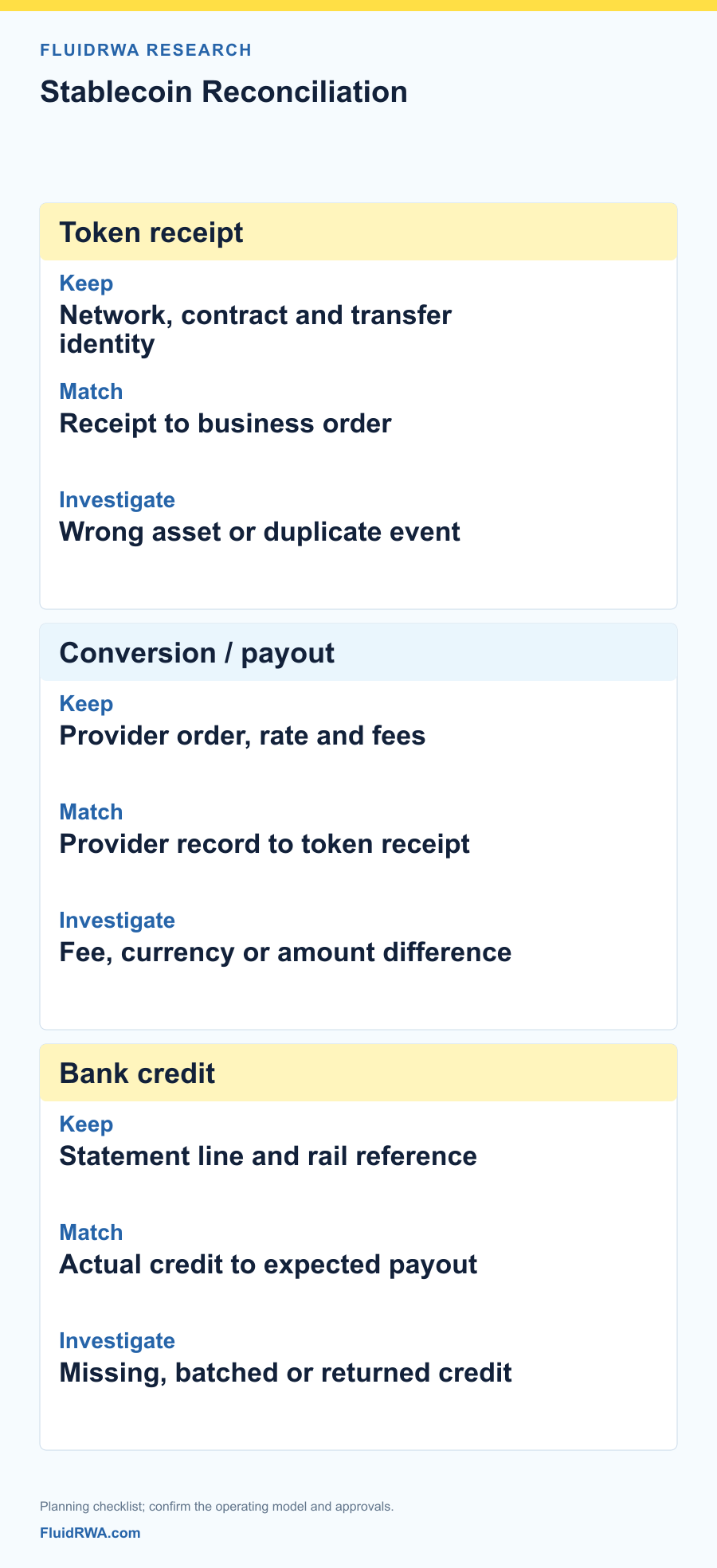
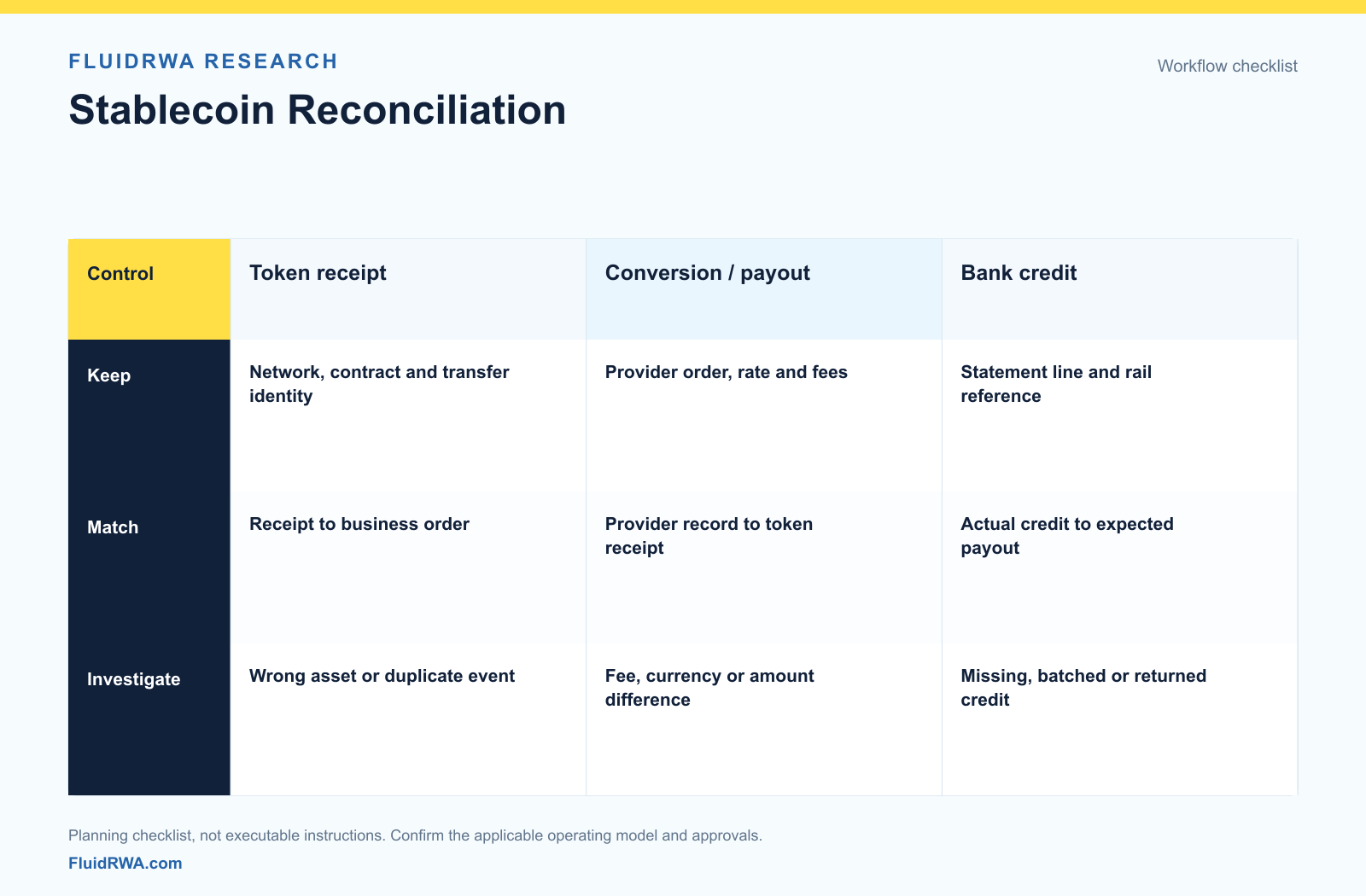
Reconcile a stablecoin payment across three records: the confirmed token transfer, the provider's conversion or payout record, and the bank credit. Link those records to the original order, preserve fees and currencies separately, and route unmatched items to review. A transaction hash or successful webhook alone does not establish that the beneficiary's bank account received the expected amount.

Match the money, not just the notification
A customer pays an invoice in stablecoins. Your dashboard turns green, but the bank statement shows a smaller amount the following day. Has a fee been deducted, has the payout been batched, or has part of the money failed to arrive?
The answer requires linked records, not another payment-status label. This guide focuses on reconciliation after a payment has been initiated. For choosing the financial service behind it, use the stablecoin infrastructure comparison.
1. Define exactly what you expect to receive
Before processing a payment, record the invoice currency, agreed amount, accepted asset and network, beneficiary, fee arrangement and any conversion terms. Decide whether the obligation is to deliver a number of token units or a fiat amount. Those are not the same promise.
Assign a business-order identifier that survives changes to the provider or payout route. Keep customer information in access-controlled systems rather than putting personal identifiers into public blockchain references.
2. Keep a record for each part of the journey
| Record | Fields to preserve | What it does not prove alone |
|---|---|---|
| Business order | Order ID, amount, currency and beneficiary | That money moved |
| Token receipt | Network, contract, transaction and transfer-event identity, amount | That the correct invoice or beneficiary was credited |
| Provider conversion | Order/resource ID, input/output amounts, FX and fees | That the bank received the payout |
| Bank credit | Account, statement line, currency, date and rail reference | Which token receipt funded it |
| Reconciliation decision | Matched records, difference, reason and reviewer | That future returns or adjustments cannot occur |
For an EVM receipt, a transaction can contain multiple transfer events. Preserve enough information to distinguish those events; do not deduplicate all transfers by transaction hash alone. Apply the equivalent identity scheme for the network you actually use.
3. Separate event identity from payment identity
Bridge's webhook schema distinguishes a globally unique event identifier from the resource identifier and includes event category and timestamp fields. That is a useful example of why one payment can produce several messages.
Authenticate the callback using the provider's current procedure. Bridge's signature guide documents its own signature-verification process; it should not be copied unchanged to another provider.
Persist valid events before acknowledging them. Make repeat delivery harmless, and allow a provider status query to resolve an ambiguous event. Event deduplication prevents duplicate processing of a message; a separate business rule must prevent duplicate application of the underlying payment.
4. Match bank references according to the rail
A provider's API identifier may never reach a bank statement. Plaid's European payment-initiation reconciliation guide explains that its payment ID differs from the identifiers carried on payment rails. It also warns that banks may alter end-to-end references. This is a scoped example for Plaid's documented European workflow, not a universal specification for stablecoin payouts.
Request the payout provider's actual reference mapping for each supported rail. Test with the statement format your bank supplies. If the provider batches payouts, obtain a batch-to-order allocation report instead of matching solely on one total amount.
5. Work through the expected-versus-received amount
Illustrative example, not a provider quotation: an agreement requires conversion of 1,000 token units at USD 1.00 per unit. The provider deducts a documented USD 5 fee, so the expected bank credit is USD 995. A statement credit of USD 990 leaves a USD 5 exception until evidence explains it.
Do not assume a stablecoin always converts at par. Store the actual agreed conversion and currency, and separate provider fees, bank charges and FX differences. Network transaction fees may be paid separately in another asset.
In an actual implementation, use decimal-safe arithmetic and the agreed rounding rules. The finance team should determine accounting treatment; the reconciliation service should preserve the inputs rather than choose a policy implicitly.
6. Give every exception an owner
Set up explicit cases for a wrong network, unexpected token contract, underpayment, duplicate event, missing payout, returned bank transfer and unidentified deposit. Each case needs an owner, evidence, deadline and approved resolution.
Useful operational measures include unmatched value by currency, oldest unresolved item and the number of credits requiring manual allocation. Do not hide a deteriorating queue behind an overall payment-success percentage.
Before launch, rehearse a delayed webhook, repeated event, batch payout, changed bank reference and return received after an earlier match. The system should preserve the original reconciliation decision and record the later adjustment.
Build the daily close pack
Export opening balances, receipts, conversions, fees, payouts, returns, closing balances and unresolved differences. Establish which sources are authoritative for each record and who signs off the close.
Our payment-event delivery comparison covers message infrastructure; our crypto-accounting comparison covers accounting tools. Neither removes the need to link payment evidence across systems.
Sources checked 22 October 2026. The workflow and numerical example are FluidRWA recommendations, not a claim about a provider's settlement guarantee. For help mapping the hand-offs, email contact@fluidrwa.com.
FAQ
Is the transaction hash a unique payment identifier?
Not by itself. One transaction can contain several token transfers. Preserve the network, contract and transfer event or instruction identity, and link it to the business order.
Does a webhook mean that a bank payout has arrived?
Not automatically. It reports a provider event or state. Read that event's documented meaning and reconcile the actual bank credit separately.
What should happen to unmatched money?
Keep it in a controlled exception or suspense process under your approved accounting policy. Do not silently mark an order paid or invent a fee to make the difference disappear.
Map your payment operations
Share the workflow, systems and responsibilities you need to cover. Prefer email? contact@fluidrwa.com.