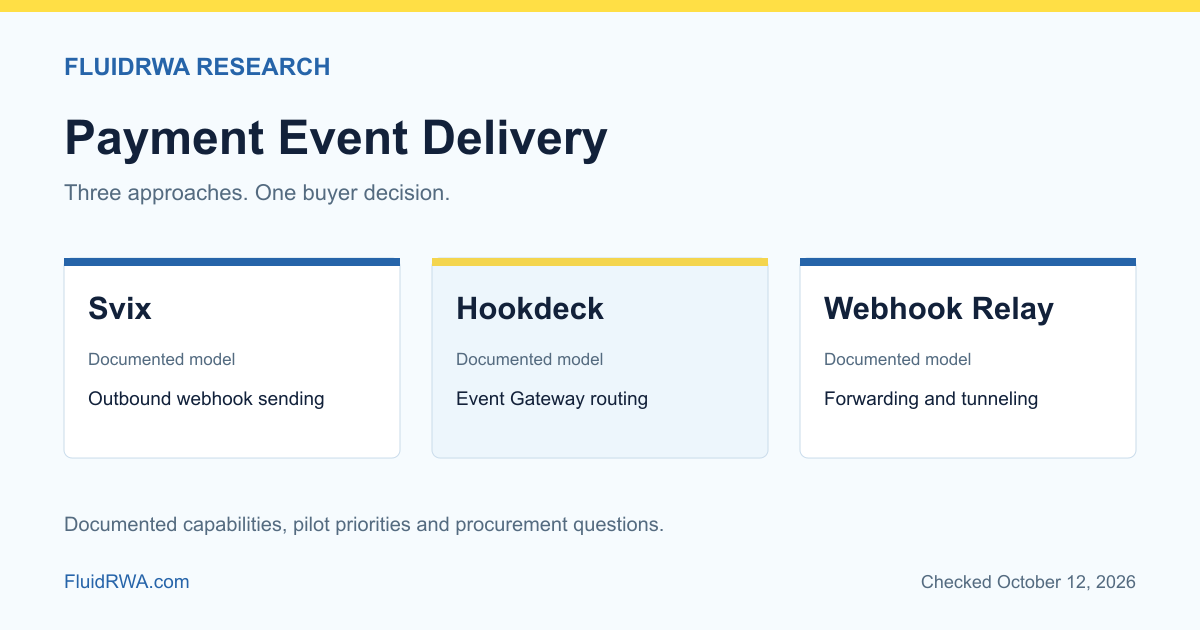
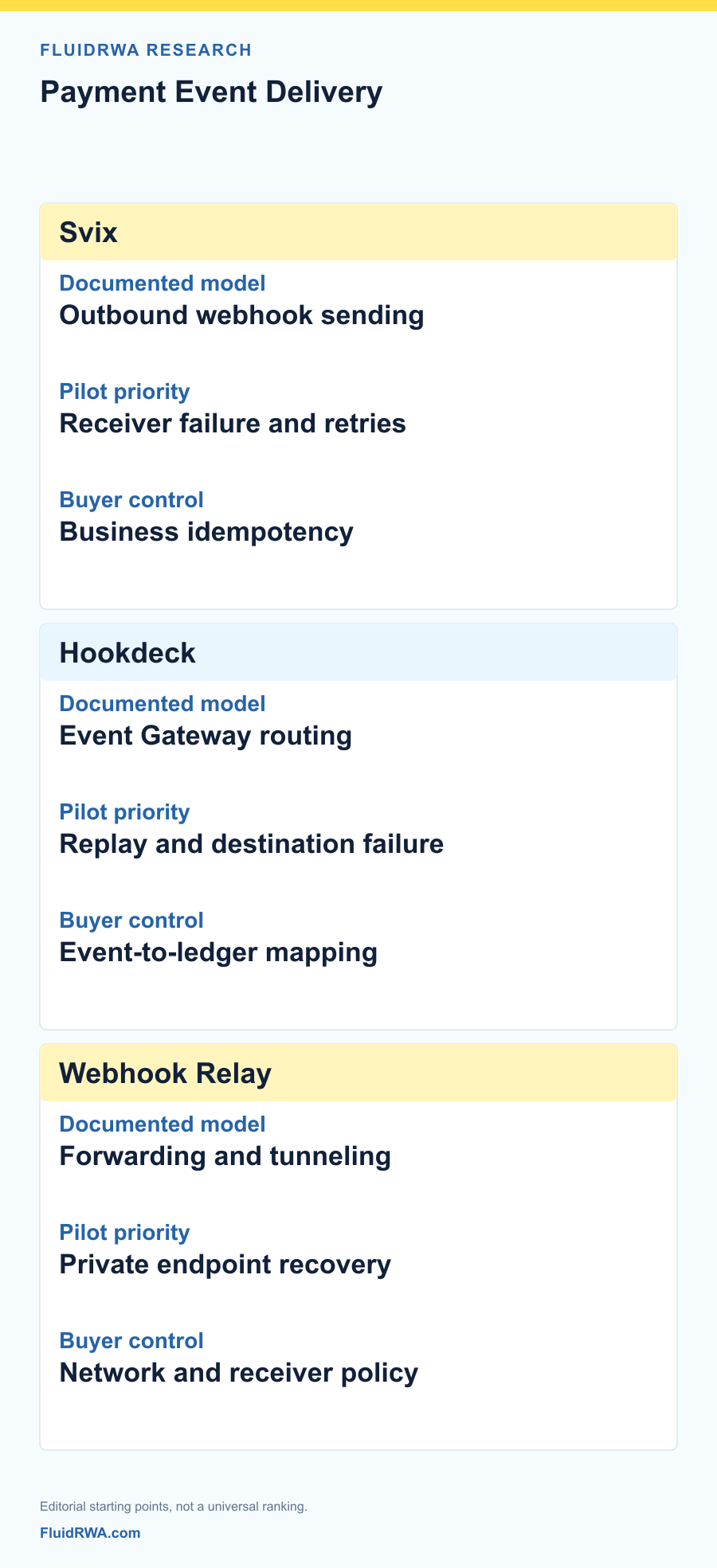
Svix documents outbound webhook sending, Hookdeck Event Gateway documents receiving and routing events, and Webhook Relay documents forwarding and tunneling. Start with the direction of your event flow, then test failure handling. None of these models by itself makes a payment final or guarantees that your ledger records an event only once.
What should payment teams compare first?
A webhook is a message about a transaction, not the transaction itself. A provider may deliver a callback successfully while your application fails to update its ledger. A receiver may update the ledger but time out before acknowledging receipt, causing another delivery. Both cases need an explicit recovery design.
This comparison concerns event transport around payment, custody and wallet systems. It does not replace our stablecoin infrastructure comparison or compare the financial services behind those events.
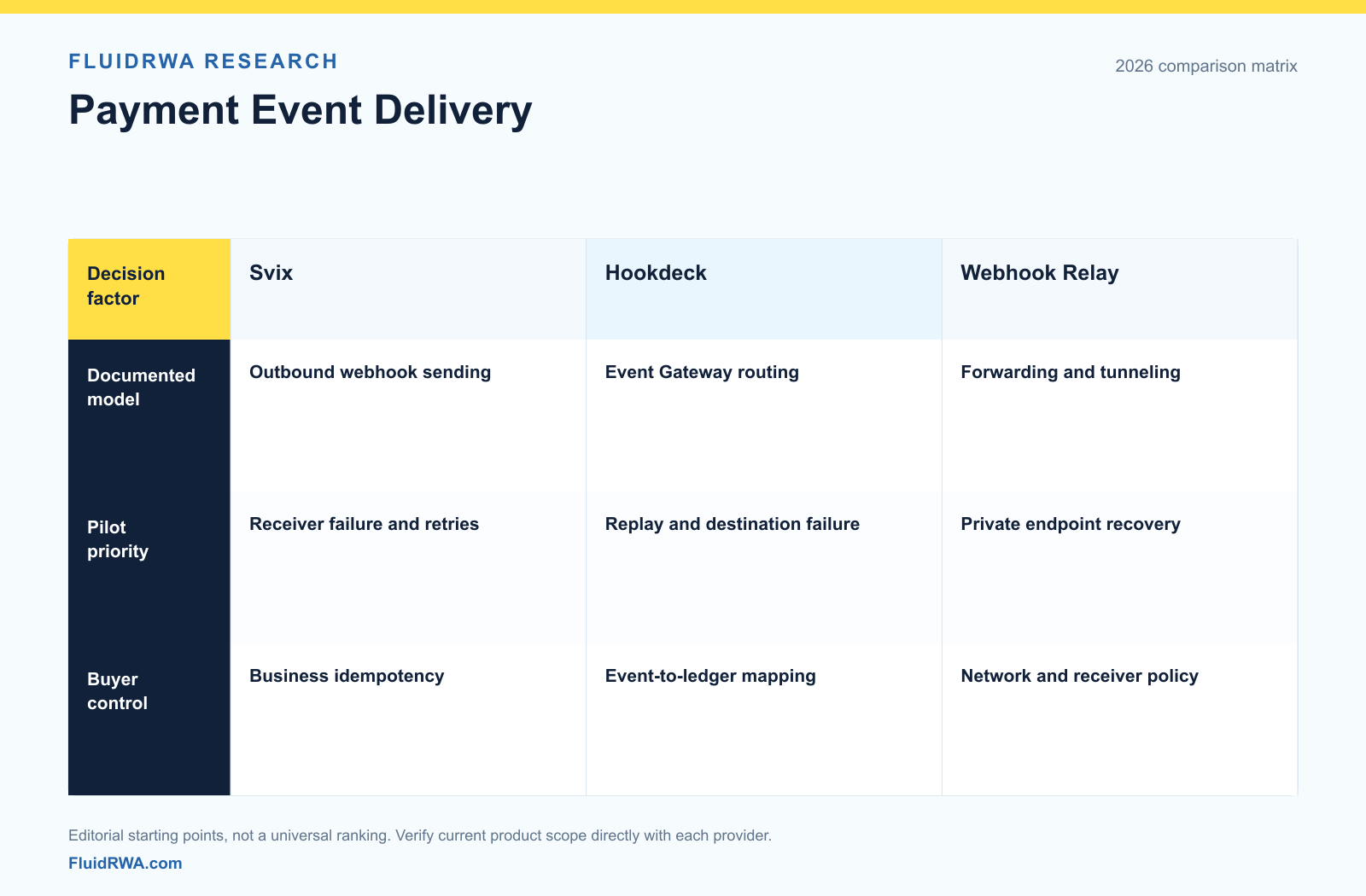
Comparison table: three documented starting points
| Buyer question | Svix | Hookdeck Event Gateway | Webhook Relay |
|---|---|---|---|
| Documentation reviewed | Webhook sending and retry schedule | Sources, destinations, retries and replay | Forwarding, tunneling and security |
| Initial design question | How do we send events to our customers? | How do we receive and route upstream events? | How do events reach a private or distributed endpoint? |
| Failure pilot | Receiver timeout followed by retry | Destination failure followed by replay | Disconnected private receiver and recovery |
| Application responsibility | Business idempotency and final state | Event-to-order mapping and final state | Receiver authorization and final state |
The cohort is not exhaustive or ranked. These are the specific product models reviewed, not claims that the companies lack other capabilities. Unavailable evidence is not verified, not proven absent.
Svix: evaluate the sending boundary
Svix's introduction describes webhook sending as a service. Its retry documentation describes delivery retry behavior. Review the precise schedule, endpoint behavior and applicable product arrangement rather than assuming a marketing reliability statement is a customer-specific guarantee.
FluidRWA buyer interpretation: if your platform emits subscription, withdrawal or onboarding events to customers, pilot a receiver that deliberately returns an error and another that processes the event but loses its acknowledgement. Inspect message identity, attempts and the final consumer-side record. Do not rely on transport retries to prevent duplicate financial actions.
Hookdeck: evaluate receipt, routing and replay
Hookdeck's Event Gateway documentation defines sources, destinations and connections, with retry, transformation, filtering and inspection workflows. Its documentation also distinguishes Event Gateway from Outpost. Compare the named product you intend to deploy rather than mixing product families in one checklist.
FluidRWA buyer interpretation: feed a test payment notification through a connection, fail the destination and replay the event after recovery. Check which fields remain stable and what an operator can modify. Treat replay permissions as sensitive: repeating a delivery must not repeat an irreversible business action.
Webhook Relay: evaluate the network boundary
Webhook Relay's current documentation covers forwarding and related delivery workflows. Its security documentation describes receiving webhooks and HTTP connections without exposing an entire internal server to the internet. That network design does not establish that the event sender or payload is trustworthy.
FluidRWA buyer interpretation: disconnect the private receiver, restore it and inspect recovery. Decide which paths and destinations may receive events. Validate payload authentication and authorization at the application boundary instead of assuming that a tunnel confers permission to change an account.
Use one failure matrix across the pilot
Test a repeated event identifier, invalid signature, out-of-order state transition, receiver timeout, expired credential and unavailable destination. Use synthetic records, not real customer financial activity. Measure complete processing and recovery, not only HTTP delivery speed.
Maintain separate identifiers for the provider event, delivery attempt, business order and ledger entry. An event may have several attempts but should not create several payments. Define when the system queries the original provider for authoritative status, especially after an ambiguous callback.
For procurement, request retention periods, payload storage locations, operator permissions, replay logs, export options and deletion behavior. Customer information can appear in webhook bodies, so treat message inspection access as access to sensitive data.
Procurement questions
- Which product sends, receives or routes our exact event flow?
- What survives a retry or replay: message ID, signature and payload version?
- Who can inspect, alter, replay or delete messages?
- How do we recover after retention expires or a destination changes?
- What quotas and support terms apply to the proposed configuration?
- Can we migrate endpoints without losing event history or duplicating actions?
Last checked October 12, 2026. Company documentation supports the product descriptions; failure tests are FluidRWA recommendations, not a performed benchmark. For help preparing a brief, email contact@fluidrwa.com.
FAQ
Which webhook provider is the most reliable?
This documentation review did not benchmark reliability. Test your event sizes, destinations, outage scenarios and replay behavior, then verify contractual service and retention terms.
Do retries prevent duplicate payments?
No. Retries can produce repeated delivery. Your application must persist event identifiers and enforce idempotent business operations before changing financial records.
Does a successful webhook mean a payment has settled?
Not necessarily. Delivery success only describes the HTTP interaction. Interpret the provider's event type and reconcile it with the authoritative payment state.
Map your event flow
Share your payment sources, destinations and failure-handling requirements. Or email contact@fluidrwa.com.