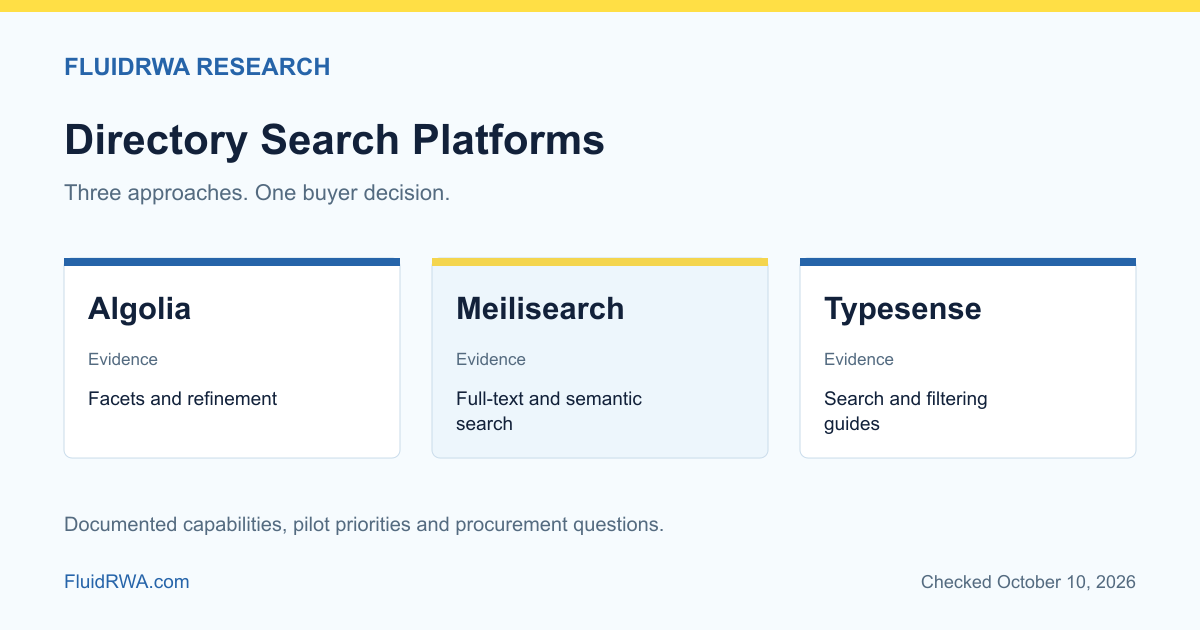
Algolia documents faceted search and result refinement; Meilisearch documents full-text and semantic search; Typesense documents search applications, filtering and relevance tuning. For a vendor directory, test useful results, reliable filters and update propagation before choosing. This is not a benchmark or a replacement for a vector-database comparison.
A directory needs useful results, not just more results
A buyer searching for custody software may mean an asset-holding service, wallet policy tooling or an integration layer. If the catalog merges those meanings, a fast search engine can return an unhelpful shortlist very quickly.
Start with a reliable record model and a defined buyer task. This comparison covers searchable catalogs, facets and relevance workflows. It does not duplicate our Pinecone, Weaviate and Qdrant vector-database comparison.
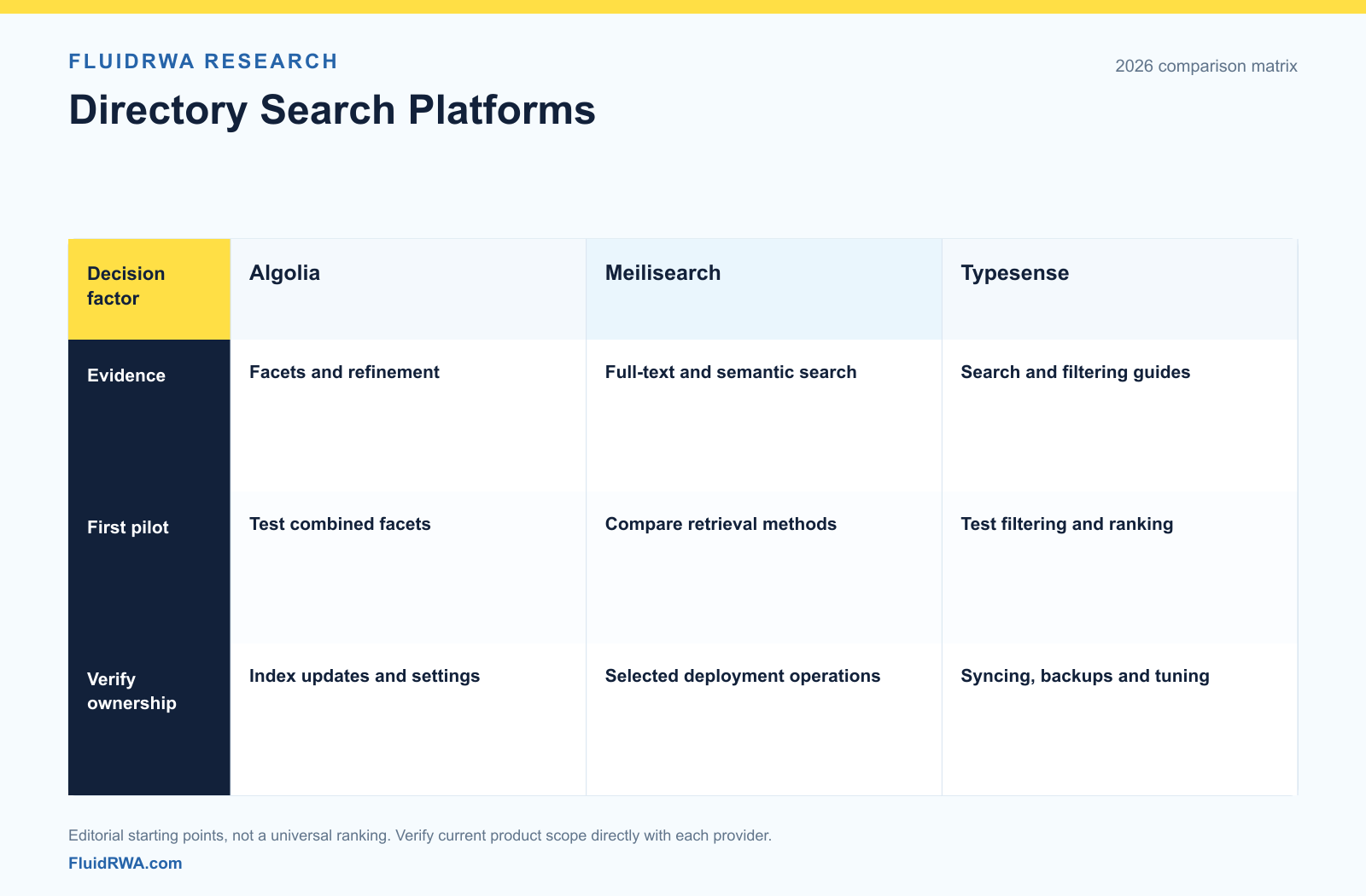
Comparison table: search workflows to evaluate
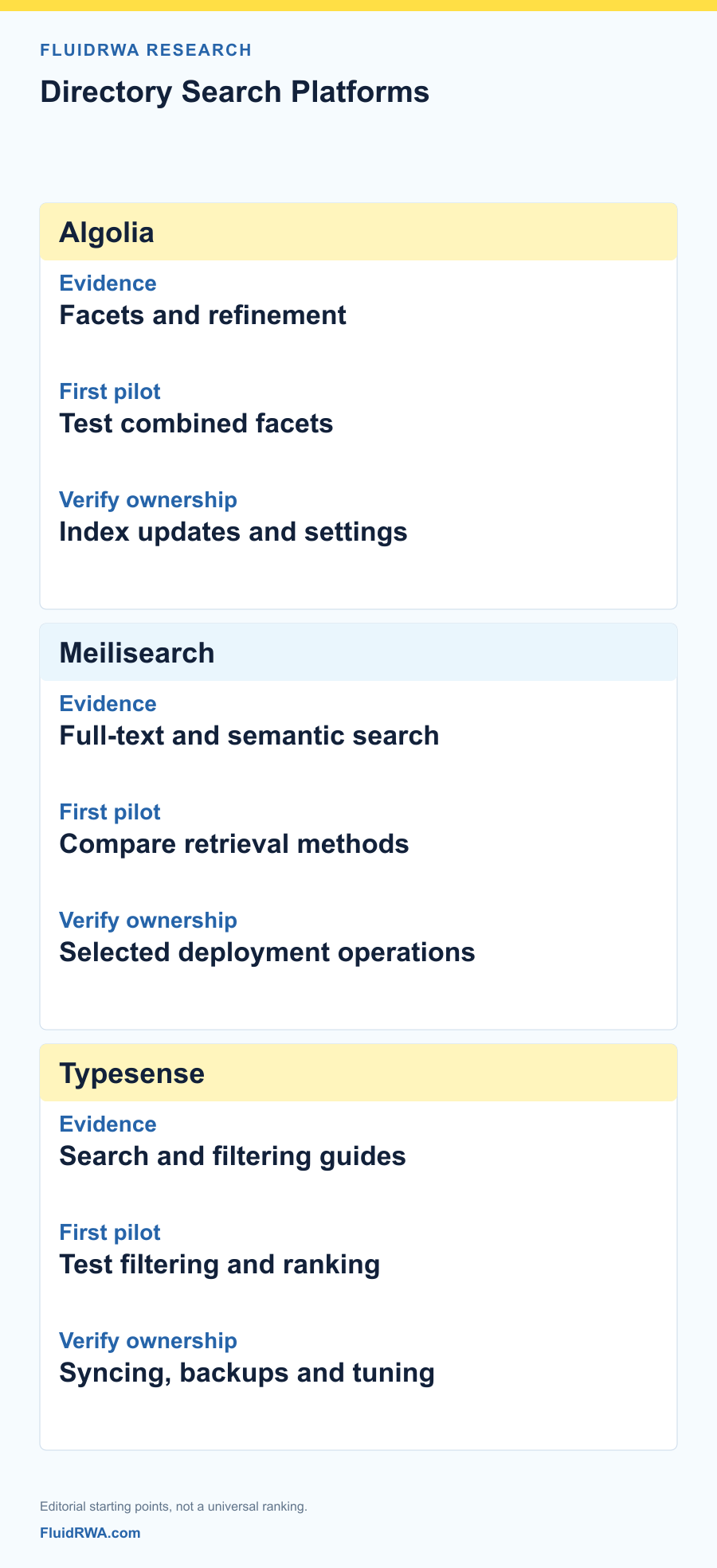
| Decision | Algolia | Meilisearch | Typesense |
|---|---|---|---|
| Evidence reviewed | Faceting and result refinement | Search overview and Cloud documentation | Search application and filtering guides |
| Starting workflow | Category refinement and facet counts | Full-text and semantic retrieval | Collection search and relevance tuning |
| First pilot | Inspect results with combined facets | Compare keyword and semantic queries | Test filters and ranking on a collection |
| Operating question | Who controls index updates and settings? | Who operates the chosen deployment? | Who owns syncing, backups and tuning? |
These are selected documented workflows, not exclusive capabilities. Missing features and customer-specific terms are not verified. No vendor is declared the universal relevance or performance winner.
Algolia
Algolia's faceting documentation explains categorizing records with attributes, refining results and obtaining contextual facet counts.
Buyer interpretation: test the combination of categories that your buyers actually use. Verify that the available facets reflect the indexed records, and distinguish a visible refinement from a mandatory permission restriction applied by the application.
Meilisearch
Meilisearch's overview documents full-text and semantic retrieval and describes its Cloud arrangement. It also presents the engine as a binary with a REST API.
Buyer interpretation: choose the deployment and relevant retrieval configuration before estimating operations. Compare keyword and semantic results on your own catalog; the documentation's feature list does not establish that every query or edition behaves identically.
Typesense
Typesense's guide covers creating search applications, organizing collections, syncing data, filtering, relevance tuning and production operations. It includes separate Cloud-specific sections.
Buyer interpretation: confirm the version and operating arrangement behind the proposal. Examine schema design, filter behavior and update processing alongside the search interface. A managed deployment and an internally operated service carry different responsibilities.
Build an evaluation set from buyer language
Select realistic tasks: an exact company name, a category, a misspelling, a multi-condition request and a query with no matching records. For each, record what would make a result genuinely useful. Have someone other than the implementation owner review the expected matches.
Do not turn that small sample into a market-wide quality score. Use it to identify failures: an irrelevant first result, a filter that drops all matches, a stale record or a supposedly deleted entry that remains discoverable.
Update a dummy vendor record, remove another and temporarily pause the indexing pipeline. Observe when search reflects each change. Display review dates from the catalog rather than treating indexing time as proof that the underlying vendor facts were checked.
Private records require a separate access test. A search result can leak a name or document excerpt even if its detail page later denies access. Evaluate permissions before returning matches, and avoid exposing unrestricted administrative keys to client applications.
Procurement checklist
- What record fields and filters are mandatory?
- Who maintains relevance settings and source data?
- How are updates, deletions and indexing failures monitored?
- Which deployment, backups and support terms apply?
- What query information is logged and retained?
- Can the team export records and recreate the index elsewhere?
For searchable private platforms, continue with B2B authentication. To scope a supplier search, email contact@fluidrwa.com.
Verification and scope
Last checked: October 10, 2026. Reviewed by FluidRWA Research Team. Company documentation supports product descriptions. The evaluation set and procurement checklist are editorial recommendations, not an independently tested benchmark.
FAQ
Which search engine is fastest?
No independent speed benchmark was performed. Test the same dataset, filters, deployment and request pattern before comparing response times.
Does semantic search remove the need for filters?
No. Similarity and explicit requirements are different. A buyer may still need hard restrictions such as jurisdiction, integration or access permission.
Is search software the source of truth for vendor claims?
No. A search index retrieves records supplied to it. Maintain sourcing and review dates in the underlying catalog and update the index when records change.
Define the search experience
Share your catalog, filtering and access requirements. Or email contact@fluidrwa.com.