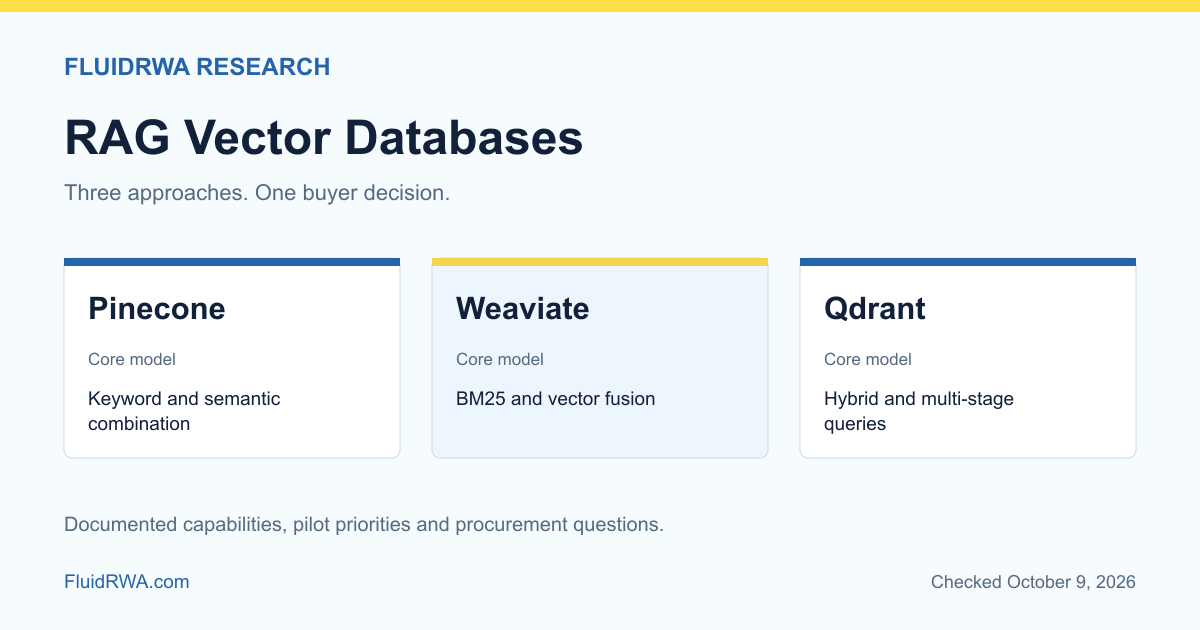
Pinecone documents several ways to combine keyword and semantic retrieval; Weaviate combines vector search with BM25 keyword search; Qdrant provides a query API for hybrid and multi-stage retrieval. Choose by the retrieval design your team can operate and validate, not by a universal accuracy ranking.
What is the actual buying decision?
A fund administrator asking an assistant about a subscription agreement needs the correct clause from the correct version, not a plausible passage from another investor's file. Retrieval quality and access boundaries matter more than a polished chatbot demo.
This comparison addresses the retrieval layer: how an application finds relevant material before generating an answer. It does not rank complete AI assistants, compare parsing vendors or establish production suitability for regulated information.
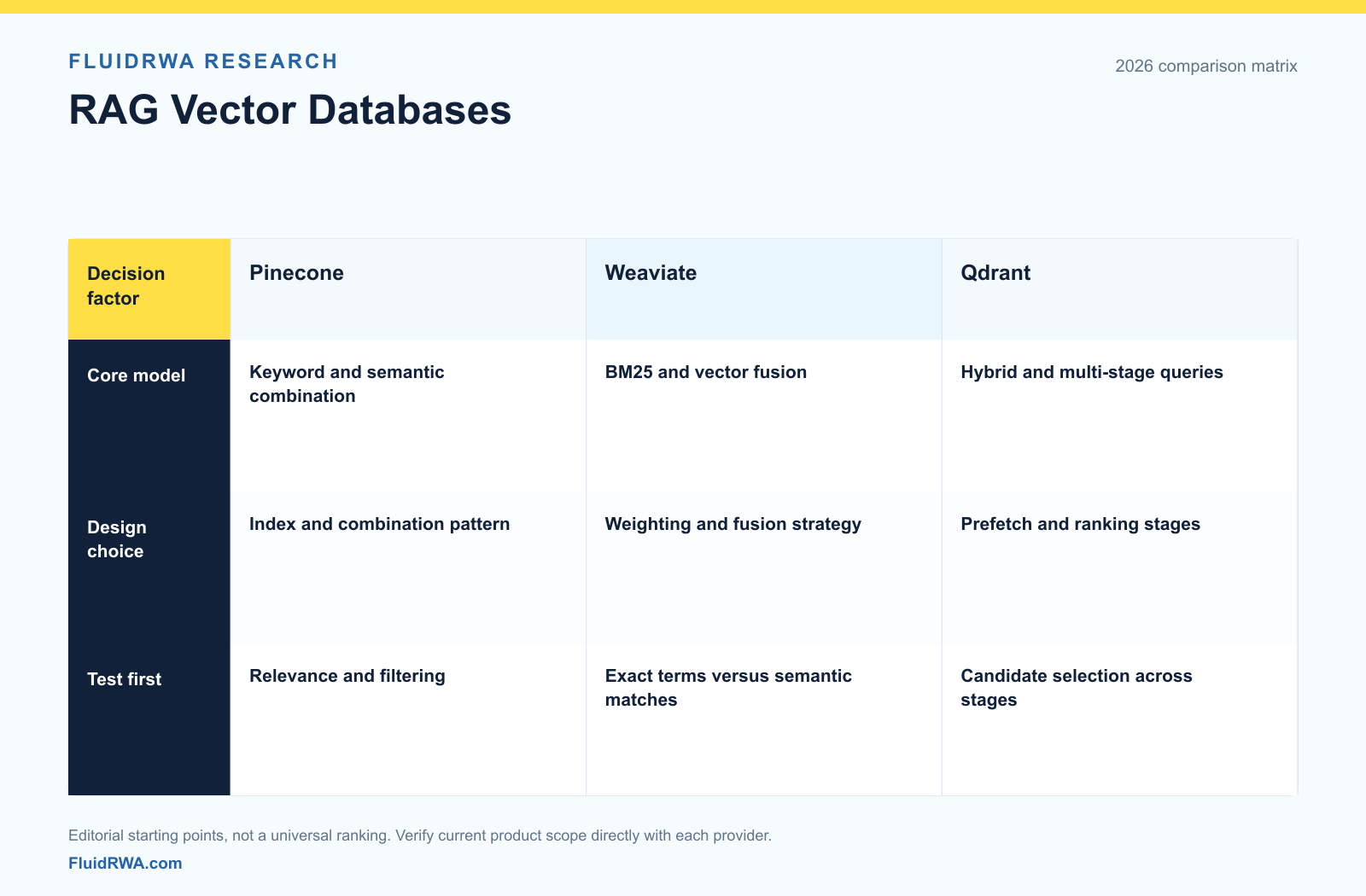
Comparison table: retrieval design and pilot priorities
| Decision | Pinecone | Weaviate | Qdrant |
|---|---|---|---|
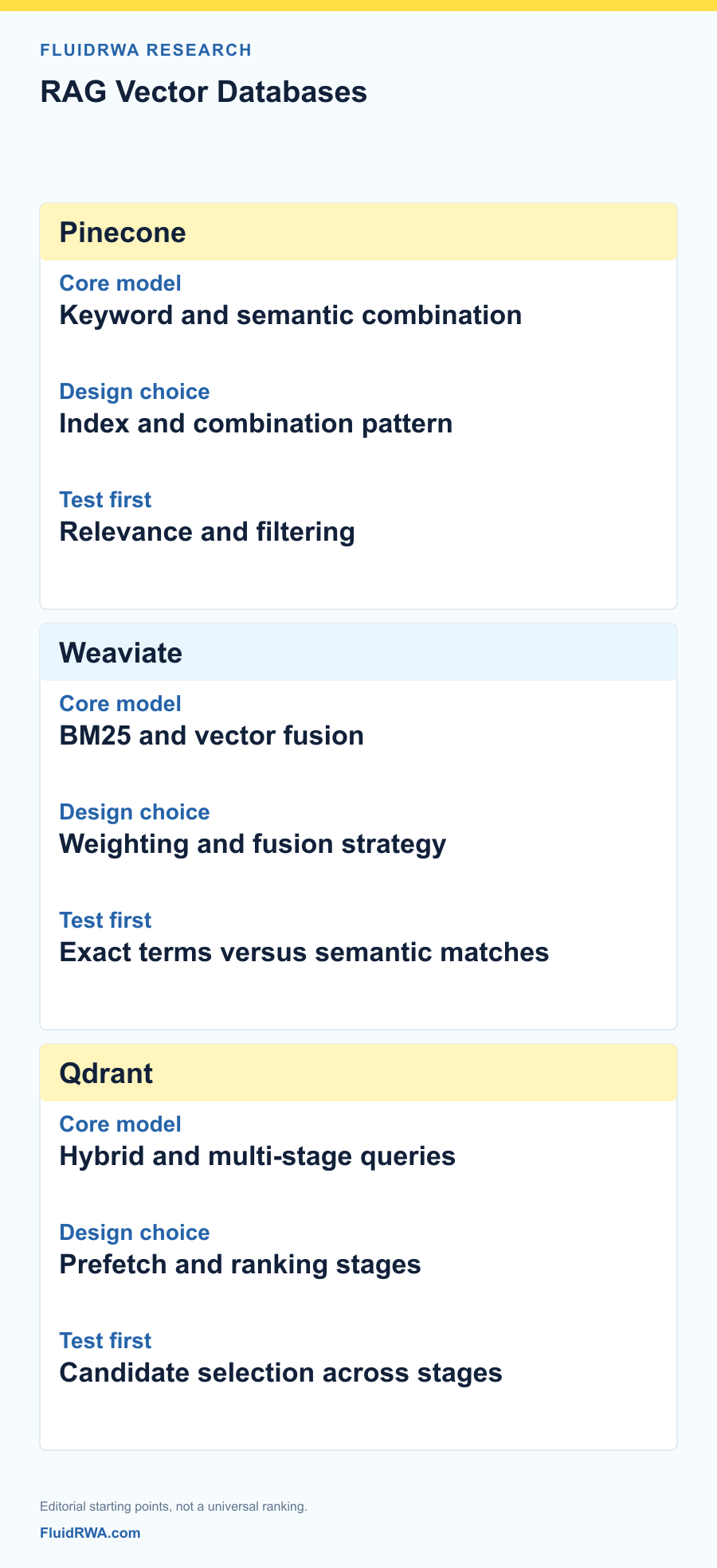
| Documented retrieval model | Keyword and semantic combination patterns | BM25 and vector search with fusion | Hybrid and multi-stage Query API |
| Configuration to examine | Single-index versus separate-search combination | Keyword/vector weighting and fusion | Prefetch stages and fusion strategy |
| Deployment evidence | Confirm the required service configuration directly | Cloud and self-managed deployments documented | Cloud and self-managed options documented |
| Pilot priority | Relevance and filtering for the selected API | Exact-term versus semantic balance | Candidate selection across stages |
| Not established here | Lowest cost or highest accuracy | Lowest cost or highest accuracy | Lowest cost or highest accuracy |
The product descriptions above are company documentation, not independent benchmark results. The cohort consists of three retrieval products with published technical documentation, not the three largest or highest-performing suppliers.
Pinecone
Pinecone's hybrid search overview distinguishes keyword filtering followed by dense ranking, client-side fusion of separate searches, and dense/sparse combination in the Vectors API. Those are different architectures, despite sharing the hybrid-search label.
Evaluate when: your team wants to compare these patterns against its application and decide how much search orchestration it will own. Verify the exact API, index configuration and required filtering behavior before translating a generic example into production.
Weaviate
Weaviate documents hybrid search combining BM25 keyword retrieval and vector retrieval through fusion. Its deployment documentation describes hosted and self-managed options.
Evaluate when: you want to experiment with exact-term and semantic signals together, while explicitly choosing who operates the database. Having deployment choices does not mean every option has identical service terms or operational burden.
Qdrant
Qdrant's hybrid-query documentation describes prefetch operations and multi-stage query composition. Its installation guide separates local/self-managed setup from cloud options.
Evaluate when: your team needs to examine candidate generation and later ranking as separate stages. A more configurable pipeline is useful only if someone can maintain and test its behavior.
How should financial-platform teams test retrieval?
Build a protected question set containing exact identifiers, paraphrased questions, ambiguous entity names and unanswerable questions. Include old and current versions of agreements. Keep the final evaluation questions separate from the questions used to tune ranking.
For every question, label the relevant document and passage. Measure whether those passages appear in the retrieved set, whether the final answer cites them correctly, and whether the assistant declines when evidence is missing. These are proposed buyer tests, not vendor performance claims.
Include permissions in the test, not just in the security questionnaire. A user who can access fund A must not retrieve fund B's private documents. Revoke access, delete a document and change its owner; then repeat retrieval and check caches and derived indexes. Do not treat a metadata filter as proof of complete application authorization.
What can distort a comparison?
Different embeddings, chunk sizes and rerankers can produce different results even when the database stays unchanged. First compare with a common pipeline. Then test a separately labeled optimized configuration for each product. Report both rather than attributing every improvement to the database.
Use an illustrative workload such as investor support across agreements, notices and reports. Ask both a broad question and one requiring an exact account or asset identifier. Examine false matches, missing passages and stale versions. Do not place production personal information in a pilot unless processing and retention have been approved.
Procurement checklist
- Which deployment, region and support terms apply to the proposed configuration?
- How are document identity, tenant boundaries and access revocation represented?
- What happens when indexing fails partway through an update?
- Can the buyer export records, vectors and the metadata needed to rebuild?
- Which costs include embedding, reranking, storage and query traffic?
- Who owns recovery, backup testing and incident escalation?
Availability, contractual guarantees, pricing and benchmark performance were not verified for a specific customer deployment. Obtain those separately; missing evidence here is not evidence that a feature is absent.
Where does this fit in the wider stack?
Start with document extraction and validation, then evaluate the retrieval layer. Teams can explore AI document intelligence and knowledge retrieval vendors or send requirements to FluidRWA. For editorial consideration or a direct enquiry, email contact@fluidrwa.com.
Verification and scope
Last checked: October 9, 2026. Reviewed by FluidRWA Research Team. Sources are linked beside the observations they support. This is a public-documentation review, not a deployed performance test or assurance of legal, privacy or security suitability.
FAQ
Which vector database produces the most accurate RAG answers?
This documentation review does not establish an accuracy winner. Measure retrieval relevance, citation correctness and unsupported answers on a held-out dataset using comparable embeddings and chunking.
Is hybrid search the same in all three products?
No. Pinecone documents multiple combination patterns, Weaviate fuses BM25 and vector results, and Qdrant supports multi-stage queries. Compare the exact API and configuration rather than the feature label.
Does a vector database enforce document permissions automatically?
Do not assume that. Your application must translate authoritative permissions into the chosen retrieval design and test revocation, filtering and tenant isolation.
Does this replace a document extraction platform?
No. Parsing, indexing, retrieval and answer generation are separate jobs. A vector database does not itself prove that a table or legal clause was extracted correctly.
Discuss your retrieval requirements
Share your document sources, access controls and deployment constraints. Prefer email? contact@fluidrwa.com.