CoinGecko, CoinMarketCap and CoinPaprika document cryptocurrency market-data APIs. The useful comparison is whether the exact endpoint, asset identifier, history and usage rights fit your dashboard. A market-data quote is not an executable price, an accounting valuation policy or a smart-contract oracle.
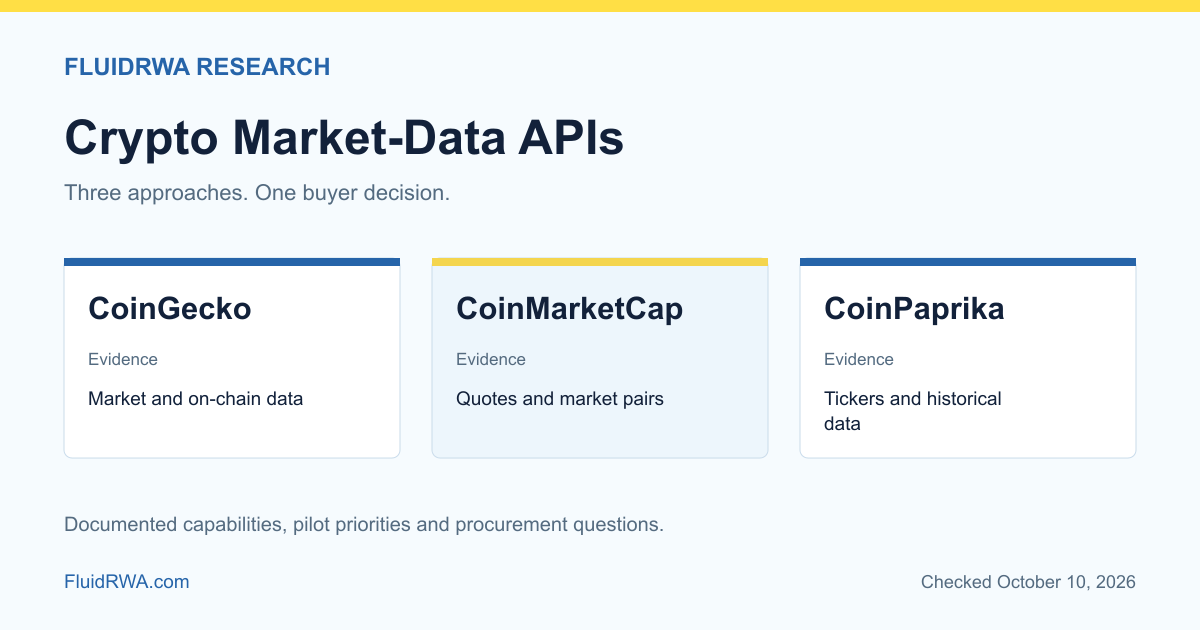
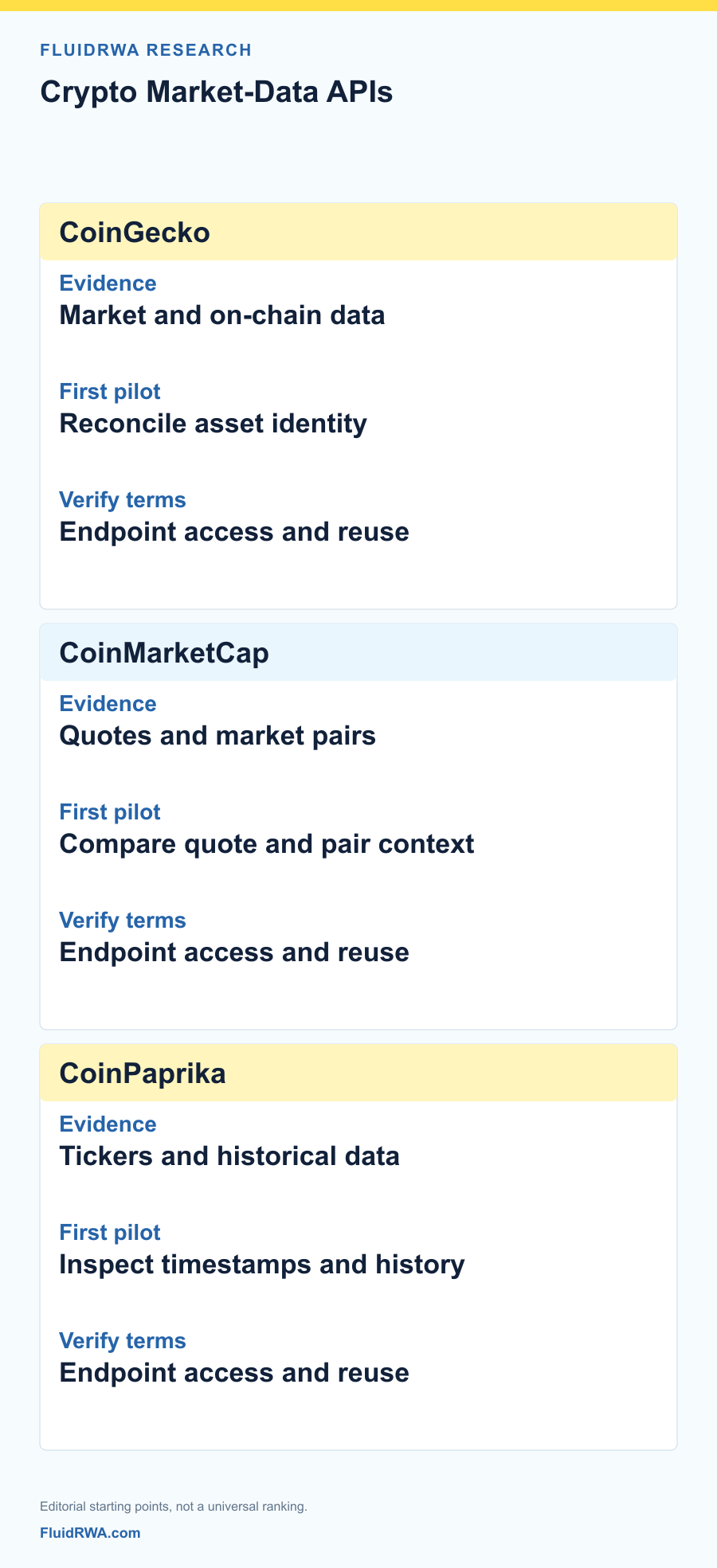
What should a crypto dashboard compare first?
A dashboard can display a plausible number while valuing the wrong token. Before comparing subscription names, decide which asset, quote currency, timestamp and source your product will show. Store the provider's identifier with the record rather than relying on a ticker symbol alone.
This article covers application-level market data. It does not repeat our Coin Metrics, Kaiko and Token Terminal comparison, which explores different institutional data and research workflows.
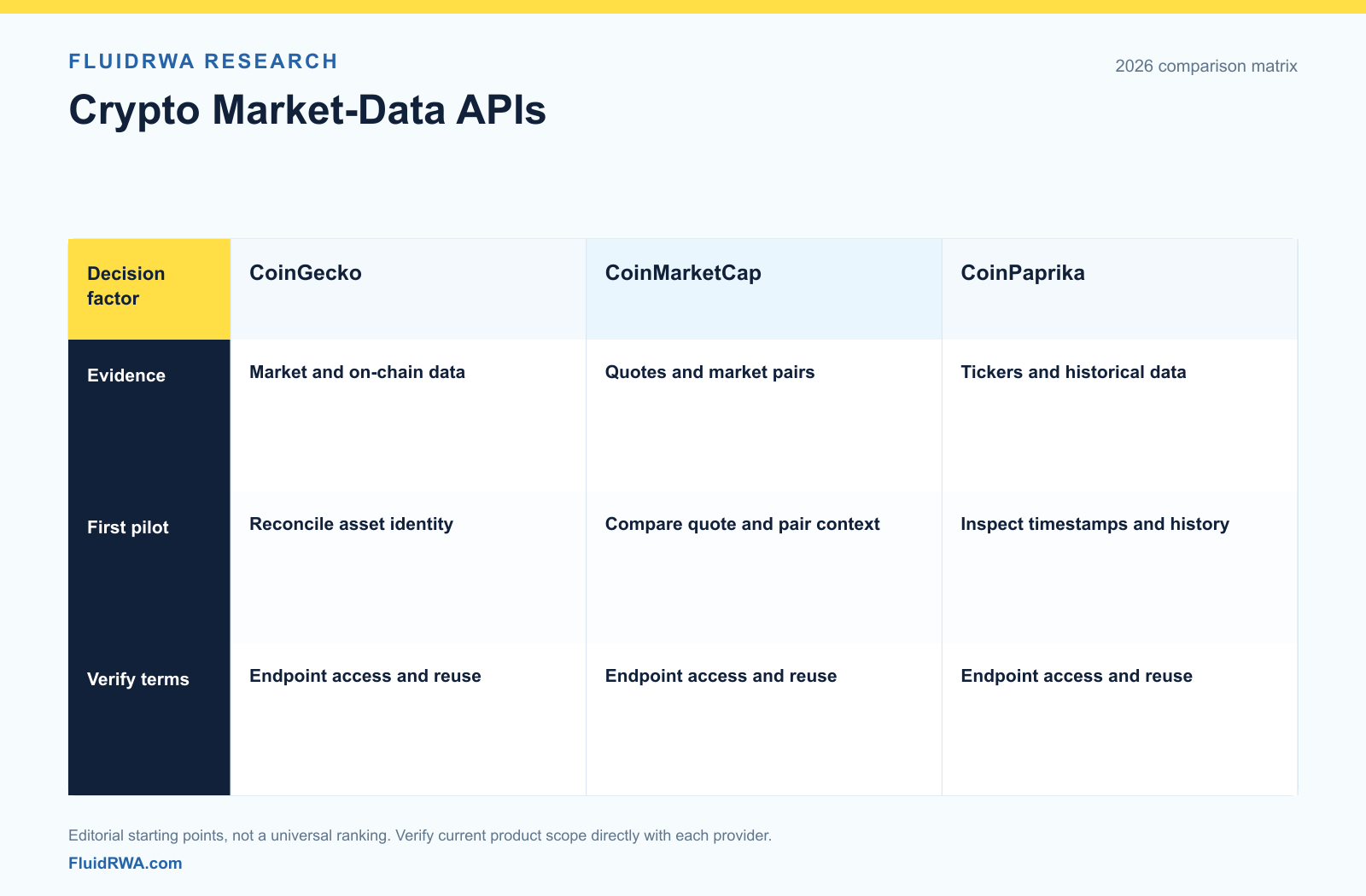
Comparison table: documented API starting points
| Buyer question | CoinGecko | CoinMarketCap | CoinPaprika |
|---|---|---|---|
| Evidence reviewed | Market and on-chain data documentation | Quote, market-pair and historical API families | Ticker and historical-data documentation |
| Mapping task | Resolve coin and on-chain asset identity | Resolve provider IDs and market context | Resolve coin ID and quote currency |
| First pilot | Reconcile one asset across endpoints | Compare quote and market-pair context | Inspect ticker timestamps and history |
| Contract check | Endpoint access and redistribution | Endpoint access and redistribution | Endpoint access and redistribution |
The cohort represents three documented API options, not a ranked or exhaustive market. Missing features are not verified, not proven absent. Table pilot tasks are FluidRWA recommendations rather than exclusive vendor capabilities.
CoinGecko
CoinGecko's API introduction describes market data and on-chain DEX data, with multiple delivery methods. Its documentation separates Demo and Pro API references. Confirm the endpoint and plan you need instead of assuming the introductory feature list applies to every arrangement.
Buyer interpretation: use a liquid asset, a token with a duplicate symbol and a thinly traded asset in your pilot. Preserve their identifiers and investigate how each response relates to chain and contract data.
CoinMarketCap
CoinMarketCap's API overview describes live quotes, listings, market pairs and historical endpoints. It also distinguishes endpoint access and historical depth by arrangement.
Buyer interpretation: examine the difference between an aggregate asset quote and data about an individual market pair. Ask what you may cache, display, export and redistribute to customers. An accessible endpoint alone is not proof of unrestricted commercial reuse.
CoinPaprika
CoinPaprika's documentation describes prices, volume, market capitalization and historical data. Its ticker example uses a coin identifier and returns quote-currency data alongside an update timestamp.
Buyer interpretation: inspect the response fields your application actually consumes. Confirm required history, resolution and delivery method directly for the proposed product tier; examples are not customer-specific service guarantees.
Build a pilot that detects the wrong answer
Use the same small asset basket for every provider. Record the requested identifier, returned asset name, quote currency, source timestamp, receipt timestamp and any missing fields. Keep raw responses for debugging, subject to the applicable rights and retention terms.
Introduce stale cached data, an unknown identifier and a simulated upstream timeout. The application should distinguish unavailable data from a zero price. Show an update time or an explicit unavailable state rather than silently substituting a different asset.
Historical comparisons need equal sampling intervals and time zones. Do not compare an hourly observation from one service with a daily close from another and call the difference an accuracy failure. Establish the required methodology with the team that owns reporting.
Procurement checklist
- Which exact endpoints and asset IDs cover our basket?
- What history and granularity are included?
- How are stale, missing and corrected observations represented?
- What quotas, retry rules and support terms apply?
- May we cache, redistribute or publish downloaded records?
- What survives a provider migration: identifiers, history and attribution?
No independently tested latency, accuracy, pricing or universal winner is claimed here. For on-chain inputs, continue with our oracle provider comparison. For help defining a brief, email contact@fluidrwa.com.
Verification and scope
Last checked: October 10, 2026. Reviewed by FluidRWA Research Team. Product observations are company documentation; pilot design and procurement questions are editorial guidance, not a tested benchmark.
FAQ
Which crypto data API is most accurate?
This documentation review did not independently test accuracy. Compare the same assets, timestamps, currencies and aggregation methods before drawing conclusions.
Can a price API replace an oracle?
Not by itself. A server-side quote does not establish how a smart contract receives, validates and updates a price. Evaluate the oracle integration separately.
Is ticker-symbol matching enough?
No. Use provider identifiers and, where relevant, chain and contract-address mappings. Different assets can share a symbol.
Define the data requirement
Share the assets, history and display rights your platform needs. Or email contact@fluidrwa.com.