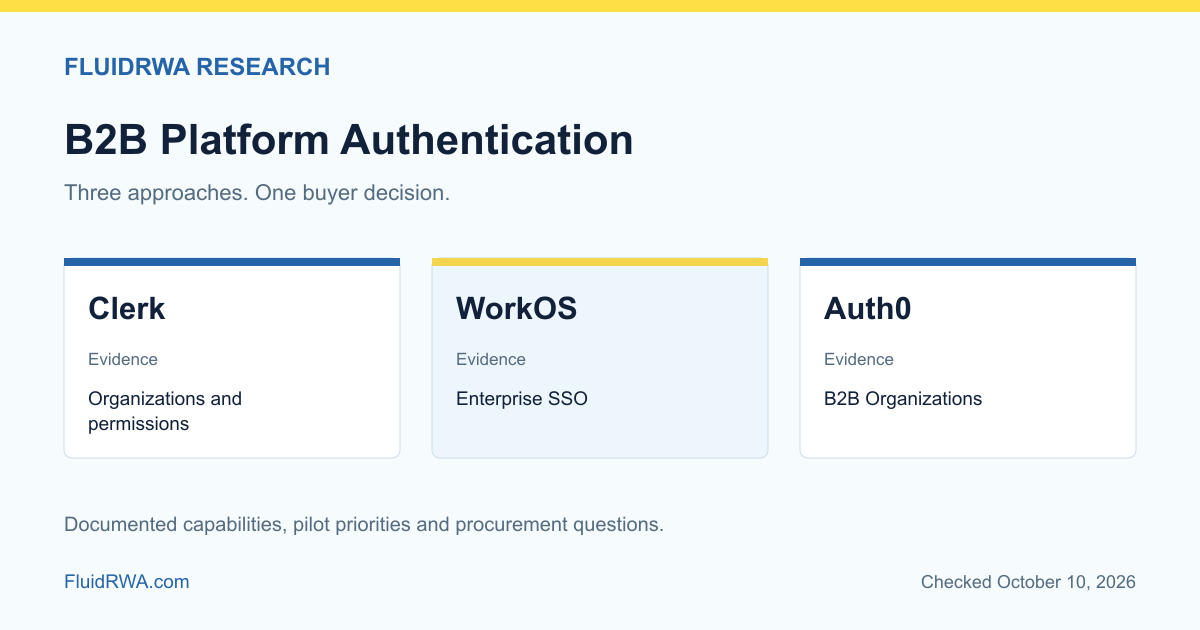
Clerk documents organization-aware memberships and permissions; WorkOS documents enterprise SSO through SAML and OIDC; Auth0 documents B2B Organizations and organization-specific login contexts. Compare tenant boundaries and offboarding, not just sign-in screens. Authentication does not establish KYC, investor eligibility or wallet-signing authority.
Why B2B access is a separate buyer task
A platform may serve an asset manager, external administrator and several vendors at once. One person can belong to more than one organization and hold different responsibilities in each. The useful question is not whether they can log in, but what they can see and do after login.
This comparison concerns application authentication and organizational context. It is separate from KYC and identity verification and from embedded-wallet onboarding. None of the selected descriptions establishes investor verification or custody authority.
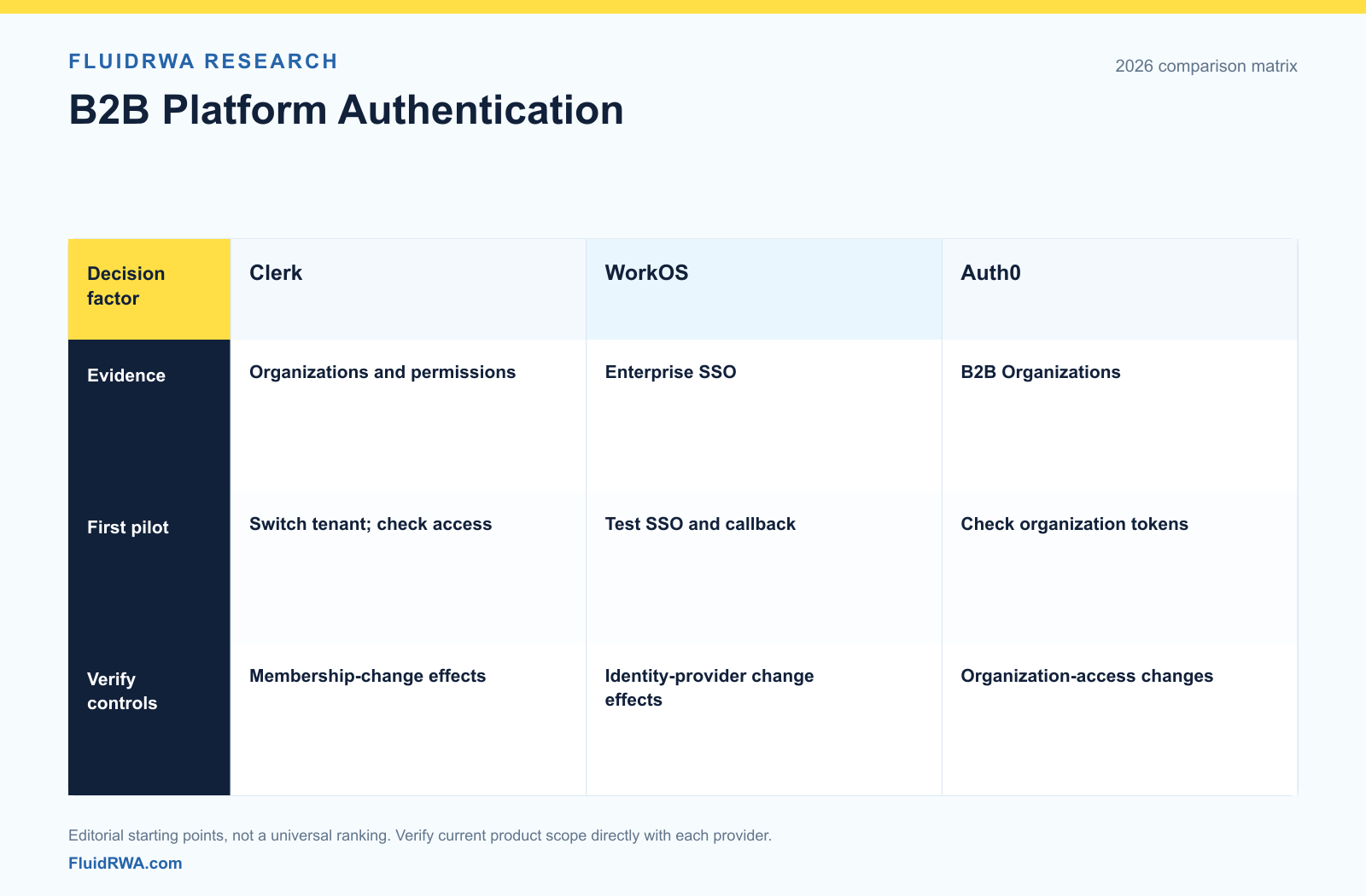
Comparison table: organization-aware access
| Decision | Clerk | WorkOS | Auth0 |
|---|---|---|---|
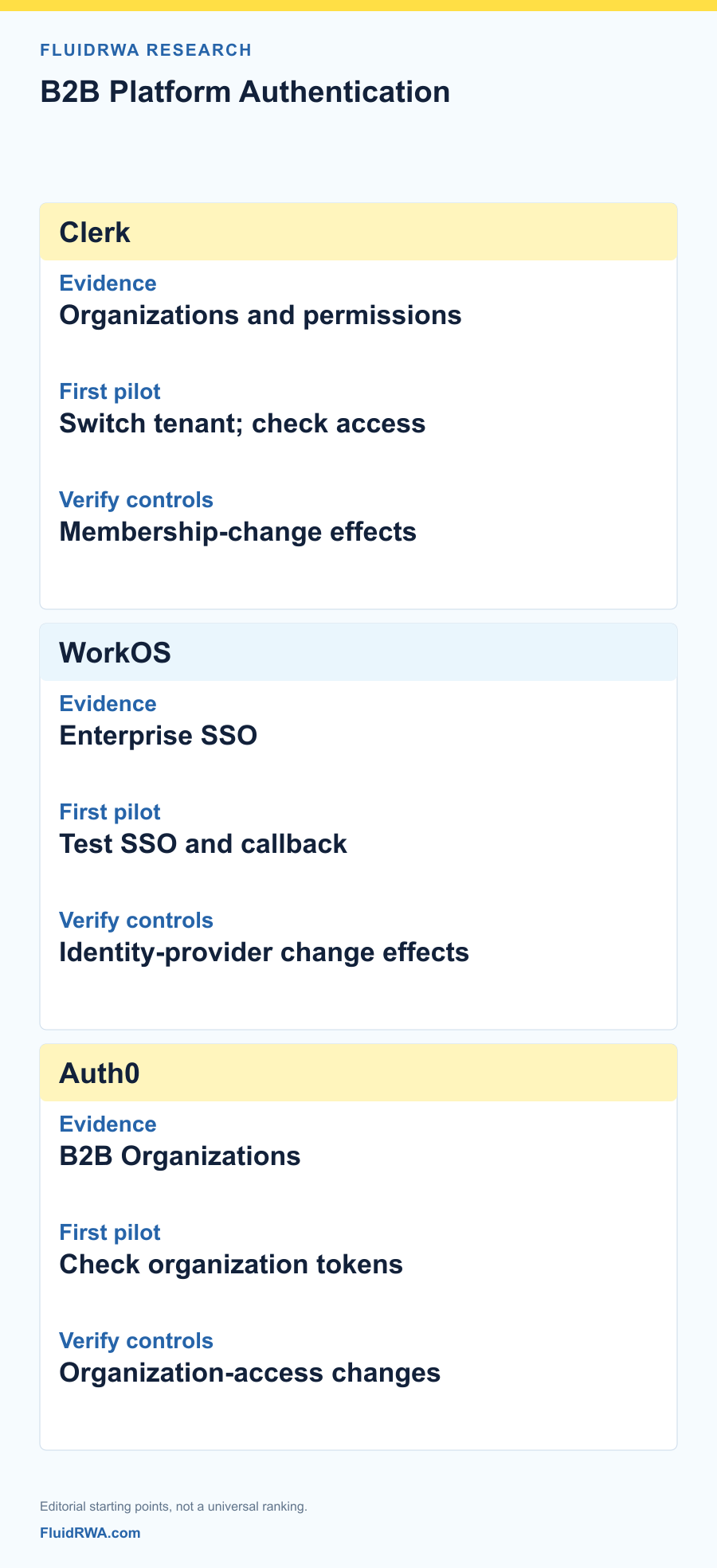
| Evidence reviewed | Organizations and permissions | Enterprise SSO documentation | B2B Organizations overview |
| Starting workflow | Membership and active organization | Login via customer identity provider | Organization-specific login and membership |
| First pilot | Switch tenant and check server access | Test an SSO connection and callback | Check tokens against organization context |
| Offboarding question | What persists after membership changes? | What persists after identity-provider changes? | What persists after organization access changes? |
The selected documentation contrasts entry points, not complete or exclusive feature sets. All three need an implementation-specific access review. Unverified plan terms are not verified, not feature absences.
Clerk
Clerk's Organizations guide describes memberships, roles, permissions and active-organization context. It also warns about organization context across multiple browser tabs and background requests.
Buyer interpretation: reproduce your actual multi-organization workflow. Inspect the authorization context passed to the server, not just the currently visible organization switcher. Confirm the SDK and application behavior you intend to deploy.
WorkOS
WorkOS's SSO documentation describes authenticating through a customer's identity provider using SAML or OIDC. It covers organization or connection selection and callback handling.
Buyer interpretation: test the actual customer identity provider, redirect configuration and error path. SSO authentication is one component; application permissions, provisioning and existing-session treatment must be specified separately rather than inferred from the SSO label.
Auth0
Auth0's Organizations overview describes representing B2B customers, membership, branded federated login flows and organization-aware API access.
Buyer interpretation: inspect how the chosen organization reaches the access token and application. Review the applicable features and configuration for the arrangement being purchased, particularly where one user belongs to several businesses.
Test the boundary that a sign-in demo misses
Create two non-production organizations and several test identities: an administrator, a read-only user and a user belonging to both organizations. Give each organization different dummy records. Attempt to read or modify the other organization's records by changing a URL, request parameter or background-job input.
Repeat with two browser tabs and a previously issued session. Your server must reject an unauthorized request even if the interface hides its button. Record the expected behavior for membership removal, role reduction and revoked customer access.
An organization administrator may be allowed to invite colleagues without being allowed to approve a payment. Keep business approvals and signing controls explicit. Authentication metadata should not silently become transaction authority.
Procurement and exit checklist
- Which customer identity providers and login flows are required?
- How is organization context validated by every backend?
- Who can invite users or change roles?
- What happens to sessions, API credentials and jobs on offboarding?
- Which audit records can customers and operators export?
- How would identities and memberships migrate to another system?
No independently validated security score or universal winner is claimed. Pair the design with secrets-management controls. Share your platform brief through Submit requirements or contact@fluidrwa.com.
Verification and scope
Last checked: October 10, 2026. Reviewed by FluidRWA Research Team. Descriptions are attributed to company documentation; tenant-boundary tests are editorial recommendations, not a security certification.
FAQ
Does enterprise login replace investor KYC?
No. Login establishes an application identity under an authentication flow. KYC, eligibility and transaction authorization require their own controls.
Does SSO automatically remove all access when someone leaves?
Do not assume that. Test existing sessions, application roles, API credentials and any provisioning integrations as separate parts of offboarding.
Is an organization identifier enough for tenant isolation?
No. The application must enforce the authorized organization context on server-side reads, writes and background operations, not merely show a tenant-specific screen.
Plan the access model
Share your customer organizations, SSO and permission requirements. Or email contact@fluidrwa.com.