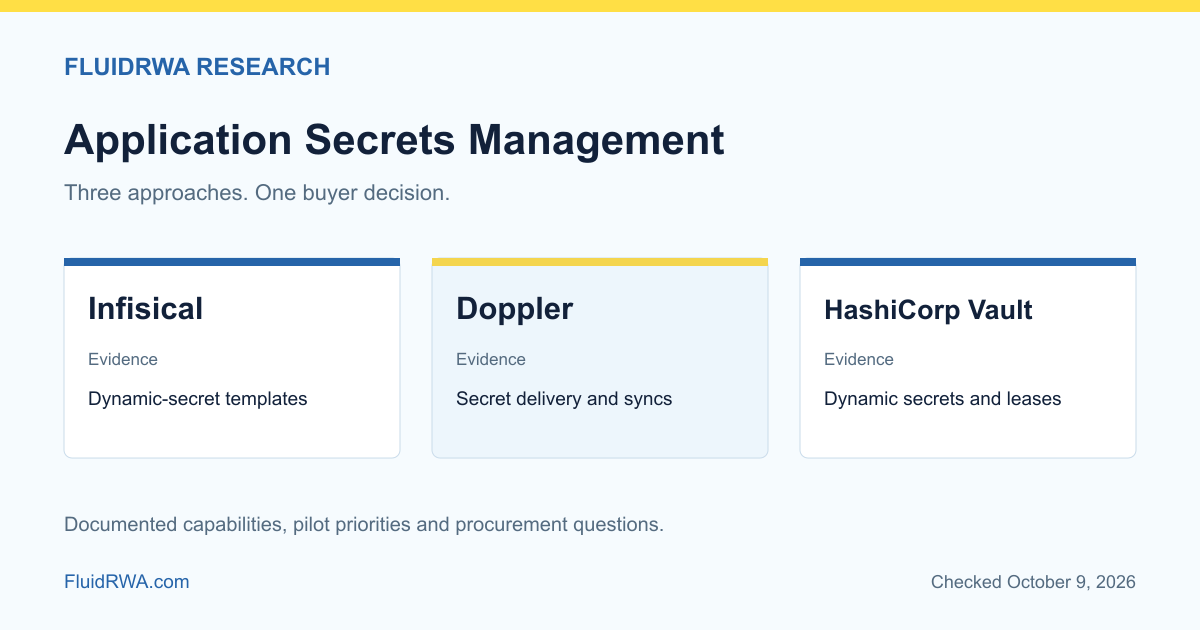
Infisical documents dynamic-secret templates; Doppler documents storing, supplying and synchronizing application secrets; HashiCorp Vault documents dynamic-secret leases and revocation. Compare the credential lifecycle you need, including delivery and consumer refresh. These products should not be assumed to replace wallet custody or transaction-signing infrastructure.
Why does a Web3 platform need a separate secrets decision?
A tokenization platform may hold credentials for its database, KYC provider, mail service and payment APIs. These are not all wallet keys, but a leaked credential can still expose documents, redirect a workflow or disable notifications.
This comparison concerns application secrets and credential lifecycles. It does not duplicate our institutional wallet infrastructure comparison, and it does not claim that a secrets manager provides a complete signing or custody system.
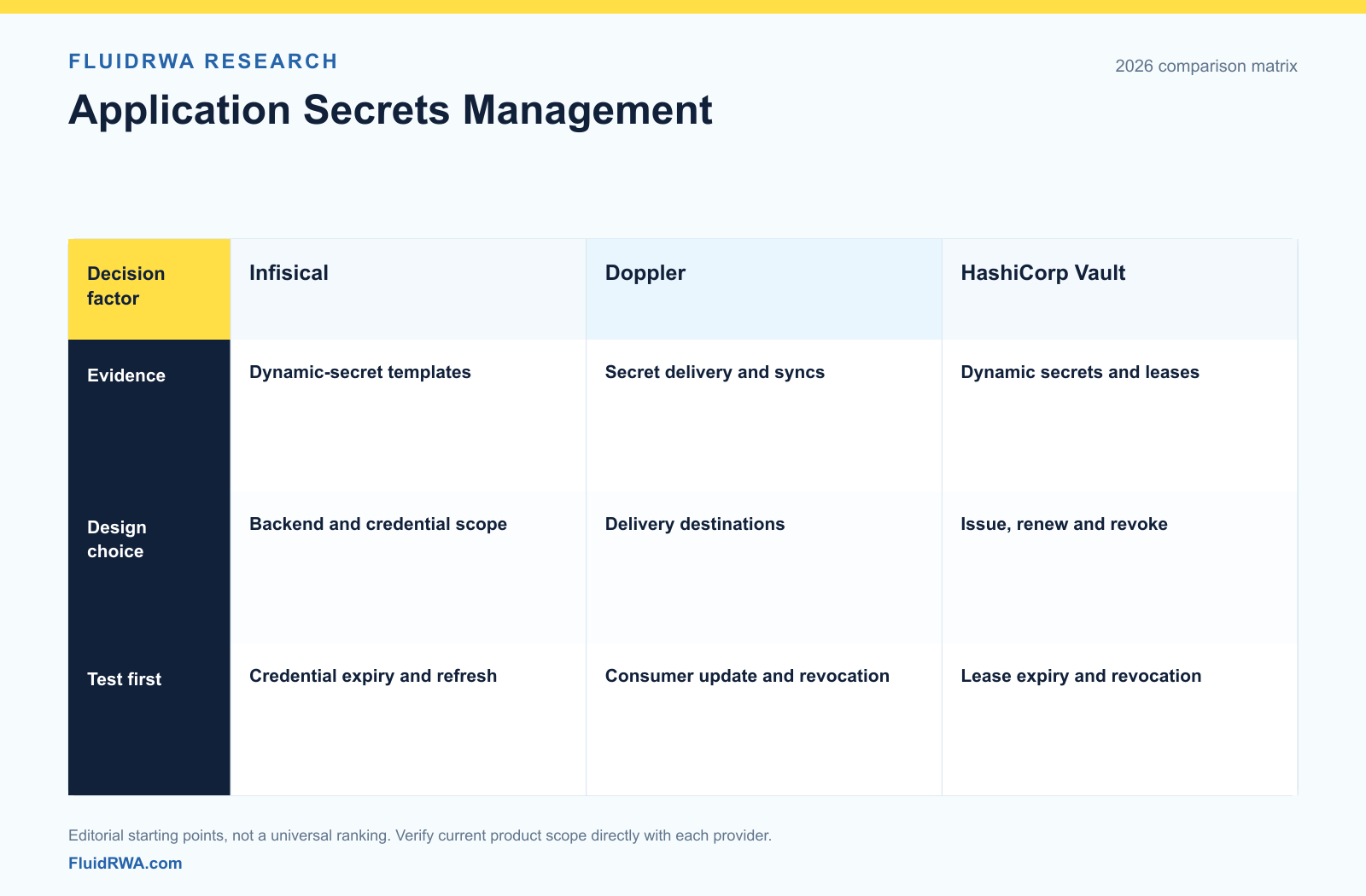
Comparison table: credential lifecycle starting points
| Decision | Infisical | Doppler | HashiCorp Vault |
|---|---|---|---|
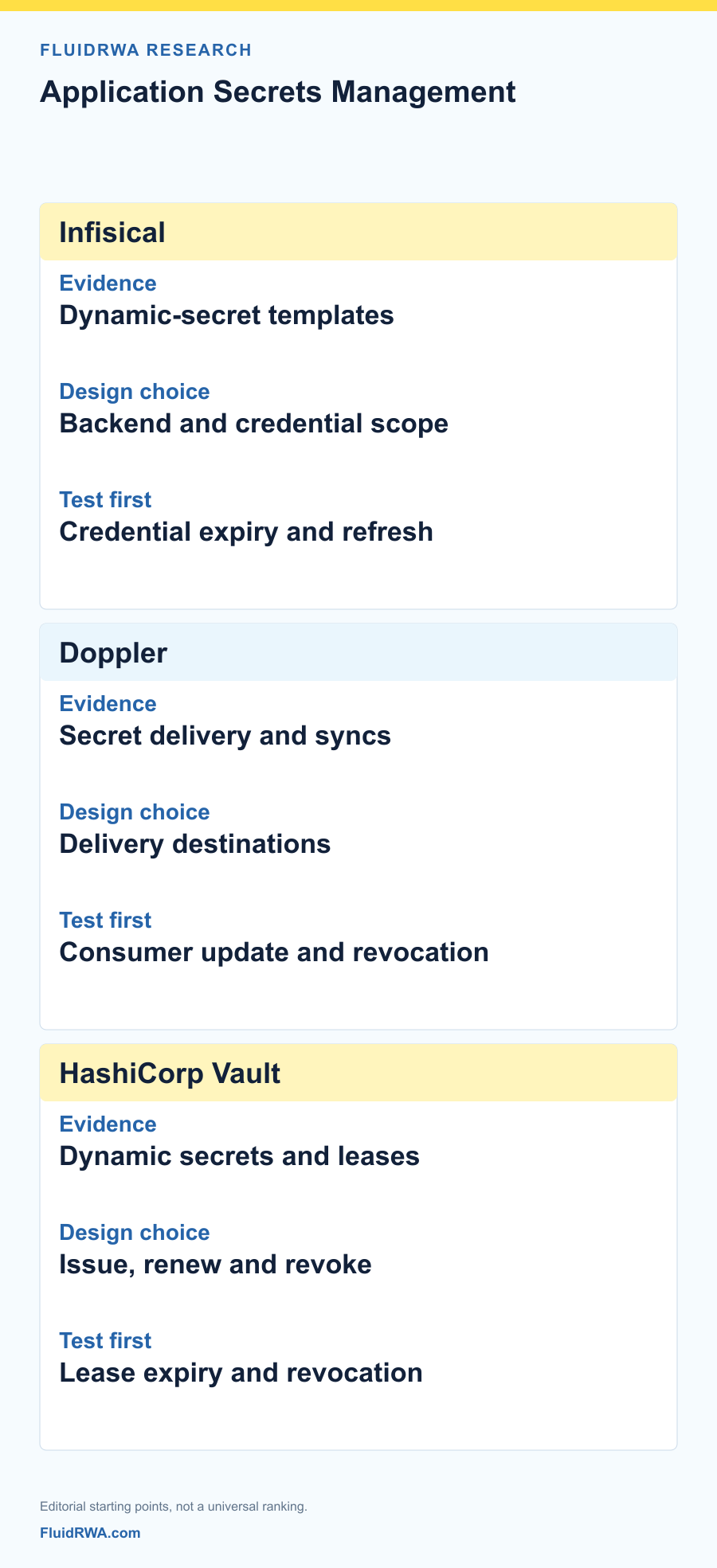
| Evidence reviewed | Dynamic-secret templates | Secret supply and automated syncs | Dynamic secrets and leases |
| Design question | Which backend template fits the workload? | Where must application secrets be delivered? | How are credentials issued, renewed and revoked? |
| First pilot | Create and expire a scoped credential | Update a value and inspect all consumers | Test lease expiry and revocation |
| Operational risk to examine | Consumer refresh and stale credentials | Sync success versus issuer revocation | Lease lifecycle and service availability |
| Not implied | Complete wallet custody | Complete wallet custody | Complete wallet custody |
The table summarizes specific documentation reviewed, not exclusive feature sets. A capability omitted here is not necessarily absent. The cohort is chosen for contrasting credential-management questions, not ranked market leadership.
Infisical
Infisical's dynamic-secret documentation lists supported templates including database and AWS IAM examples. The exact template matters: a general dynamic-secret claim does not establish support for every third-party API.
Buyer interpretation: evaluate the required backend and how the application obtains, refreshes and relinquishes credentials. Ask which product arrangement includes the necessary controls and who operates the underlying infrastructure.
Doppler
Doppler's secrets documentation describes supplying secrets to applications, including environment-variable use through its CLI. Its automated-sync documentation describes pushing secrets to supported destinations.
Buyer interpretation: examine how development, deployment and running consumers receive updates. A successful synchronization is not proof that a leaked key has been revoked at the issuing service or that an existing process has reloaded the new value.
HashiCorp Vault
Vault's lease documentation describes time-limited metadata for dynamic secrets and service tokens. Its static and dynamic secrets tutorial explains the distinction between storing a value and generating credentials.
Buyer interpretation: evaluate lease renewal, expiry and revocation for the chosen backend. Avoid treating every value in a secrets store as a leased dynamic credential. Plan for credential delivery and consumer behavior as well as issuance.
Map four different actions
Write down where a credential is issued, where it is stored, how it is delivered and how it is invalidated. Those actions may belong to different systems. Updating a value in one place does not necessarily complete the other three.
For an illustrative payment integration, keep sandbox and production credentials separate. Restrict each application identity to the resources it needs. Test whether a stopped worker, old deployment or exported configuration still contains usable credentials after a change.
Do not print real secrets into audit logs or screenshots. Verification should demonstrate the action and outcome without revealing the secret itself. Secret names and paths can also reveal sensitive architecture, so control access to metadata.
A recovery pilot before procurement
Create a non-production credential, deliver it to a test consumer and confirm which identity accessed it. Change or expire it; then test whether the consumer refreshes, fails safely or keeps using a stale value. Finally revoke it at the issuing service and confirm that the old value no longer works.
Simulate the secrets service being unavailable during startup and during an update. Decide whether the application can continue, for how long and under which controls. A convenience cache can create a revocation delay; document that trade-off instead of assuming availability and immediate revocation are both automatic.
These are proposed acceptance tests. They do not establish the native behavior of every edition, backend or deployment in the comparison.
Procurement checklist
- Which credential types and external services are supported by the proposed arrangement?
- How does a workload authenticate without embedding another permanent secret?
- Can access be scoped by application and environment?
- What audit evidence shows retrieval, change, issuance and revocation?
- Which components require operating, updating and backing up?
- How are old deployments and downstream copies invalidated?
- Which support, licensing and deployment terms apply to the actual feature set?
Exact prices, independently validated security outcomes and customer-specific service guarantees were not verified here. Obtain current contractual evidence directly. No provider is declared the universal security winner.
Keep secrets outside the AI trace
Connect secrets handling to AI observability controls so tool calls do not accidentally record API credentials. For a platform brief, use Submit requirements, or email contact@fluidrwa.com.
Verification and scope
Last checked: October 9, 2026. Reviewed by FluidRWA Research Team. Product observations are attributed to official documentation. The lifecycle framework and pilot design are editorial recommendations, not a penetration test, certification or custody assurance.
FAQ
Is secrets management the same as crypto custody?
No. Managing database passwords and API credentials does not establish a wallet-signing policy, key-custody model or asset-recovery arrangement. Evaluate those separately.
Is rotation the same as issuing a dynamic secret?
No. Rotation changes an existing credential; a dynamic credential is issued for a scoped use and lifetime. Verify the supported backend and how consumers obtain and refresh it.
Does secret synchronization revoke a leaked API key?
Not necessarily. Updating a stored or synchronized value is different from invalidating the old credential at its issuing service. Test both actions.
Which product has the strongest security?
No security ranking was established. Assess the exact deployment, identities, access policies, audit evidence and recovery process against a threat model.
Define the security requirement
Share your credential types, deployment constraints and access-control requirements. Email contact@fluidrwa.com for a direct enquiry.