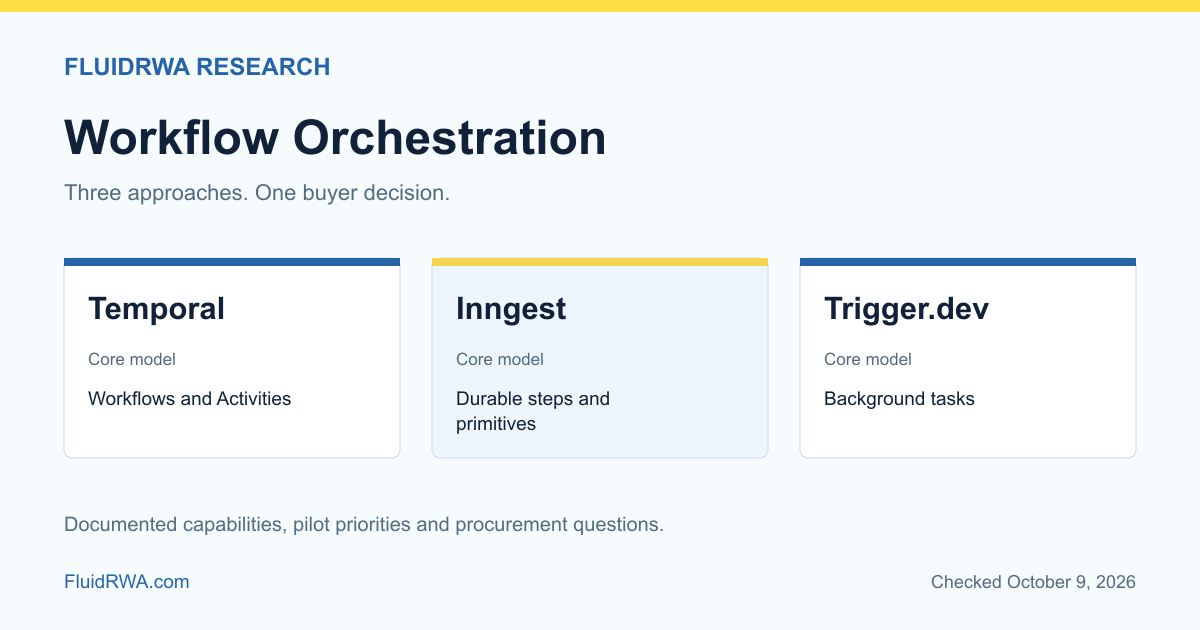
Temporal documents event-history replay and Activities; Inngest documents durable steps, saved results and event waits; Trigger.dev documents tasks with retry and concurrency controls. Select by the workflow model your team can operate. Durable execution does not by itself prevent duplicate external payments or authorize an action.
Why compare workflow models rather than feature counts?
A payout request can succeed at the payment provider while the caller times out. Retrying blindly may create a duplicate; refusing to retry may leave an unpaid supplier. The buying question is how your application records state and resolves uncertainty, not whether a vendor's website contains the word retry.
This article compares general application orchestration. It is separate from on-chain transaction automation and from vendor comparisons about payment processing itself.
Comparison table: execution and recovery models
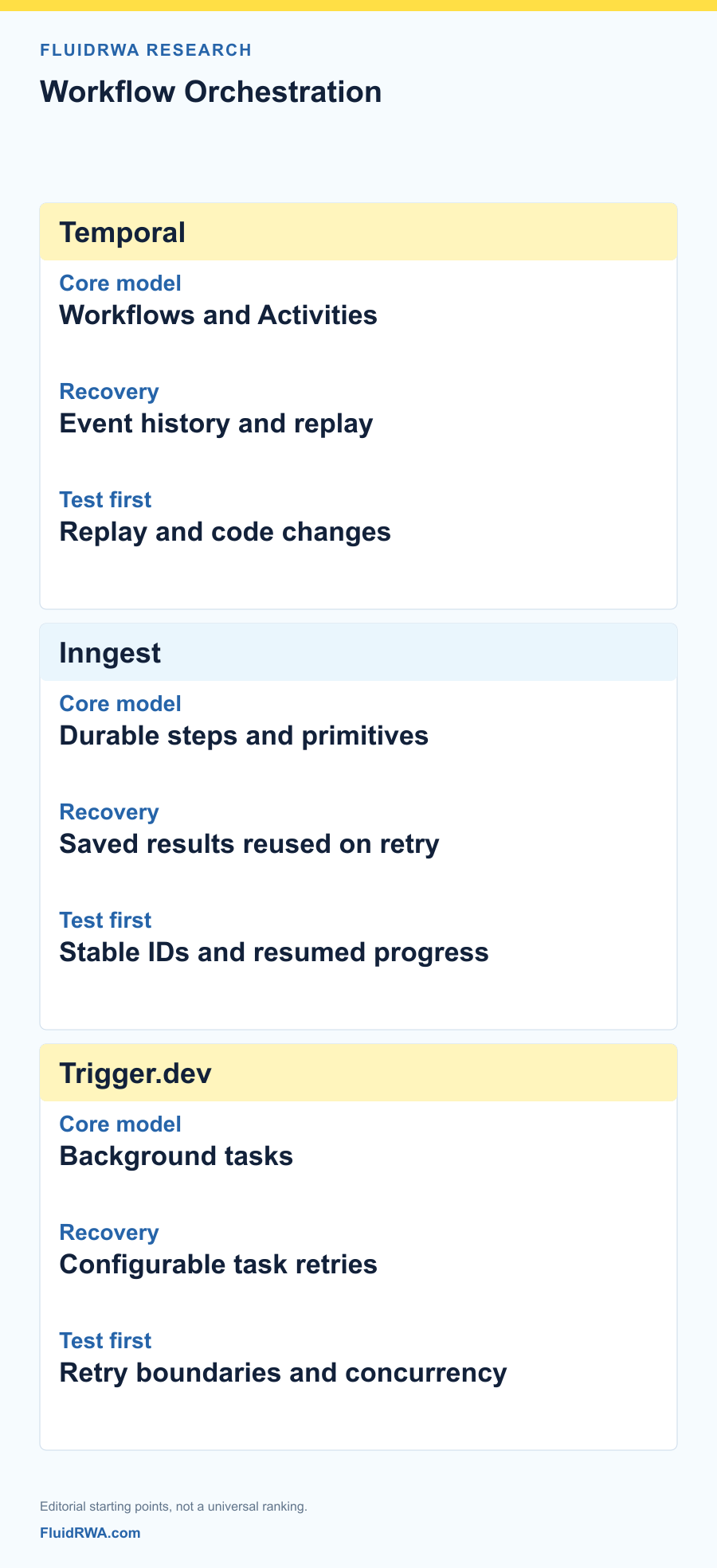
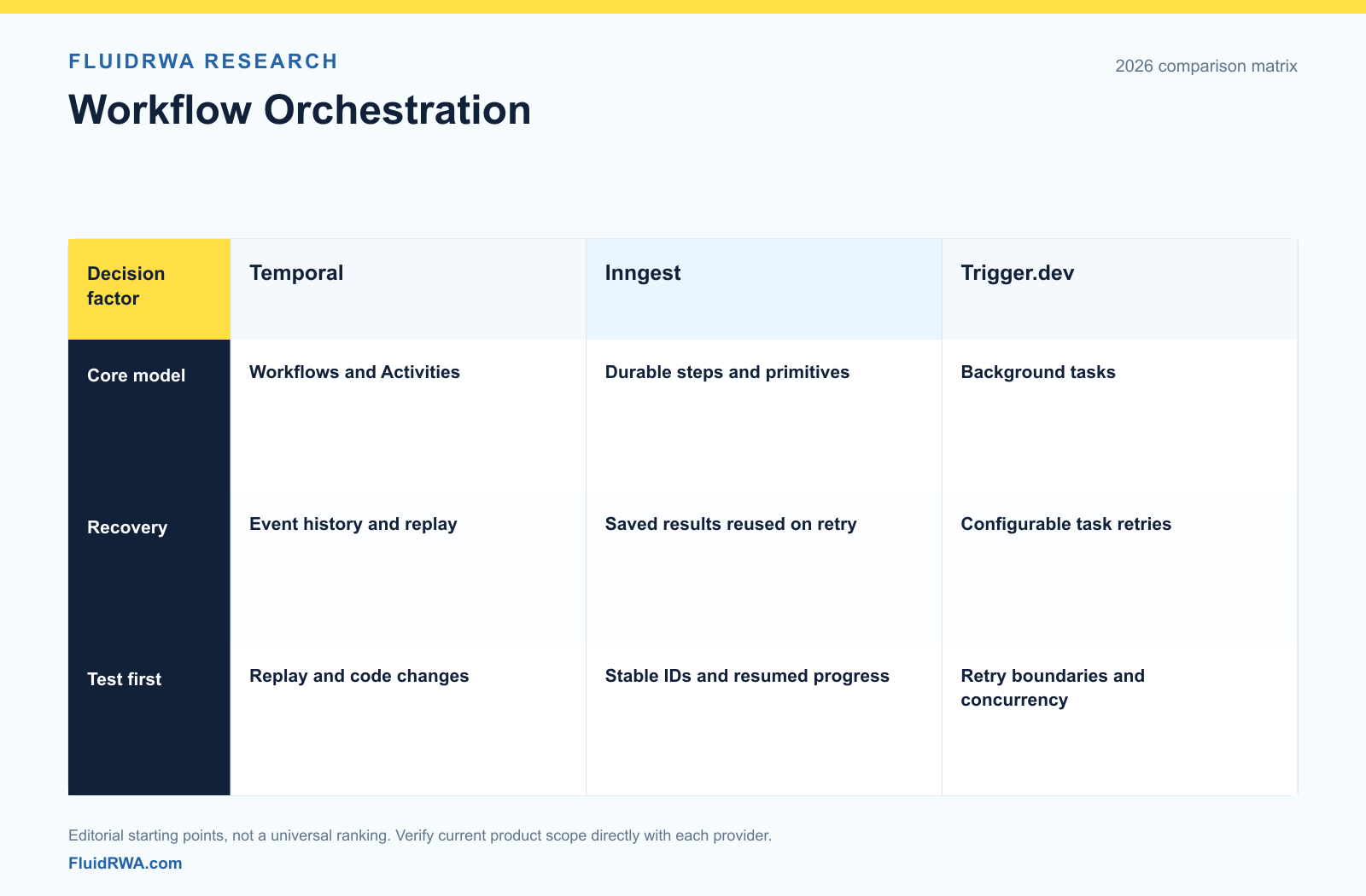
| Decision | Temporal | Inngest | Trigger.dev |
|---|---|---|---|
| Documented unit | Workflow plus Activities | Durable steps and primitives | Background task |
| Recovery evidence | Recorded event history and replay | Saved step results reused on retry | Configurable task retries |
| Coordination evidence | Workflow events and timers | Sleep and event-wait primitives | Queue and concurrency configuration |
| Pilot priority | Replay after failure and code change | Stable step IDs and resumed progress | Retry boundaries and concurrency |
| Responsibility retained | External side-effect safety | External side-effect safety | External side-effect safety |
The comparison uses public company documentation. It does not assert that these are the only capabilities, the market leaders or equivalent service arrangements. No latency, uptime or price ranking was measured.
Temporal
Temporal's Workflow documentation describes recorded event history and replay to reconstruct execution state. It separates workflow logic from Activities that interact with external systems. Replay requires consistent decisions for the same recorded history.
Buyer interpretation: evaluate Temporal where the team wants to reason explicitly about durable workflow state and external operations. Include workflow changes and long-lived runs in the pilot. A recorded result during replay must not be confused with a guarantee that every attempted external operation is inherently idempotent.
Inngest
Inngest's primitives documentation describes saving completed step results and reusing them when later work retries. It also describes sleep and event-wait primitives, and emphasizes stable step identifiers.
Buyer interpretation: evaluate whether named steps and event waits fit the application's process. Test code outside saved steps and changes to step identifiers, rather than assuming all application logic executes only once.
Trigger.dev
Trigger.dev's task overview documents tasks, configurable retries, queues and concurrency. It also distinguishes task retry settings from retrying a block within a task.
Buyer interpretation: examine task boundaries and runtime needs. Decide whether a failure should repeat a whole task or only an isolated operation. Prove that concurrency limits align with external-provider limits and the ordering your process requires.
The failure test a payment team should insist on
Use a sandbox provider and an illustrative workflow: validate an instruction, request approval, submit a payout, record confirmation and reconcile the result. Interrupt it immediately after the external submission but before the local success record.
The operator should be able to find the provider reference and determine whether funds moved. A retry should reuse a supported idempotency key or check the authoritative status. Neither a successful task log nor an exhausted retry count proves the financial outcome.
Repeat with duplicate webhooks, late events, a denied approval and a revoked credential. Record the recovery action and who can perform it. These are proposed acceptance tests, not claims that every selected product implements the whole payment workflow natively.
Approval waits and changing permissions
A human approval is not just a timer. Store the decision, approver, scope and instruction version. If a beneficiary or amount changes, require the appropriate new approval. Recheck permissions when execution resumes rather than relying on the permissions held when a job was created.
Keep personal information and credentials out of ordinary workflow payloads where references suffice. Ask which execution data is retained and what an operator can export. Define cancellation semantics before presenting a cancel button to users: an irreversible external operation may already have occurred.
What belongs in the commercial evaluation?
Model normal runs, retries, long waits, peak concurrency and recovery work. Do not compare only the nominal number of tasks. Include engineering ownership, debugging, retained history, networking, support and the cost of a wrong external action.
- Which runtime and deployment arrangements fit the current application?
- What happens to active executions after a code change?
- How are uncertain external outcomes reconciled?
- Can support staff inspect state without permission to trigger payments?
- How are retention, export, deletion and access controlled?
- What is the tested recovery process if the orchestration service is unavailable?
Specific contractual guarantees, prices and customer deployment limits are not verified here. Obtain them for the proposed arrangement rather than interpreting this review as an operational assurance.
Related buyer resources
Use the stablecoin payment provider RFP to define external-provider responsibilities, and the white-label payment gateway guide to separate branding from operating ownership. Submit a workflow requirement, or email contact@fluidrwa.com.
Verification and scope
Last checked: October 9, 2026. Reviewed by FluidRWA Research Team. Sources support the execution-model descriptions; failure scenarios and procurement recommendations are editorial. This review does not establish exactly-once payments, legal eligibility or production performance.
FAQ
Does durable execution guarantee a payment happens only once?
Do not assume that. An external provider may accept a request before the caller records success. Use provider-supported idempotency, durable references and reconciliation.
Are retries always safe?
No. Retrying a read differs from retrying a payout, issuance or email. Define which actions are repeatable and how an uncertain outcome is resolved.
Should we replace every queue with a workflow engine?
Not necessarily. First identify long-lived state, approval waits, failure recovery and operator needs. A simple isolated job may not need the same orchestration as a multi-system process.
Which product has the fastest recovery?
No recovery benchmark was run for this review. Test the chosen deployment and workload, including failure after an external side effect and recovery after a code change.
Plan the operating workflow
Share the processes, approval points and recovery requirements you need to support. Email contact@fluidrwa.com for a direct enquiry.