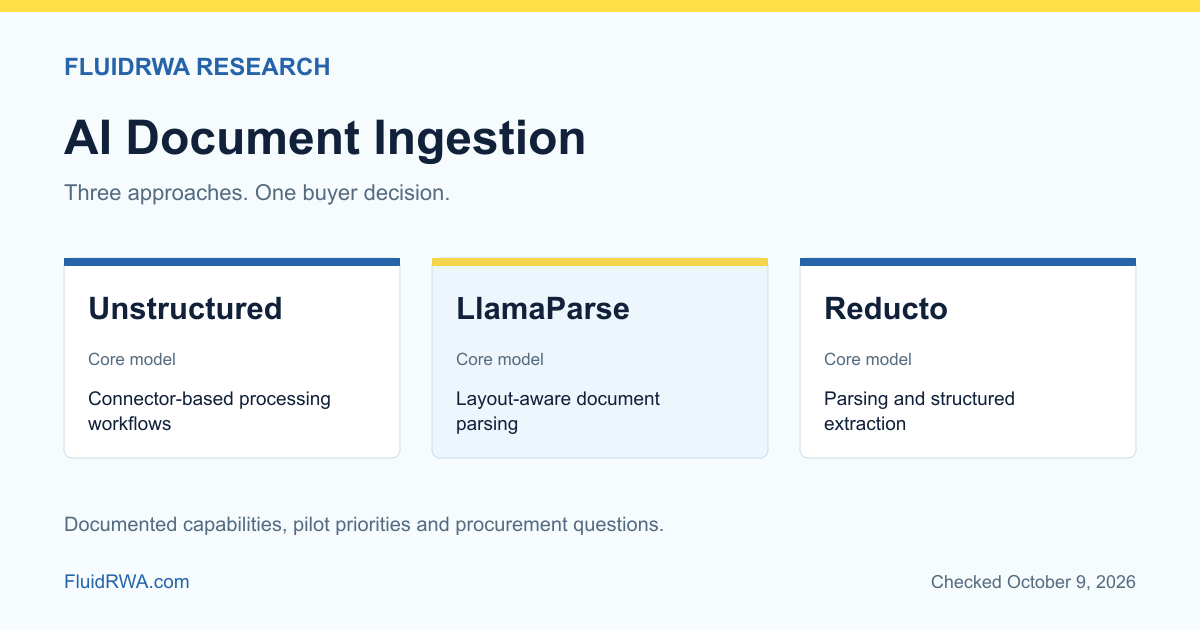
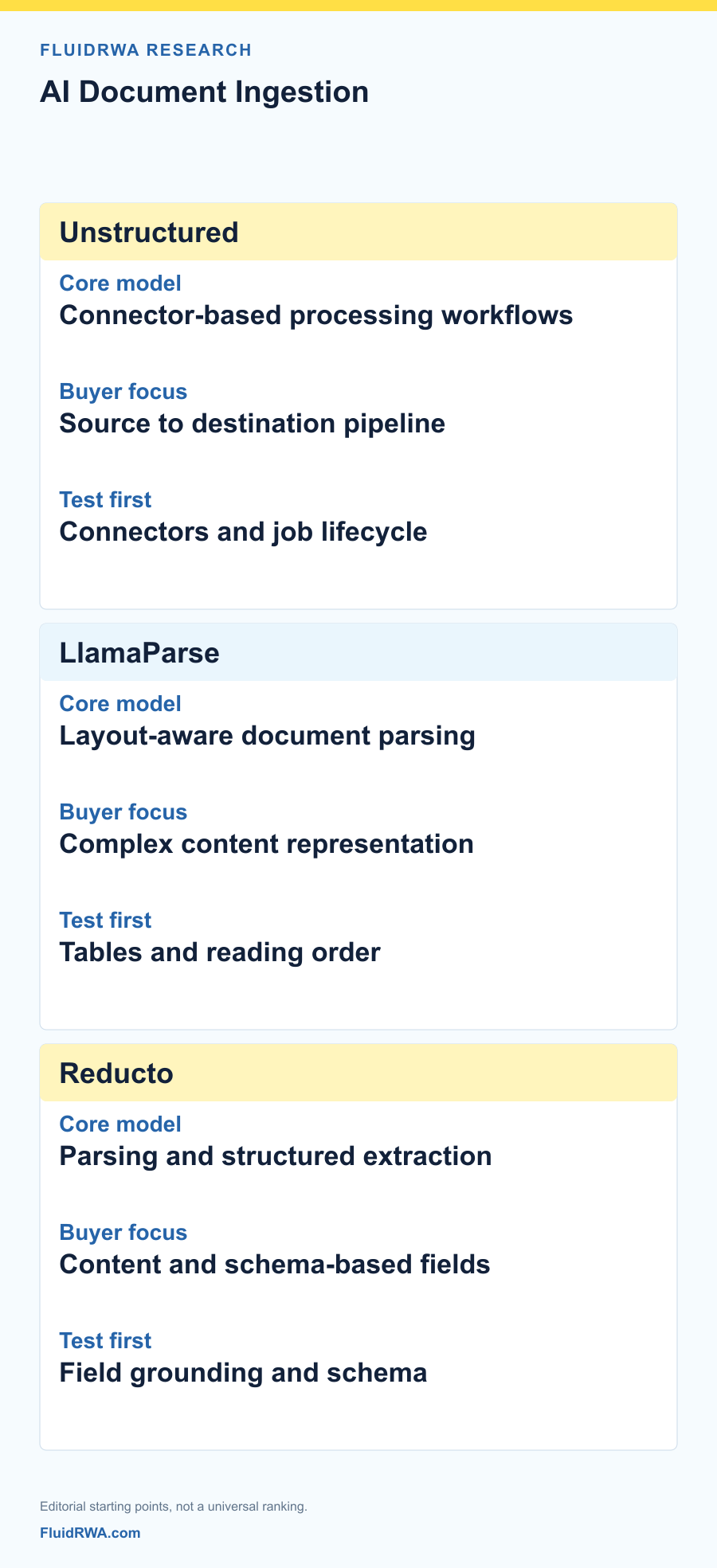
Unstructured documents connector-based processing workflows; LlamaParse documents layout-aware parsing into text, markdown or JSON; Reducto documents parsing and structured extraction APIs. Compare them by your ingestion boundary and evidence requirements, not by an unsupported accuracy league table.
Why does ingestion deserve its own comparison?
An assistant can quote the wrong number because a table was flattened badly before the model saw it. A retrieval system can miss an agreement because the ingestion job failed without alerting anyone. These are upstream document-pipeline problems, not necessarily model problems.
This article compares preparing files for AI retrieval and extraction. It deliberately does not reproduce our Rossum, Nanonets and Google Document AI comparison, which covers document-processing workspaces and operator validation.
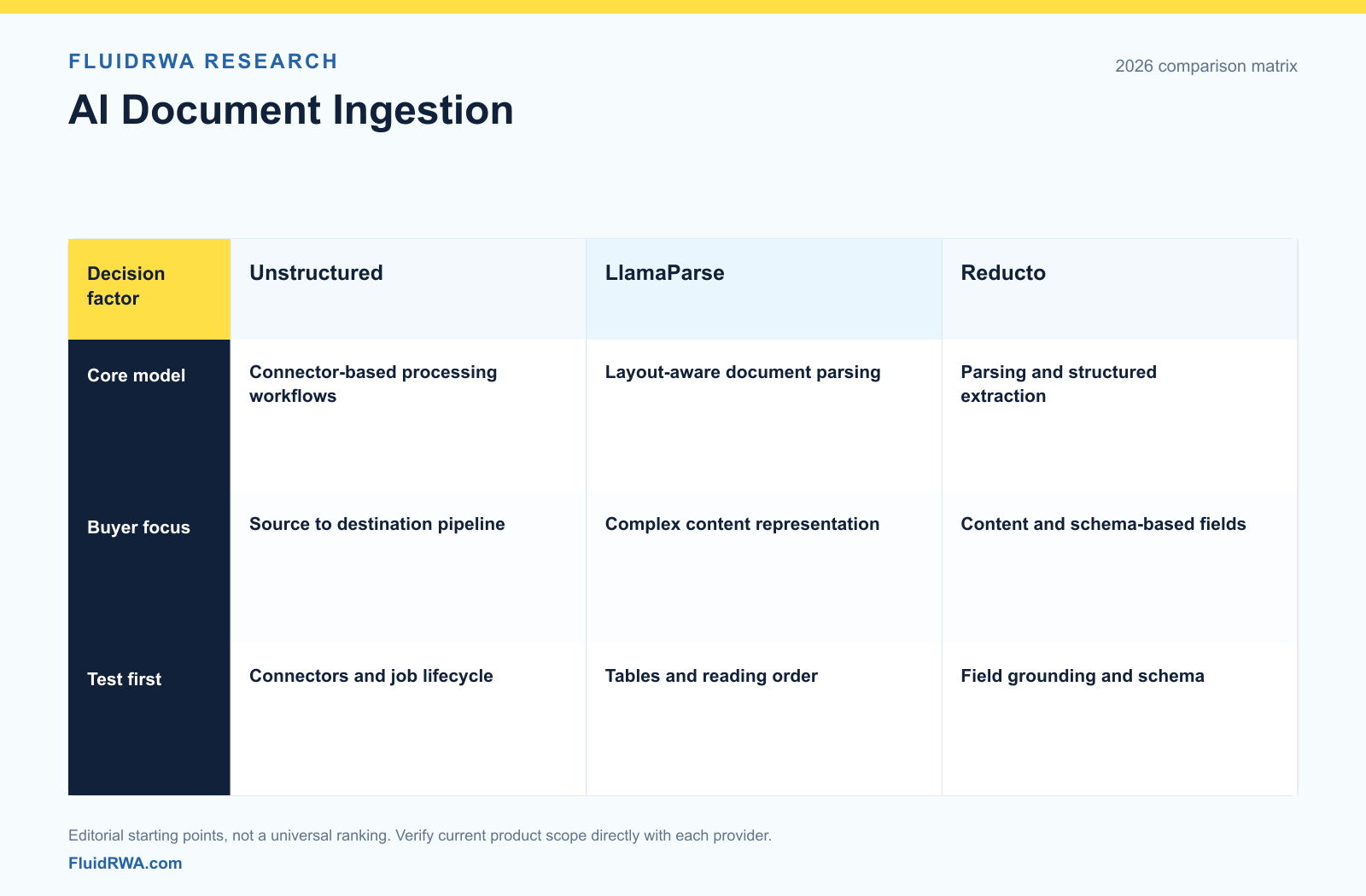
Comparison table: where each documented product starts
| Decision | Unstructured | LlamaParse | Reducto |
|---|---|---|---|
| Documented starting point | Sources, workflows, jobs and destinations | Layout-aware document parsing | Parsing and structured extraction APIs |
| Buyer focus | Repository-to-destination processing | Representation of complex document content | Parsed content and schema-based fields |
| First test | Connector and job lifecycle | Tables and reading order | Field grounding and extraction schema |
| Boundary to confirm | Current connector and API compatibility | Product, output mode and processing settings | Endpoint, output and citation settings |
| Not established here | Accuracy on the buyer's files | Accuracy on the buyer's files | Accuracy on the buyer's files |
These are documented entry points, not exclusive capabilities. Inclusion follows relevant published documentation, not a market-share ranking. Vendor evidence has not been independently validated in a production deployment.
Unstructured
Unstructured's Pipelines operations documentation describes source connectors, destination connectors, workflows and jobs. A workflow defines processing; a job runs it at a particular time. The page also documents compatibility restrictions, which buyers should read before reusing an older example.
Buyer interpretation: examine Unstructured when your problem includes ingesting from repositories and sending processed material to a destination. Confirm connector permissions, update behavior and the exact supported interface rather than assuming every legacy SDK supports the current pipeline API.
LlamaParse
LlamaIndex's Parse overview describes layout-aware OCR and outputs including markdown, text and JSON for LLM pipelines, with PDFs, scans, tables and charts among the documented inputs.
Buyer interpretation: examine LlamaParse when the main uncertainty is faithful representation of complex documents before retrieval. Test whether the chosen output preserves the relationships your application needs. A useful text rendition is not automatically a validated financial record.
Reducto
Reducto's documentation overview distinguishes parsing from extraction and describes composing APIs into pipelines. Its Extract product page documents schema-oriented extraction and citation information linking fields to source material.
Buyer interpretation: examine Reducto when both content representation and specific structured fields matter. Ask which output contains source references, how those references behave across processing stages and what a reviewer can actually inspect.
A pilot that reveals material errors
Use a protected set of subscription agreements, valuation reports, bank confirmations and asset statements. This is an illustrative test set, not evidence that any provider has approved a particular financial workflow.
Label critical fields manually. Include multi-page tables, rotated scans, footnotes, amended agreements, missing pages and two similar entity names. Keep a final hold-out set that vendors do not use to tune configuration.
Measure separate outcomes: text completeness, reading-order correctness, table relationships, field correctness and source-reference usefulness. An average document score can hide a wrong currency or misplaced decimal. Record those critical errors separately and test whether a reviewer can find the original evidence quickly.
Repository changes and deletion matter
Specify what happens when a file changes or is deleted at its source. Store an immutable source identifier, a version reference and the processing configuration alongside downstream chunks. If an agreement is superseded, the retrieval system should not silently treat both versions as current.
Test a partial job failure and a repeated delivery. Confirm that retries do not create duplicate chunks and that operators can distinguish queued, failed and completed files. These are buyer acceptance tests, not claims about native capabilities in every product.
Deletion should cover originals, parsed outputs, derived chunks and downstream indexes. Obtain written retention and subprocessor details for the exact service arrangement. Public documentation alone does not establish that your processing route satisfies a particular legal obligation.
Commercial questions worth asking
- What input types and size limits apply to the selected endpoint?
- Which output includes source pages, coordinates or other review evidence?
- How is an amended document identified and reprocessed?
- What does the quote include: pages, jobs, extraction and reprocessing?
- Which failures require operator action rather than an automatic retry?
- How do retention, deletion and data regions differ by arrangement?
Pricing, contractual throughput, residency guarantees and accuracy on private buyer documents are not verified here. Do not interpret that label as absence of a capability.
How does ingestion connect to retrieval?
Parsing prepares content; vector retrieval finds candidate passages; an assistant generates an answer. Keep evidence and permission boundaries intact across all three stages. Explore AI document intelligence and knowledge retrieval vendors, or email contact@fluidrwa.com with your requirements.
Verification and scope
Last checked: October 9, 2026. Reviewed by FluidRWA Research Team. The named features are supported by linked company documentation; the pilot and procurement recommendations are FluidRWA's editorial guidance. No benchmark, independent assurance or universal winner is claimed.
FAQ
Is parsing the same as structured extraction?
No. Parsing represents document content and layout; structured extraction maps selected information into a defined schema. A pipeline may need both, with separate validation tests.
Which product is most accurate on financial documents?
This review does not establish an accuracy winner. Test held-out examples of your documents, including tables, scans, missing pages and conflicting versions.
Does this duplicate an invoice-processing comparison?
No. This article focuses on preparing documents for AI retrieval and downstream extraction, rather than selecting an operator workspace for invoice validation.
Can extracted figures go directly into issuance or reporting?
Material values should pass validation and appropriate approval first. Correctly parsing a document does not prove its authenticity or authorize a financial action.
Shortlist document infrastructure
Share the files, output requirements and review controls your team needs. You can also email contact@fluidrwa.com.