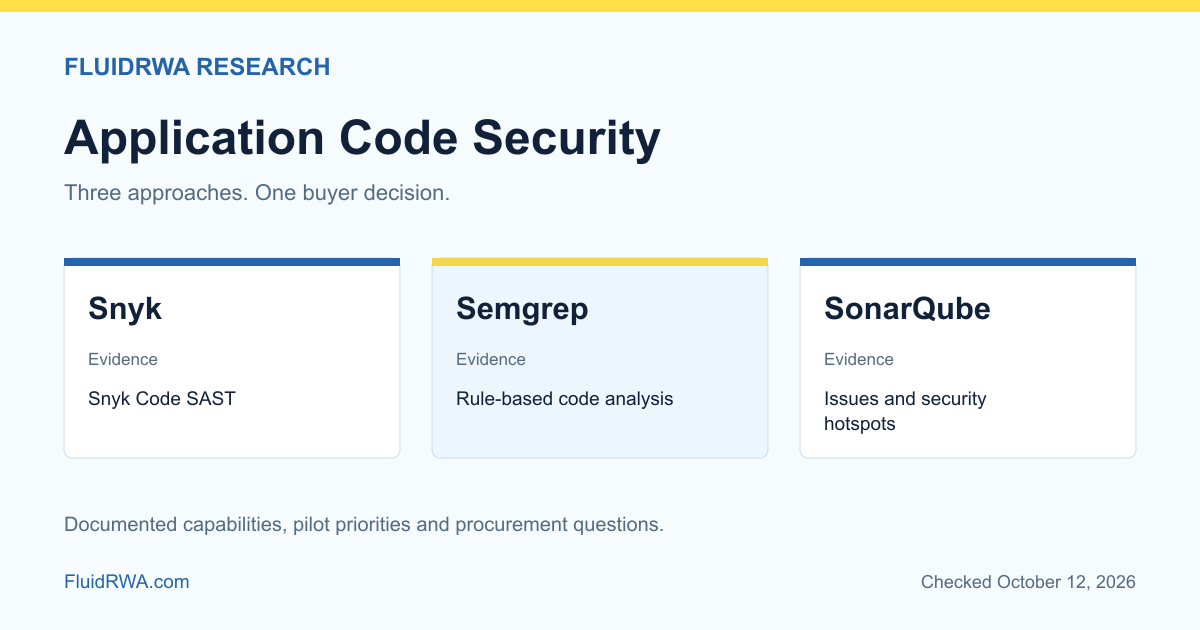
Snyk Code documents SAST analysis, Semgrep documents code analysis and rules, and SonarQube distinguishes security issues from hotspots needing contextual review. For fintech and Web3 backends, compare supported code paths, finding quality, source handling and remediation workflow. These tools do not replace a smart-contract audit or prove that an application is secure.
Which code is this comparison about?
A Web3 service can have a reviewed smart contract and still expose customer data through a backend authorization error. An investor portal can have a secure custody arrangement and still process an unsafe administrative request. This comparison covers application-code analysis around those systems, not blockchain consensus or custody assurance.
Start with the repository, languages and execution paths you need to protect. Include public APIs, administrative routes, queue consumers and code that interprets external callbacks. For contract-specific specialist work, see our smart-contract audit comparison.
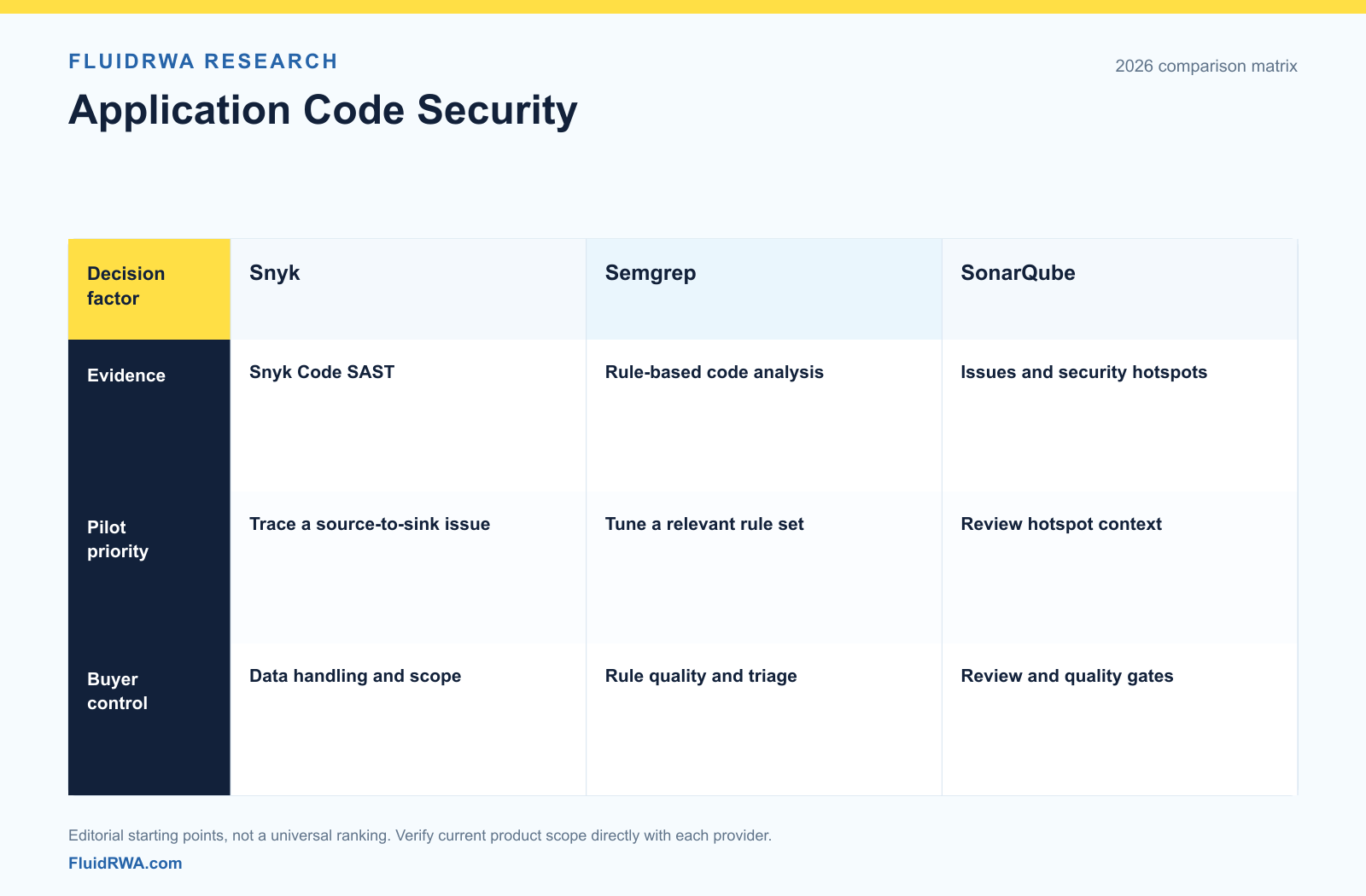
Comparison table: evidence and the first useful test
| Buyer question | Snyk Code | Semgrep | SonarQube |
|---|---|---|---|
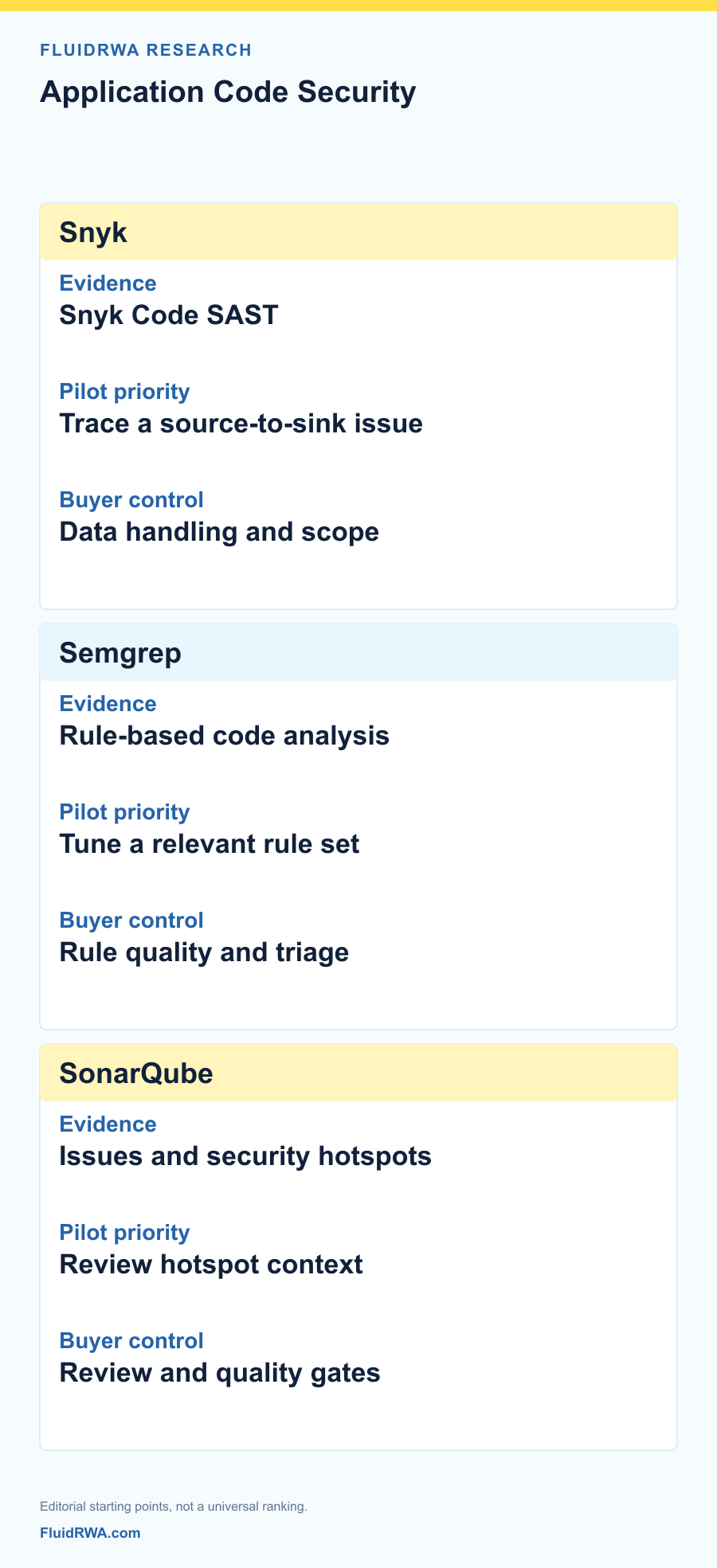
| Evidence reviewed | SAST and developer workflow documentation | Quickstart and Community Edition documentation | Security hotspot review documentation |
| First useful test | Investigate a source-to-sink finding | Run and tune an applicable rule set | Review a hotspot with execution context |
| Scope check | Language and deployment configuration | Engine, rules and paid versus community scope | Edition, analyzer and configured analysis |
| Evidence to retain | Finding trace and remediation decision | Rule version, result and triage decision | Review status and justification |
These are documentation-backed starting points, not an exhaustive feature matrix. Capability unavailable in the reviewed evidence is not verified, not absent. No fabricated detection scores or vendor winner are used.
Snyk Code: review the finding and source-handling model
Snyk's Code documentation describes static application security testing through developer workflows and data-flow analysis. It also distinguishes deployment arrangements, including a local engine for stricter upload policies. Availability and operational requirements must be checked for the proposed arrangement.
Buyer interpretation: select a known test issue and inspect the trace from input to the sensitive operation. Confirm whether the finding maps to reachable code and whether the suggested change preserves intended behavior. Separately document what source material leaves your environment; the fact that a command runs locally does not prove no upload occurs.
Semgrep: assess rules, configuration and triage
Semgrep's quickstart explains starting scans. Its Community Edition description describes source-code review and rules. Do not combine the community engine, paid capabilities and every product-family feature into a single assumed deployment.
Buyer interpretation: use rules relevant to your actual framework and customize one rule for a sensitive internal API. Test positive and negative examples so the rule does not merely match harmless syntax. Preserve configuration and rule versions with the result; a scan is hard to reproduce when those inputs are missing.
SonarQube: distinguish review prompts from confirmed issues
SonarQube's security hotspot documentation explains that a hotspot needs contextual review. A security-sensitive construct may be safe in one path and dangerous in another. A hotspot count should not be reported to management as a count of proven exploitable vulnerabilities.
Buyer interpretation: assign a reviewer and require a reason for a safe or fixed disposition. Check how the decision is revisited after code changes. A quality gate is useful only if the team understands which findings it blocks and which unresolved review obligations remain.
Run a pilot with known issues and known safe code
Use a non-production repository containing deliberately introduced input-handling and authorization examples. Keep a separate reviewed record of what each test is intended to show. A higher finding count can reflect duplicate or irrelevant results rather than stronger protection.
Compare coverage of the selected language and framework, actionable findings, false positives, investigation time and regression behavior. Review misses as carefully as hits. Do not seed customer secrets or dangerous production credentials to test a scanner.
Attach a named owner and a time-bound remediation decision to important findings. Exceptions should explain business context and expire or reopen after relevant changes. Permanent blanket ignores can make a successful scan report less informative over time.
Questions before procurement
- Which languages, frameworks and analysis modes cover our repositories?
- What source, metadata and findings are uploaded or retained?
- Can we reproduce results with pinned configuration and rule versions?
- How are branch, pull-request and production-baseline findings reconciled?
- Who reviews hotspots, accepts risk and verifies fixes?
- Which additional tests are still needed for runtime and contract logic?
Last checked October 12, 2026. Vendor documentation is company evidence; the proposed pilot is FluidRWA editorial guidance, not a performed test. Email contact@fluidrwa.com with the scope you need reviewed.
FAQ
Can SAST replace a smart-contract audit?
No. This review concerns application source-code workflows. Smart-contract logic, economic assumptions and deployed configurations require their own appropriate review.
Does a security hotspot mean a confirmed exploit?
No. SonarQube documentation describes hotspots as security-sensitive code requiring review. Context is needed before deciding whether a fix is required.
Which scanner finds the most vulnerabilities?
This review did not run a detection benchmark. Use a controlled codebase with known issues and reviewed findings; raw issue count alone is not a measure of useful coverage.
Scope the security review
Describe your backend, languages and review requirements. Or email contact@fluidrwa.com.