Treat a tokenization-platform migration as a records and permissions change, not just a new contract deployment. Identify the authoritative ownership register, export investor positions and restrictions, reconcile the target state, coordinate approvals and integrations, and release the new system only after agreed acceptance checks. Contract replacement, platform replacement and a change of transfer agent can require different processes.

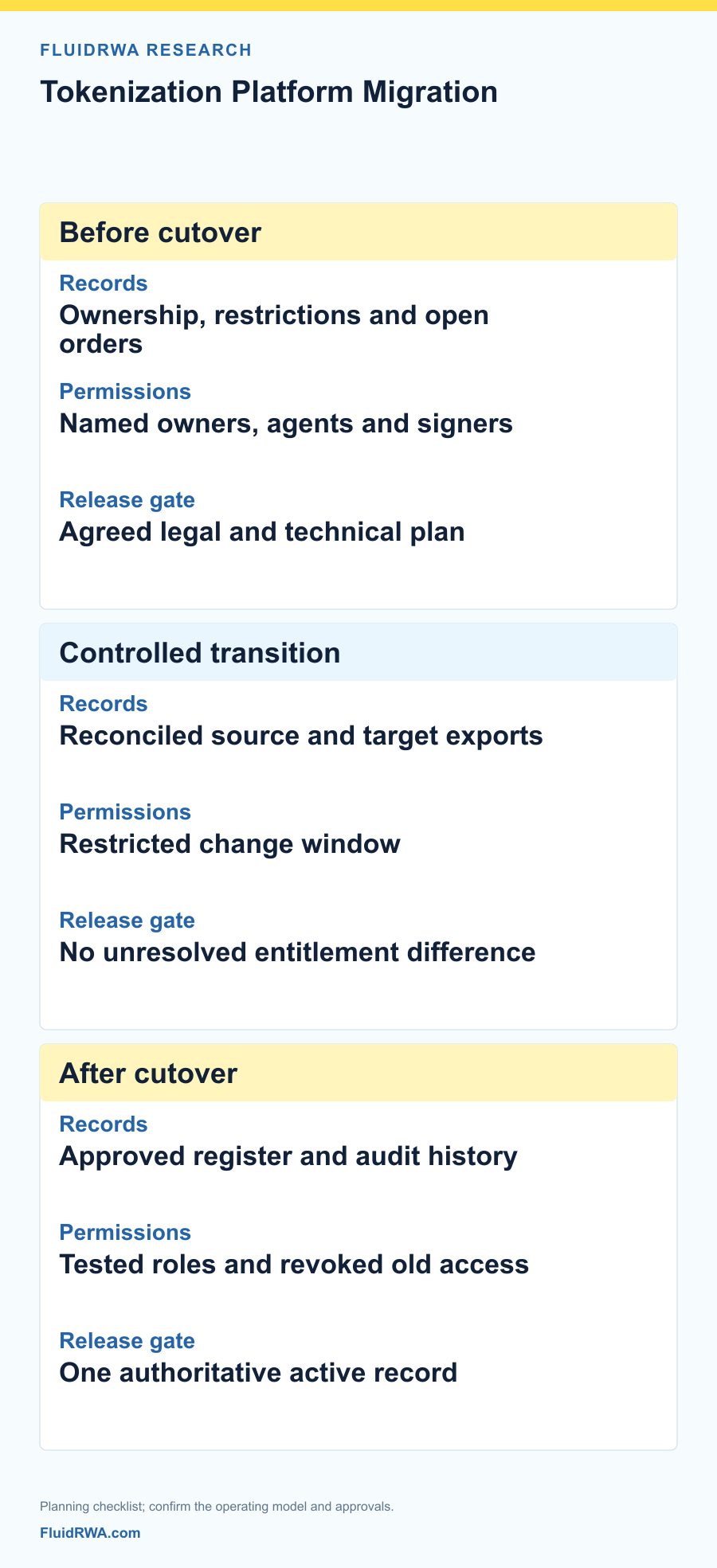
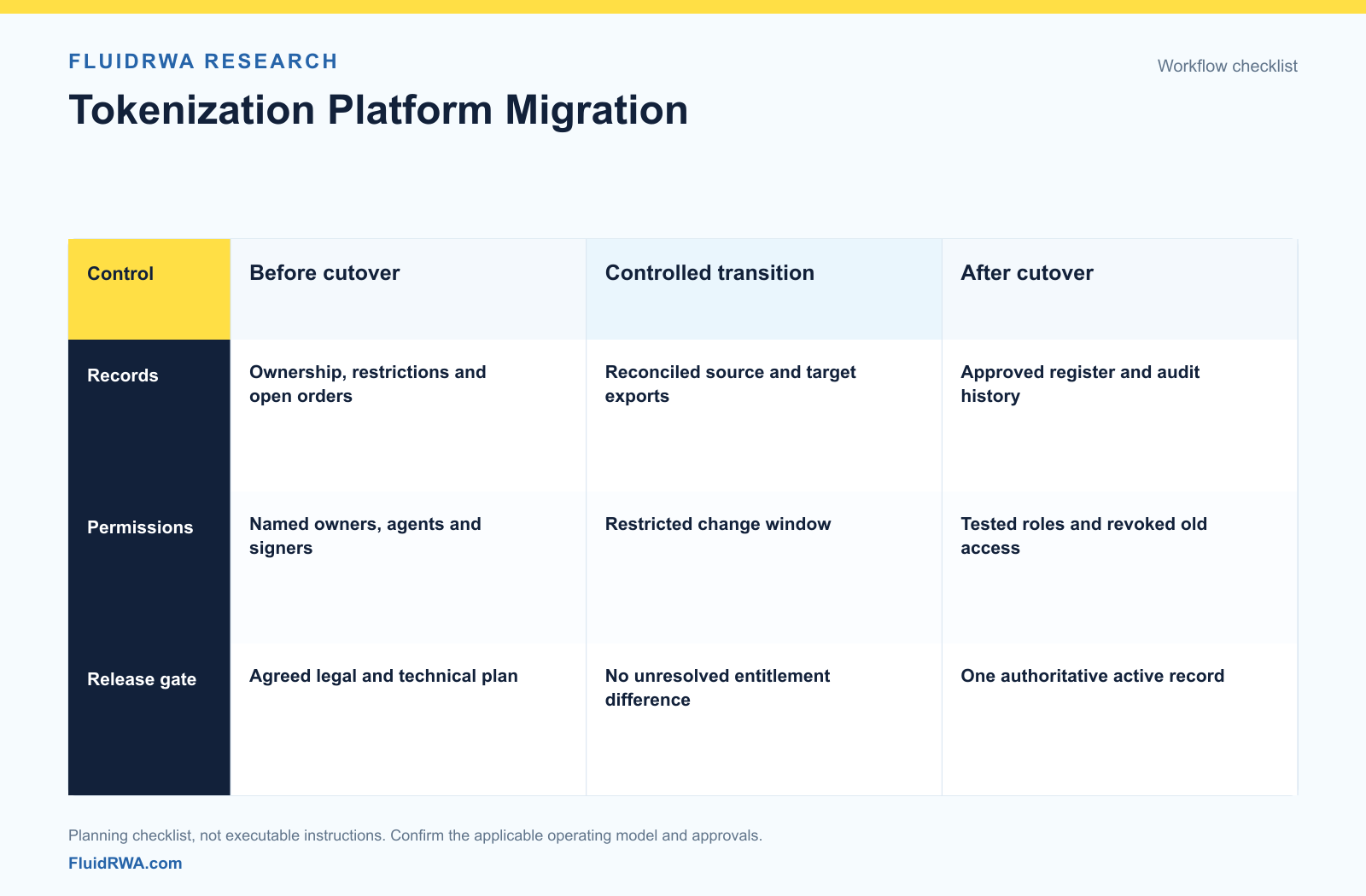
A new dashboard is not a completed migration
The new system may show the right total supply while individual investors have the wrong restrictions, an unpaid subscription appears allocated or a former operator retains powerful signing permissions. A migration is complete only when the records and responsibilities work together.
This guide concerns a planned transition between systems. It complements, rather than replaces, the contingency questions in what happens if a tokenization platform shuts down.
1. Decide what is actually changing
Separate four possible changes: the user-facing platform, token contract, blockchain network and transfer-agent or register-maintenance arrangement. They may happen together, but none automatically implies the others.
Write down the current and proposed legal entities, systems and service providers. Ask counsel, the fund administrator and the relevant register operator which consents, notices, contractual changes or other approvals apply. Technical access does not itself authorize a change to investor rights.
2. Identify the authoritative records
The migration inventory should extend beyond wallet balances.
| Record | Required migration check | Sign-off owner to name |
|---|---|---|
| Ownership register | Legal holder, position and effective date agree | Register operator |
| Wallet associations | Verified entity-to-wallet mapping is preserved | Authorized operations team |
| Restrictions | Frozen amounts, eligibility and transfer rules remain correct | Compliance owner |
| Orders and cash | Pending subscriptions, redemptions and unsettled money agree | Administrator / finance |
| Documents and history | Agreements, notices, approvals and prior versions remain retrievable | Legal / records owner |
| Permissions | Owner, agents, signing policies and service accounts are mapped | Security / platform owner |
An export that contains only address and balance may be insufficient. Record which data can be transferred, under what authority and through which protected channel.
3. Use a provider-specific runbook
Tokeny's migration guide provides a concrete example: it calls for coordination with support, export of investor positions, qualification of investors for the new token and reconnection of affected modules. Its guide describes a specific token migration, not a generic procedure for every platform.
Tokeny's token-actions documentation separately describes authorized agent actions such as minting, burning, pausing and recovery. These are controlled capabilities, not permission to execute them without an approved migration plan.
Do not copy an online sequence directly into production. Identify the exact contract version, available permissions, modules, custodian requirements and irreversible steps in your own system.
4. Rehearse with the difficult records included
Use a protected copy or synthetic dataset that includes a blocked position, multiple wallets for one holder, book-entry holdings, an open redemption and a recent recovery case. Reconcile the source export with the target import by investor and by relevant restriction, not only by aggregate balance.
Test access as an ordinary investor and as each operational role. Confirm that users can retrieve the documents they should see and cannot access another investor's records. Have the administrator reproduce the same position report from both systems at the agreed cutoff.
Set explicit acceptance criteria. An unresolved entitlement difference should not be waived because the overall token count matches.
5. Control the change window
Agree which subscriptions, transfers, redemptions and automated jobs must stop or queue. Capture the final approved source state and record the chain/block reference where relevant. Document how events arriving during the transition will be treated.
No universal rule says to pause every contract: the available controls and the legal operating model differ. Specify the permitted actions, required signers, order of operations and independent checks. Use a communications plan that tells investors what will be unavailable and where to request help.
A temporary duplicate representation must never be presented as two independent entitlements. The runbook should prevent simultaneous unapproved use of old and new records.
6. Prove the new system works before releasing it
Require a signed reconciliation of positions, restrictions, open orders and cash. Exercise a subscription, transfer and redemption in the appropriate test environment, then perform the approved production acceptance checks. Validate portal links, custody records, reports, price feeds and external integrations.
Review old agents, API credentials and service accounts. Revoke obsolete access according to the plan without destroying records that must be retained. Keep the evidence of what changed, when and under whose authorization.
7. Write recovery limits before the change
An abort plan should identify the last safe stopping point and which actions cannot be reversed. If token burns, new transfers or third-party settlement have already occurred, recovery may require a forward correction rather than restoring an old database backup.
Ask both providers for an export specification, assistance obligations, retention periods and costs. Include an independently readable history archive. Our transfer-agent RFP and transfer-control guide provide related procurement questions.
Documentation checked 22 October 2026. This is a planning framework, not executable migration instructions or legal approval. Send your current system, target system and proposed scope to contact@fluidrwa.com.
FAQ
Does moving to another platform always require a new token?
No. A platform migration, contract upgrade, chain migration and transfer-agent change are different projects. Determine what must change from the actual architecture, permissions and legal documents.
Can a token-holder CSV replace the legal ownership register?
Not automatically. A balance export may omit beneficial-owner records, restrictions, pending orders or offchain holdings. Establish the authoritative register and reconcile all relevant records.
Is rollback always possible after migration?
No. Minting, burning, transfers or third-party integrations may make parts of the change irreversible. Define abort conditions and recovery options before execution, not after a failed cutover.
Build a focused vendor brief
Share the workflow, systems and responsibilities you need to cover. Prefer email? contact@fluidrwa.com.