VNX publishes B2B white-label technology for tokenizing allocated precious metals and other assets by arrangement. Meld Gold focuses on gold and silver tokens and bullion-industry integration. Kinesis offers gold- and silver-backed currencies with business payment integrations. Compare what a buyer is actually procuring: infrastructure to issue under its own brand, integration with a metals ecosystem, or access to an existing gold-backed currency.


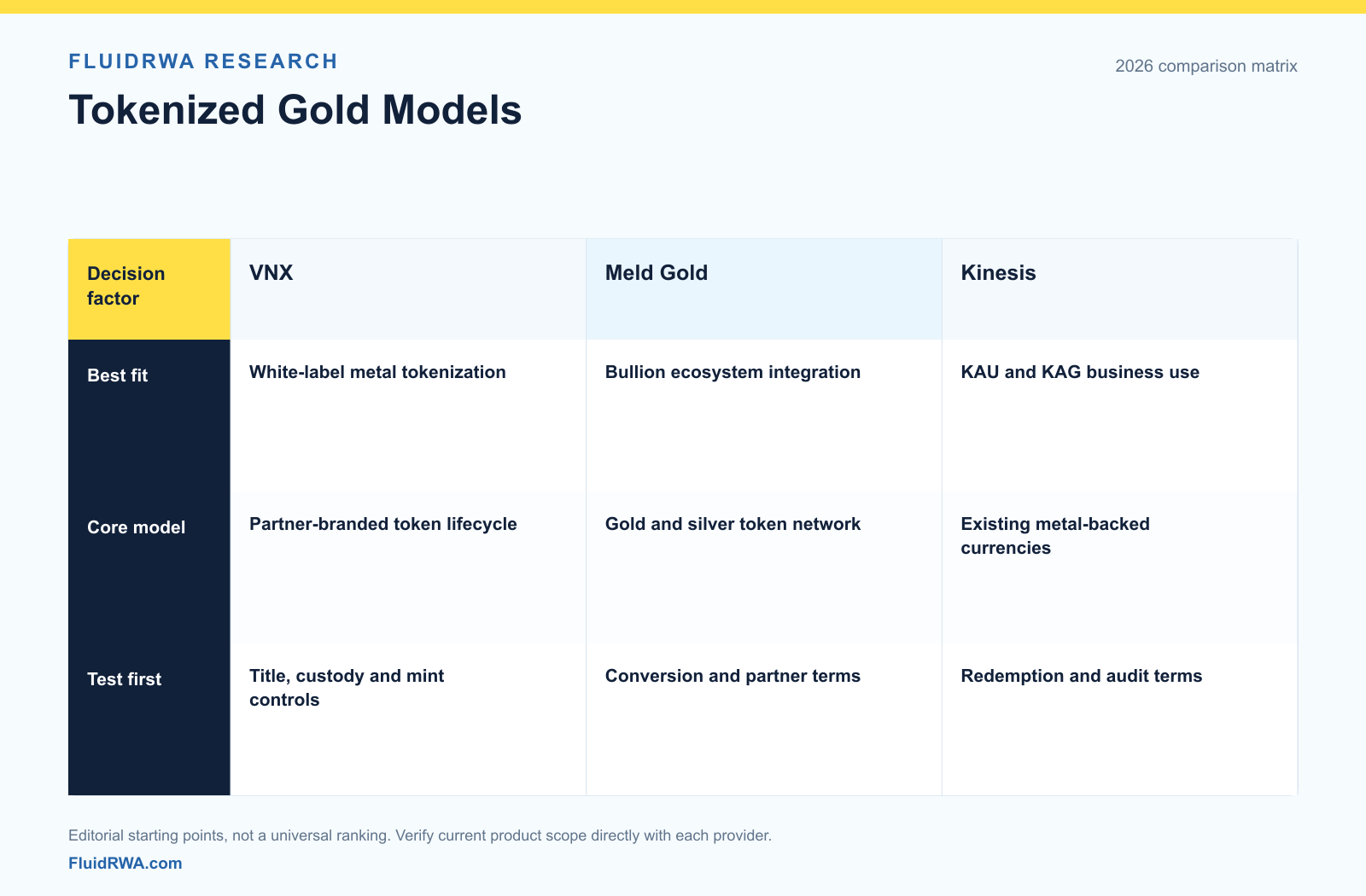
Tokenized gold is often discussed as one category, but a treasury team, bullion dealer and issuer may be buying three different things. One may need technology to create a branded token against metal it controls. Another may want to accept an existing gold-backed token. Another may need a distribution and redemption network. This article compares operating models, not expected returns or token prices.
Short Answer
Consider VNX for a B2B white-label tokenization project that needs token generation and lifecycle tooling around allocated metal. Consider Meld Gold when integration with a gold-and-silver token ecosystem and bullion partners is the main requirement. Consider Kinesis when the use case concerns existing KAU/KAG currencies, business acceptance or physical redemption under its rules. These are not substitutes for one another in every procurement.
Comparison at a Glance
| Decision area | VNX | Meld Gold | Kinesis |
|---|---|---|---|
| Published model | B2B white-label tokenization plus own metals case study | Metal tokens and bullion-partner ecosystem | Existing gold and silver currencies plus business integrations |
| Buyer asks | Can we tokenize our asset under our brand? | Can we digitize or integrate with the metal supply chain? | Can our business hold, use or accept KAU/KAG? |
| Custody diligence | Independent custodian and token-to-metal reconciliation | Bullion partner and certificate or token terms | Allocated metal, audit and redemption terms |
| First test | Mint, burn, bar mapping and legal claim | Conversion, liquidity and partner operations | Business API, fees and redemption thresholds |
The Three Models
VNX says its tokenization framework can support a partner's own asset, brand and commercial setup, with precious metals as its established case. Its tokenization description covers minting and burning against asset data, programmable controls and reporting. An issuer should ask precisely which functions VNX provides, who holds legal title to metal and who acts as custodian.
Meld Gold describes gold and silver tokens designed for investors and businesses, as well as an integrated bullion supply chain. Its conversion page identifies participating bullion partners. A buyer should establish whether it is integrating existing tokens, using a bullion partner or seeking custom issuance; those are different contracts.
Kinesis markets business acceptance and integration for its gold and silver currencies, KAU and KAG. Its redemption guidance states that bullion redemption is subject to minimum withdrawal requirements and describes periodic independent audits. The relevant procurement question is whether the existing currency and its terms fit the business, not whether Kinesis will build a new branded gold token.
Five Tests That Matter More Than Token Branding
- Legal claim: Does the holder own metal, a contractual claim against an issuer, or another right? Obtain the operative terms.
- Inventory: Can token supply be reconciled to specific bars, vault records and any outstanding redemption instructions?
- Redemption: What amount, country, fee, notice and identity checks apply to physical delivery or cash settlement?
- Control: Who can mint, burn, pause, freeze or upgrade the token and under what governance process?
- Distribution: Where can the token be held or traded, and what happens when an integration or market-maker is unavailable?
For an institutional buyer, add an adverse scenario: a vault discrepancy, a delayed audit, a redemption queue and a chain outage on the same day. Ask which party owes the holder performance under each event.
Where This Sits in FluidRWA Research
The tokenization platform directory is for broader issuance infrastructure. The proof-of-reserves due-diligence guide covers reserve questions across assets. This comparison stays specifically on tokenized-metal operating models, so it should not compete with the general platform ranking.
Primary Sources and Editorial Note
- VNX tokenization infrastructure
- Meld Gold metal-token overview
- Meld Gold bullion conversion partners
- Kinesis business integrations
- Kinesis bullion redemption guidance
This is independent research, not investment, legal or custody advice. Product terms, eligibility and redemption rules can change; verify the current documents before transacting.
FAQ
Are VNX, Meld Gold and Kinesis the same type of provider?
No. VNX explicitly offers white-label tokenization infrastructure; Meld Gold centers on its metal-token ecosystem and bullion partners; Kinesis centers on its gold and silver currencies and related business integrations.
Does tokenized gold always mean direct ownership of a specific bar?
No. The legal claim, allocation method and redemption rights depend on the issuer's documents. Inspect those documents and custodian evidence rather than inferring rights from the token name.
What should an issuer test before choosing a metals-token provider?
Test title to metal, custody and bar records, mint and burn controls, independent reserve evidence, transfer restrictions, redemption thresholds, fees and failure handling.
Is a reserve audit enough due diligence?
No. Reserve evidence is one input. Buyers also need legal rights, counterparty analysis, operational controls, market liquidity and jurisdictional review.
Decide whether you need to issue or integrate
Define asset rights, bar custody, redemption, token lifecycle and distribution before selecting a metal-token partner.