Hacken offers proof-of-reserves verification and reserve-coverage work. CertiK describes one-time and continuous PoR products with public reporting through Skynet. The Network Firm emphasizes on-chain reserve reporting and oracle-linked data services. The right choice turns on what asset and liability populations are tested, how off-chain evidence is obtained, and what the public can independently verify.


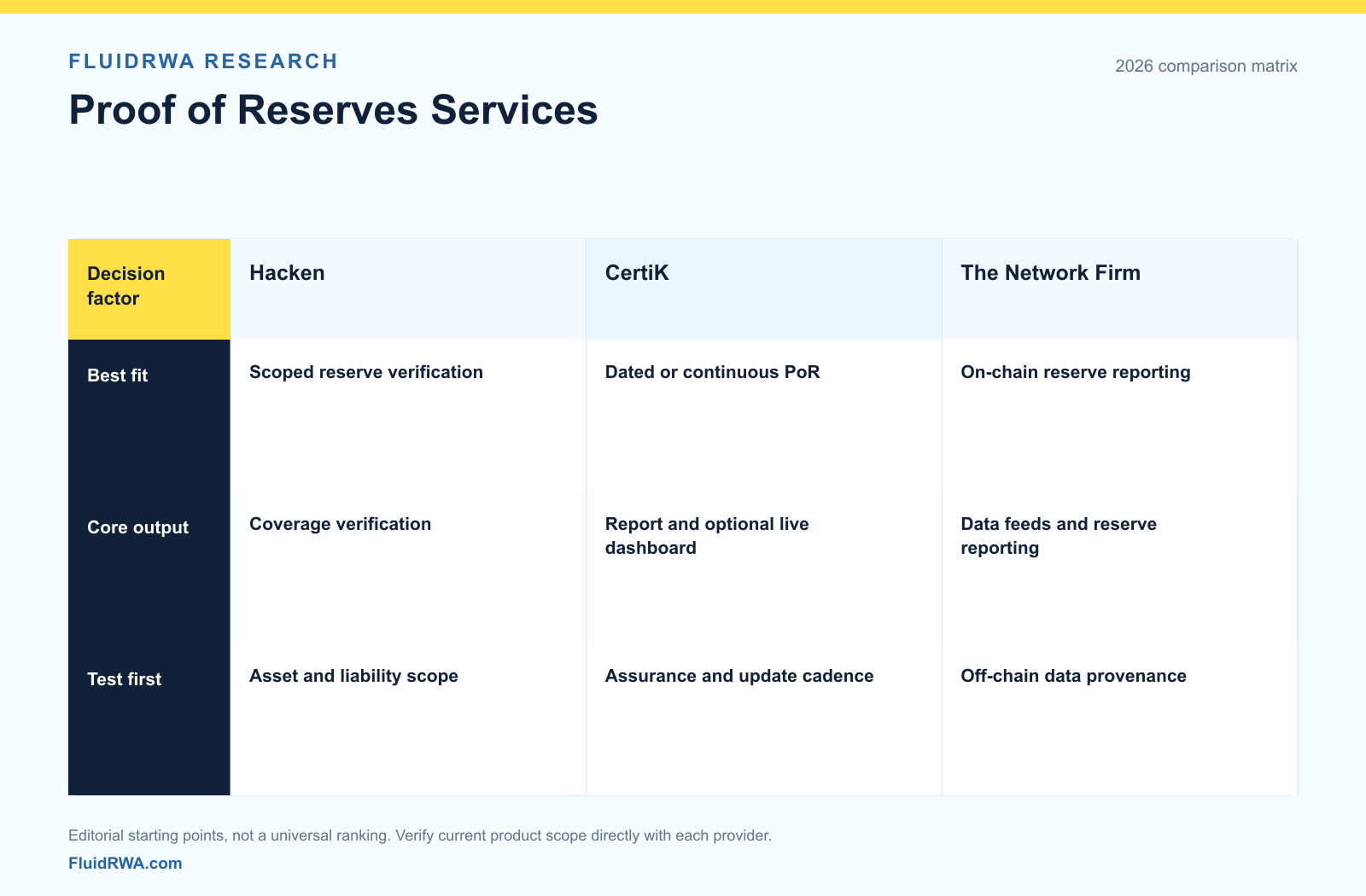
Proof of reserves is often presented as one badge. In reality, the work can range from a dated verification to a continuous feed, and the scope may include only wallet balances, or also liabilities and off-chain assets. For a stablecoin or a gold-backed token, that difference is material. This is a comparison of reserve-evidence services, not a claim that the three providers perform identical audits.
Short Answer
Hacken is worth evaluating for scoped reserve-coverage verification. CertiK publishes both one-time and continuous proof-of-reserves offerings. The Network Firm focuses on on-chain proof-of-reserves reporting and data feeds. Before choosing any of them, write down the exact claim you want independently tested and the evidence a skeptical token holder should be able to inspect.
Comparison at a Glance
| Decision area | Hacken | CertiK | The Network Firm |
|---|---|---|---|
| Publicly described offer | Proof-of-reserves verification | One-time PoR audit and continuous PoR option | On-chain reserve reporting and oracle data |
| Best evaluation question | How is coverage verified and reported? | What differs between dated and live outputs? | Which off-chain and on-chain inputs feed the report? |
| Likely buyer | Issuer needing a scoped reserve verification | Issuer or platform seeking report plus public status | Issuer designing a repeatable on-chain transparency feed |
| Critical diligence | Asset, liability and legal-entity scope | Assurance scope and update cadence | Source provenance and independent validation |
What Each Provider Publishes
Hacken describes proof-of-reserves verification and on-demand reserve-coverage validation. Ask for a sample report that shows the subject entity, observation time, procedures, exceptions and any excluded liabilities.
CertiK describes a one-time PoR product with a signed report and a continuous option linked to a public dashboard. Those outputs answer different questions. A dated report can document procedures at a defined point; frequent updates help users observe subsequent changes, but only to the extent the inputs are reliable and in scope.
The Network Firm describes an on-chain reporting service that aggregates on-chain liabilities and off-chain assets and can supply oracle data. Its published use cases include asset-backed tokens. An issuer should ask whether the reporting engagement also includes an independent opinion and, if so, precisely what that opinion covers.
Define the Claim Before Buying a Badge
For a fiat stablecoin, the claim may be that eligible reserve assets cover tokens outstanding at a specified observation time. For tokenized gold, the claim may concern allocated inventory in a named custodian's vault, the owner's enforceable interest, and token supply after minting and burning. Neither claim is established by displaying a wallet balance alone.
The RFP should distinguish five evidence layers:
- Asset existence: What bank, custodian or vault evidence confirms the reserve?
- Asset rights: Who legally owns it, and can it be pledged, lent or otherwise encumbered?
- Liabilities: What token supply and other claims must the reserve cover?
- Reconciliation: How are mint, burn, redemption, settlement and exception records matched?
- Publication: What can a user check publicly, how often is it refreshed, and what remains private?
A Useful Pilot
Provide a sample day with minting, burning, a pending redemption, an off-chain asset movement and a data-feed outage. Ask each provider to show the exact report or dashboard response. The highest-value question is not whether the graphic shows 100%; it is what would happen when the inputs disagree.
This piece complements the existing proof-of-reserves due-diligence guide, which explains what to ask. It also connects to the stablecoin infrastructure directory. The guide and directory should not be replaced by another broad PoR explainer.
Primary Sources and Editorial Note
- Hacken proof-of-reserves verification
- CertiK proof-of-reserves products
- The Network Firm on-chain proof of reserves
This comparison is independent research. It is not an assurance report, legal opinion or assessment of any provider's specific engagement. Read the signed scope and limitations of a current proposal.
FAQ
Does proof of reserves prove that a token is fully backed?
Only within the stated scope and observation time. A buyer must also understand liabilities, asset ownership, encumbrances, custody, legal rights and report limitations.
Is a live dashboard the same as an independent audit?
No. A live data feed can improve transparency, while an independent assurance engagement has a defined scope, evidence standard and report. One does not automatically replace the other.
What is most important for a gold-backed token?
Check the custodian's bar or inventory records, ownership rights, reconciliation to circulating tokens, redemption rules, encumbrances and independent verification of the off-chain metal.
How often should reserves be checked?
Frequency depends on issuance and redemption activity, asset volatility, legal obligations and the risk of changes between observations. Ask what is checked continuously and what is checked only at a fixed date.
Specify the assurance question first
Define the assets, liabilities, legal entity, observation time and public evidence before requesting a reserve-verification proposal.