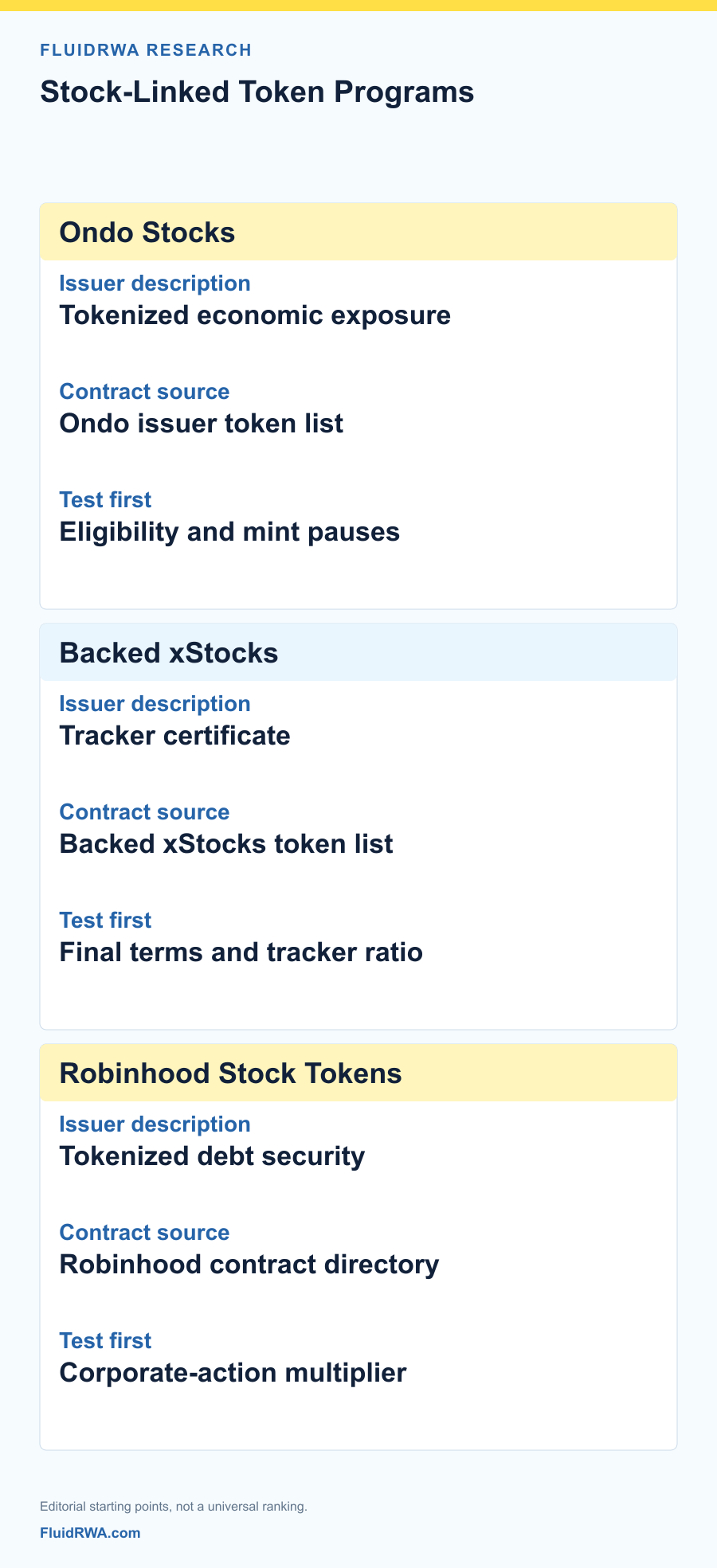
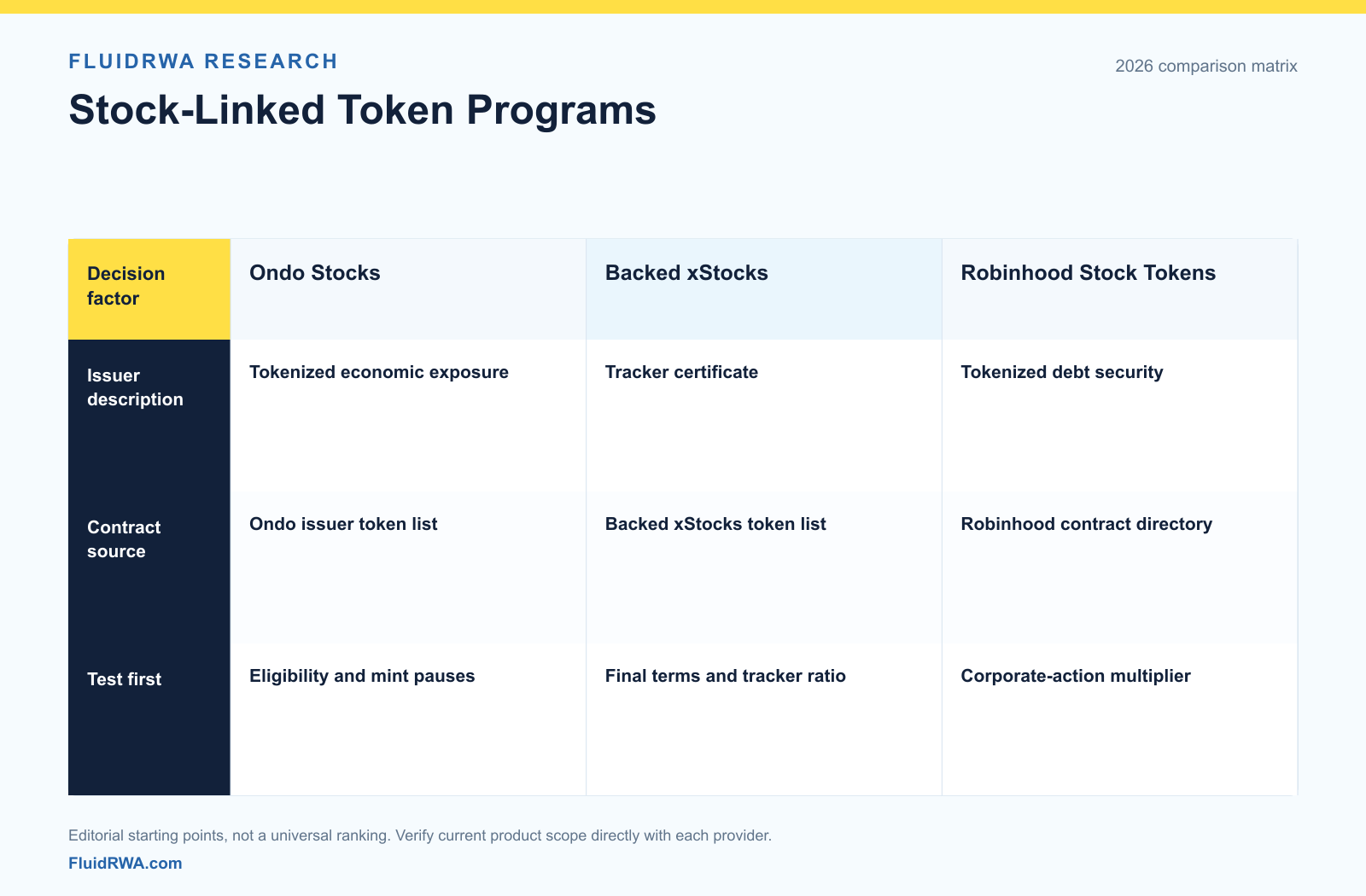
Ondo Stocks, Backed xStocks and Robinhood Stock Tokens all reference listed securities, but the issuer, legal instrument and integration rules differ. Ondo describes tokenized economic exposure; Backed describes xStocks as tracker certificates; Robinhood describes Stock Tokens as debt securities without underlying shareholder rights. Verify each product's current terms, eligibility, canonical contract and corporate-action rules before integration.

Short answer
These are three stock-linked product programs, not three versions of the same share. A platform choosing one needs to compare the issuer's promise to the holder, the product's jurisdiction and investor rules, where the canonical contract is published, and how splits, distributions and redemptions affect balances. A common stock ticker is not a common legal claim.
The comparison below uses public issuer documentation reviewed October 17, 2026. It does not independently verify backing, custody, current liquidity or suitability. Product terms may change.
Documented differences at a glance
| Buyer question | Ondo Stocks | Backed xStocks | Robinhood Stock Tokens |
|---|---|---|---|
| Public product description | Tokenized economic exposure to stocks and ETFs, per Ondo | Tracker certificates tracking the underlying price, per Backed | Tokenized debt securities providing economic exposure, per Robinhood |
| Named issuer or program | Confirm legal issuer and terms for the specific Ondo token | Backed Assets (JE) Limited is named on the AAPLx product page | Robinhood Assets (Jersey) Limited is named in the Stock Token documentation |
| Contract source | Ondo issuer token list | Backed xStocks token list | Robinhood contract directory and assets API |
| Integration check | Current eligibility and mint/redemption pauses | Product final terms, eligible holders and tracker economics | Corporate-action multiplier and trading status |
Ondo Stocks: test eligibility and lifecycle
Ondo's product overview describes tokenized economic exposure to US-listed stocks and ETFs and directs buyers to current eligibility criteria. It also says minting or redemption may pause for corporate actions, volatility or risk controls. That is a material integration detail: a wallet or brokerage interface should not promise continuous conversion merely because an onchain token can move. Ask for the specific product's legal issuer, offering documents, price source, distribution treatment and a live address list.
Backed xStocks: read the certificate terms
Backed's AAPLx page calls the product a tracker certificate issued as Solana SPL and ERC-20 tokens and names Backed Assets (JE) Limited as issuer. The page links product documents and notes distribution restrictions. The certificate's rights are those in the legal documents, not automatically shareholder voting or title to an Apple share. For an integration, compare the contract address, the certificate's price-tracking mechanics, available networks, supported custody arrangements and redemption conditions in the current terms.
Robinhood Stock Tokens: account for the multiplier
Robinhood's developer documentation describes Stock Tokens as debt securities issued by Robinhood Assets (Jersey) Limited. It states holders receive economic exposure but no legal or beneficial rights in the underlying securities. Its API documentation exposes asset metadata, deployments and corporate-action data; it warns that raw underlying prices and onchain multiplier-adjusted values differ. A display or collateral engine that ignores the multiplier could misstate a position after a corporate action.
Robinhood's documentation also limits who can subscribe in the primary market. Do not assume that a wallet developer can mint, redeem or distribute these products just because the token is an ERC-20.
Buyer tests that reveal the differences
- Pick the same reference company in all three programs and obtain each exact legal document, chain ID and contract address.
- Compare holder rights, eligibility, primary-market access, redemption and dispute route without using marketing shorthand.
- Simulate a split, dividend, market closure and delayed issuer price update. Check displayed units and order status.
- Test a prohibited jurisdiction, lost-wallet recovery and unsupported transfer path.
- Record what each source proves. An issuer token list identifies a contract; it does not certify collateral, investor rights or liquidity.
The verification checklist walks through those steps. The Network Explorer supply monitor publishes dated contract-unit observations for selected Ondo and Backed deployments, without summing them into share ownership or market size. This page compares product models; it is not an investment recommendation.
Primary sources
- Ondo Stocks overview and eligibility direction
- Ondo official token list, pinned snapshot
- Backed Apple xStock product and documents
- Backed official xStocks token list, pinned snapshot
- Robinhood Stock Token documentation
- Robinhood contract addresses and APIs
FAQ
Are these tokens direct shares in Apple or another reference company?
Do not assume that. The issuer's legal instrument determines rights; Robinhood explicitly says its Stock Tokens do not grant legal or beneficial rights in the underlying securities.
Does one ticker identify one token across programs?
No. Match the issuer-controlled address and chain ID. Products can reference the same company while having different contracts, claims and corporate-action mechanics.
Can any investor mint or redeem directly?
No universal rule applies. Eligibility, geography and primary-market access differ by product and must be verified in current issuer terms.
Can raw token supplies be compared as share counts?
No. Token units may have different legal claims and ratios to the reference security, and a contract totalSupply reading is not a market-value measure.
Compare the full securities stack
Map issuer, broker, custodian, identity, market data and transfer responsibilities for your jurisdiction. Prefer email? contact@fluidrwa.com.