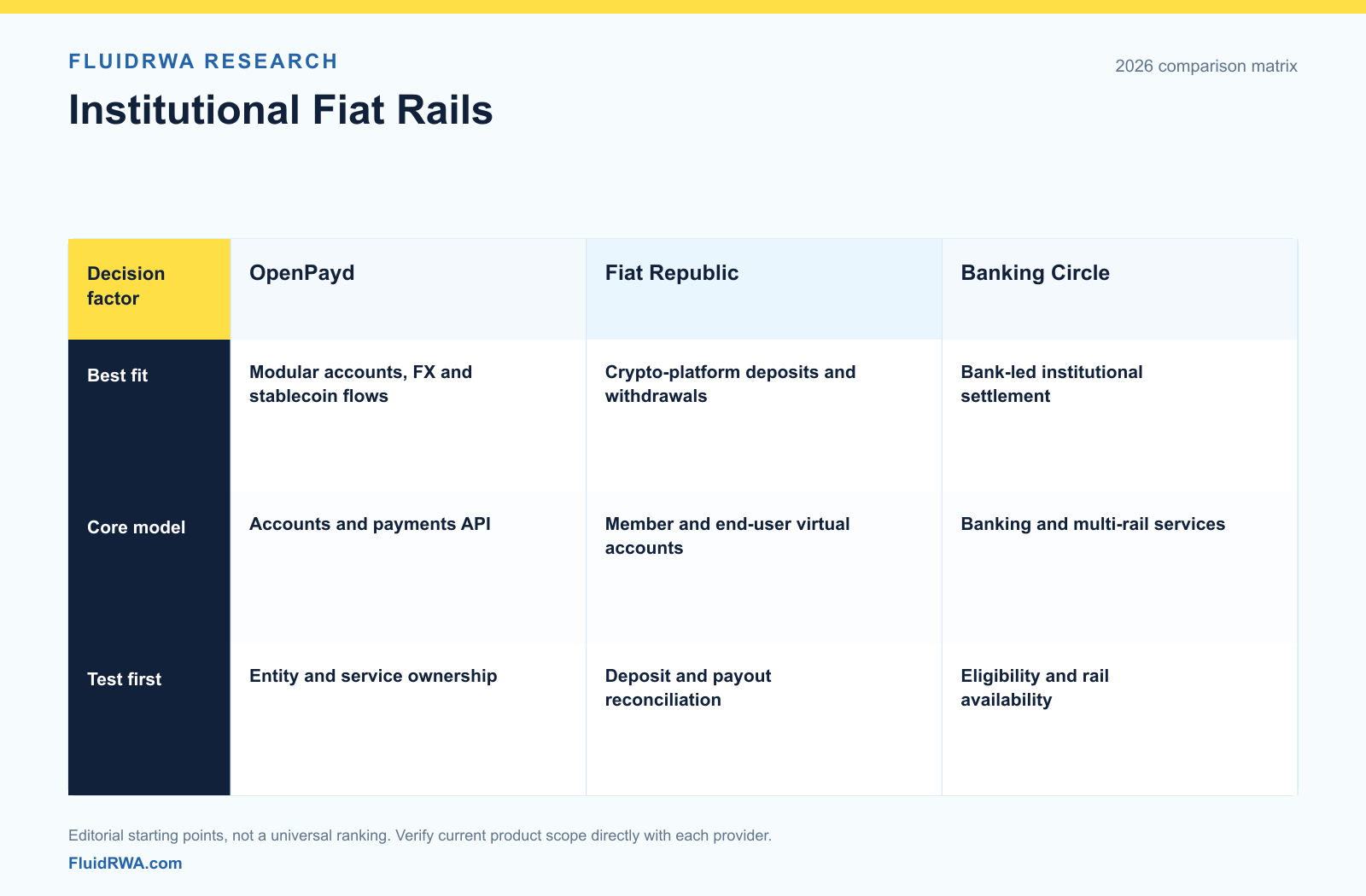
OpenPayd combines accounts, payments, FX and stablecoin services in a modular API offering. Fiat Republic documents fiat accounts, named virtual accounts and payments for crypto platforms and their end users. Banking Circle approaches the problem as an institutional bank and multi-rail settlement provider. These are different contracting and operating models; confirm jurisdiction, eligibility and who performs conversion before shortlisting.


An investor funding flow can look simple on a pitch deck: collect fiat, issue or purchase a tokenized asset, then pay redemption proceeds. In production, it depends on account ownership, payment-system access, sanctions and identity checks, FX, liquidity and ledger reconciliation. This comparison is for platforms buying those institutional fiat rails, not a checkout widget for a retail crypto purchase.
Short Answer
Shortlist OpenPayd when you want a modular API spanning payment accounts, FX and digital-asset services. Shortlist Fiat Republic when a crypto platform needs a documented member/end-user model for fiat collections and withdrawals. Shortlist Banking Circle when bank-led accounts and multi-rail institutional settlement are the central requirement. None is a universal substitute for the others: the licensed entity, geography and service contract determine the actual offering.
Comparison at a Glance
| Decision area | OpenPayd | Fiat Republic | Banking Circle |
|---|---|---|---|
| Published orientation | Modular accounts, payments, FX and stablecoin API | Fiat accounts and payments for crypto platforms and end users | Banking and digital-asset rails for institutions |
| Account question | Which group entity supplies each service? | How are member and end-user virtual accounts linked? | Does the buyer qualify for the proposed bank account and rails? |
| Best evaluation scenario | Combining fiat operations and conversion in one commercial stack | End-user deposits and withdrawals with account-level reconciliation | Bank-led, multi-currency settlement at institutional scale |
| First proof point | End-to-end funds flow by jurisdiction | Deposit, webhook and payout exception test | Written account, settlement and onboarding terms |
What Each Provider Actually Publishes
OpenPayd describes one API for stablecoins, FX, accounts and global payments, including virtual IBANs and on/off ramps. Its site also states that fiat payments and digital-asset services are supplied by different group entities. A buyer should map which entity contracts for each leg instead of assuming one licence covers the entire workflow.
Fiat Republic's developer documentation describes API-managed fiat deposits, withdrawals, virtual accounts, payment rails and webhooks. Its member/end-user model distinguishes the crypto platform's own accounts from virtual accounts used to collect or pay funds for its customers. That is a useful starting point for investor-level reconciliation, but the actual permitted activities and regions still require confirmation.
Banking Circle positions itself around banking for digital-asset institutions and fiat/digital-asset rails. This is a bank-led procurement route, not simply an interchangeable developer widget. Ask whether the specific legal entity, account type, stablecoin service and payment corridor you need are available to your business model.
Follow One Investor Payment End to End
For a tokenized fund or security, require each vendor to diagram a real subscription and redemption:
- The investor is onboarded and screened by named parties.
- The investor receives bank details or a payment reference; the platform records who legally owns the account.
- The payment arrives, is matched to the investor and is checked for name and source-of-funds exceptions.
- If fiat is converted to a stablecoin, identify the conversion provider, wallet controller, liquidity source, cut-off time and rate lock.
- The tokenization platform records issuance only after its defined settlement condition is met.
- On redemption, the same chain of evidence supports the payout, reversals and accounting close.
Do not evaluate a demo only on the happy path. Simulate a third-party payment, a wrong reference, a returned payout, an account freeze and an investor whose KYC changes between subscription and redemption.
Questions for the RFP
- Which legal entity provides the account, payment, conversion and digital-asset services in each jurisdiction?
- Are customer funds held in a named account, virtual account or pooled account, and who is the legal account holder?
- Who performs KYC, AML screening, transaction monitoring, Travel Rule checks where applicable and sanctions escalation?
- What event confirms irreversible funding for issuance, and how are chargebacks or recalls handled?
- Which webhook, statement and API fields reconcile an investor, bank payment, on-chain transfer and ledger entry?
- What happens if a payment arrives outside processing hours, a stablecoin depegs or the conversion partner is unavailable?
Where This Fits in the Existing Research
This article compares institutional account and settlement infrastructure. For card or wallet-based retail conversion, use the MoonPay vs Transak vs Banxa comparison. For broader rails and integration options, start with the fiat on/off-ramp provider directory. These are adjacent layers, not duplicate lists of the same product.
Primary Sources and Editorial Note
- OpenPayd stablecoin, account and payment services
- Fiat Republic API introduction
- Fiat Republic member and end-user account model
- Banking Circle digital-asset institutions
This is independent procurement research, not an endorsement or a statement that all services are available in every country. Obtain current product schedules and legal terms directly from each provider.
FAQ
Is this the same as comparing MoonPay, Transak and Banxa?
No. This article focuses on institutional accounts, treasury settlement and customer deposit or withdrawal rails. A consumer on-ramp widget is a different procurement decision.
Which provider offers virtual accounts for end users?
Fiat Republic documents virtual accounts linked to a platform member account for end-user collection and payouts. OpenPayd also markets virtual IBANs. Confirm legal account ownership and availability in the required jurisdiction.
Does a fiat account provider automatically provide stablecoin conversion?
No. Conversion, liquidity, custody and payments may be supplied by different entities or partners. Require a written funds-flow diagram and service schedule.
What should a tokenization platform test first?
Test investor deposits, reference matching, screening handoffs, failed payments, reconciliation, redemption payouts and exception handling using the exact countries and currencies in scope.
Map the full funding and redemption workflow
Compare account ownership, payment rails, stablecoin conversion, KYC responsibilities and reconciliation before requesting proposals.