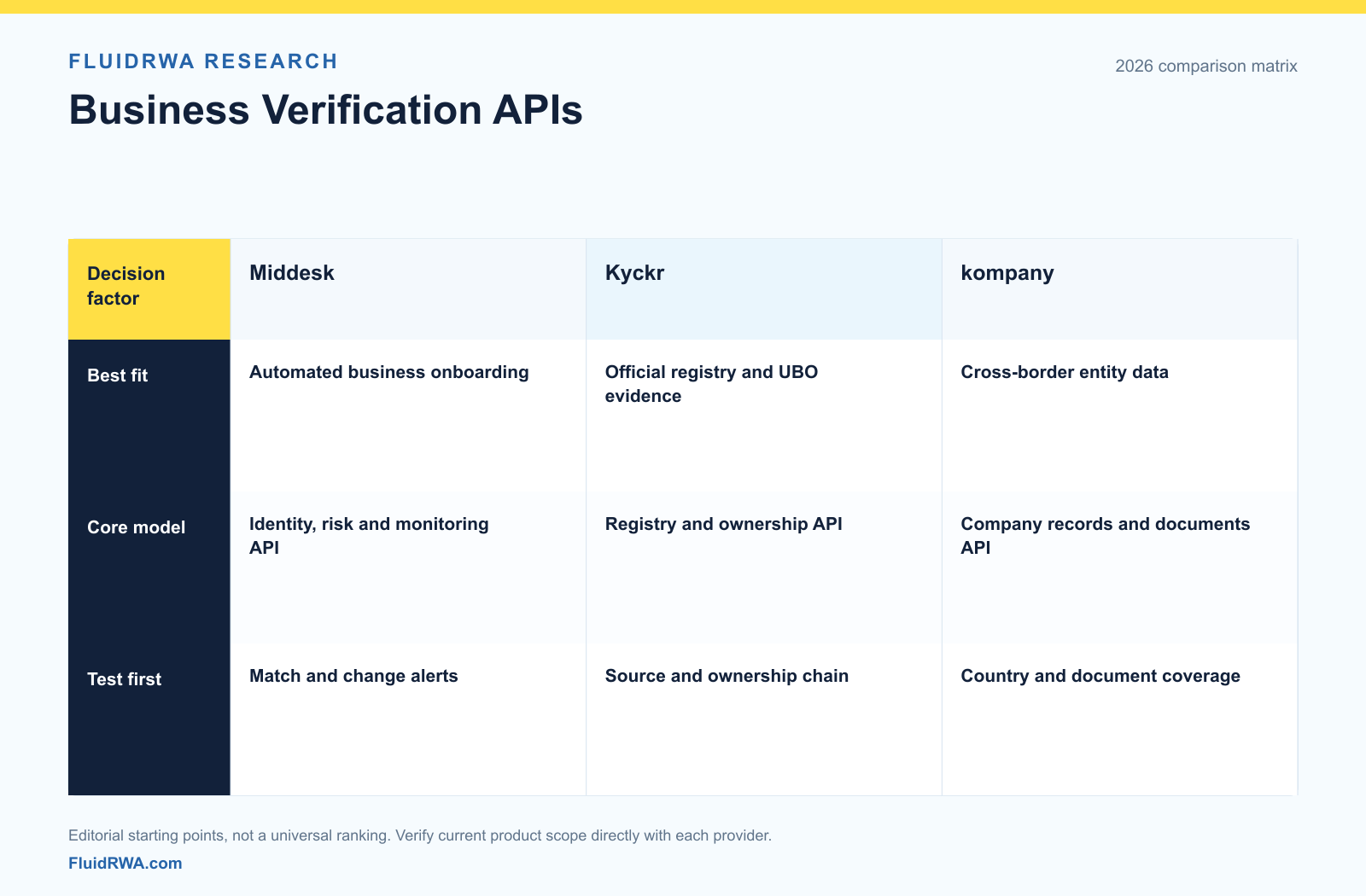
Middesk is an API-led business verification and monitoring option with identity and risk signals. Kyckr centers its KYB offering on live company-register data and ownership discovery. kompany provides API access to official company information and documents across jurisdictions. Choose by the jurisdictions, entity types and evidence standard in your onboarding policy, not by a headline company-count claim.


Institutional investor onboarding is not just a passport check. A fund, broker, treasury client or corporate token holder may need its legal existence, officers, beneficial owners, sanctions exposure and ongoing changes verified before it can subscribe or transact. This article compares business-verification APIs only. It does not rank individual ID checks, wallet screening or a full compliance platform.
Short Answer
Choose the KYB provider that can produce defensible evidence for your countries and entity structures. Middesk is a useful candidate for API-led business onboarding and ongoing risk signals. Kyckr is focused on live registry-derived company and ownership information. kompany is a candidate for official-source company data and documents integrated into compliance workflows. Test coverage with actual sample entities before accepting a global-coverage claim.
Comparison at a Glance
| Decision area | Middesk | Kyckr | kompany |
|---|---|---|---|
| Published focus | Business identity, risk checks and monitoring via API | Official registry records and ownership discovery | Official company information and documents via KYC API |
| Buyer fit | Product teams automating business onboarding | Teams requiring traceable registry and UBO evidence | Cross-border entity data in existing compliance systems |
| Pilot priority | Identity match, officers and change webhooks | Ownership chain and source timestamp | Country, registry-document and API response coverage |
| Common blind spot to test | Exceptions beyond automated match | Unavailable or restricted UBO data | Inconsistent document fields across jurisdictions |
What the Public Documentation Supports
Middesk's API documentation describes business verification, sanctions and PEP checks, officer checks and monitoring of changes to registrations, addresses, officers and watchlists. This breadth is useful for a product team building a repeatable onboarding flow. Ask whether every feature is available for the jurisdictions and entities you need.
Kyckr emphasizes access to official company-register records, business verification and ownership discovery through a portal or API. Its documentation also cautions that shareholder and beneficial-ownership data vary by jurisdiction. A buyer should inspect the underlying source, retrieval time and ownership-calculation logic, not just the final pass/fail result.
kompany's KYC API describes access to company information from commercial registers and other authoritative sources. It can supply entity data and documents to an existing CRM or compliance workflow. Confirm whether the required document is live, cached, translated or unavailable for each country.
The Institutional Investor Workflow
Start with a real legal-entity applicant, not a made-up test company. Retrieve registry identity and status, identify directors and signatories, build the ownership chain to natural persons where possible, screen the relevant people and entities, and record evidence with timestamps and source references. Then re-run the same case after a simulated ownership or status change.
The KYB API should not silently decide investor eligibility. A tokenization issuer or its regulated partner still needs policies for accreditation or professional-investor status, jurisdiction restrictions, source of funds, record retention and escalation. An unmatched entity is an investigation queue, not necessarily a rejection.
Procurement Scorecard
- Coverage: Which specific registers, entity types and corporate documents are available for your target countries?
- Ownership: Does the response show declared UBOs, a calculated chain, shareholder records, or only a summary flag?
- Provenance: Can a reviewer reproduce the source, retrieval time and decision?
- Change detection: Which events trigger monitoring, and how quickly are webhooks delivered?
- Exceptions: What happens when a register is offline, data conflicts or ownership is hidden behind another jurisdiction?
- Commercial terms: How are searches, documents, monitoring and manual reviews billed separately?
Avoid Cannibalizing the Existing Guides
Use this piece for entity and UBO verification. The Trulioo vs Veriff vs Ondato article covers broader identity and KYC/KYB packaging; the KYC/AML directory spans many compliance layers. Readers who need wallet sanctions or on-chain monitoring should move to those layers separately.
Primary Sources and Editorial Note
This comparison is independent research based on public materials, not a certification of any vendor. Confirm coverage, data rights, pricing and service levels in a current proposal.
FAQ
What is the difference between KYC and KYB?
KYC verifies an individual. KYB verifies a business entity and often includes ownership, officers, registry status, sanctions and related risk checks. Both may be needed for institutional investors.
Can one KYB API identify every beneficial owner?
No. Ownership data availability and permitted access vary by country and entity type. Escalation to documents or manual review remains necessary.
Which provider is best for cross-border registry evidence?
Kyckr and kompany emphasize official registry information across jurisdictions. Compare the exact countries and document types you need; Middesk may be a better fit for API-led US business onboarding and monitoring workflows.
What should a tokenization issuer test in a KYB pilot?
Test an ordinary company, a multi-layer ownership chain, a newly formed entity, an inactive business, an unavailable register and a changed director or shareholder.
Test the companies you actually onboard
A KYB pilot should include complex ownership chains, stale records, missing registers and ongoing-change alerts.