Choose Talos for broad institutional execution, portfolio and trade-lifecycle infrastructure; Wyden for bank and broker orchestration spanning front, middle and back office; and Finery Markets for non-custodial ECN, OTC and white-label liquidity workflows.

How to use this comparison
This guide is written for a buyer selecting institutional digital asset execution, liquidity aggregation or brokerage infrastructure. It compares public product information, operating models and procurement implications. It is not a ranking, certification or claim that one provider is universally better. Capabilities, integrations, commercial terms and geographic availability change, so the final decision should be based on a current proposal, technical validation and legal review.
The useful question is not “which brand is biggest?” It is “which operating model fits the system we are actually accountable for?” Start by documenting users, assets, jurisdictions, transaction volume, trust assumptions, internal owners, recovery requirements and the consequences of failure. A provider that looks feature-rich in a demo can still be a poor fit if it creates an unclear custody position, weak exit path or operational process the team cannot staff.
Decision criteria
Explore the institutional digital asset trading platform directory for category scope, provider sources and procurement questions. It covers execution software and operating workflows, not a ranking of exchanges or DeFi venues.
- Execution model.
- Liquidity connectivity.
- Agency and principal workflows.
- OEMS and risk controls.
- Custody and settlement integration.
- White-label capability.
- Regulatory operating model.
- Implementation and support.
Side-by-side comparison
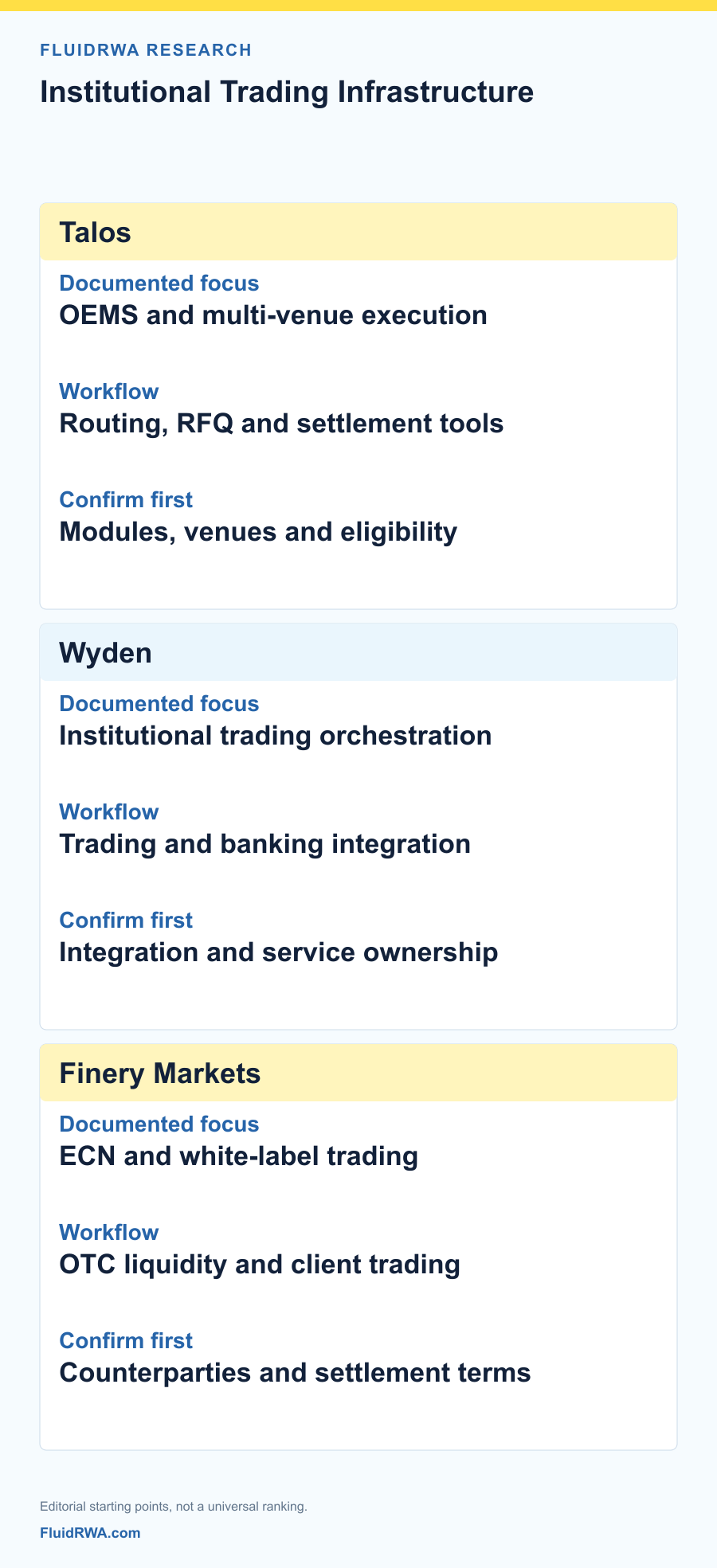
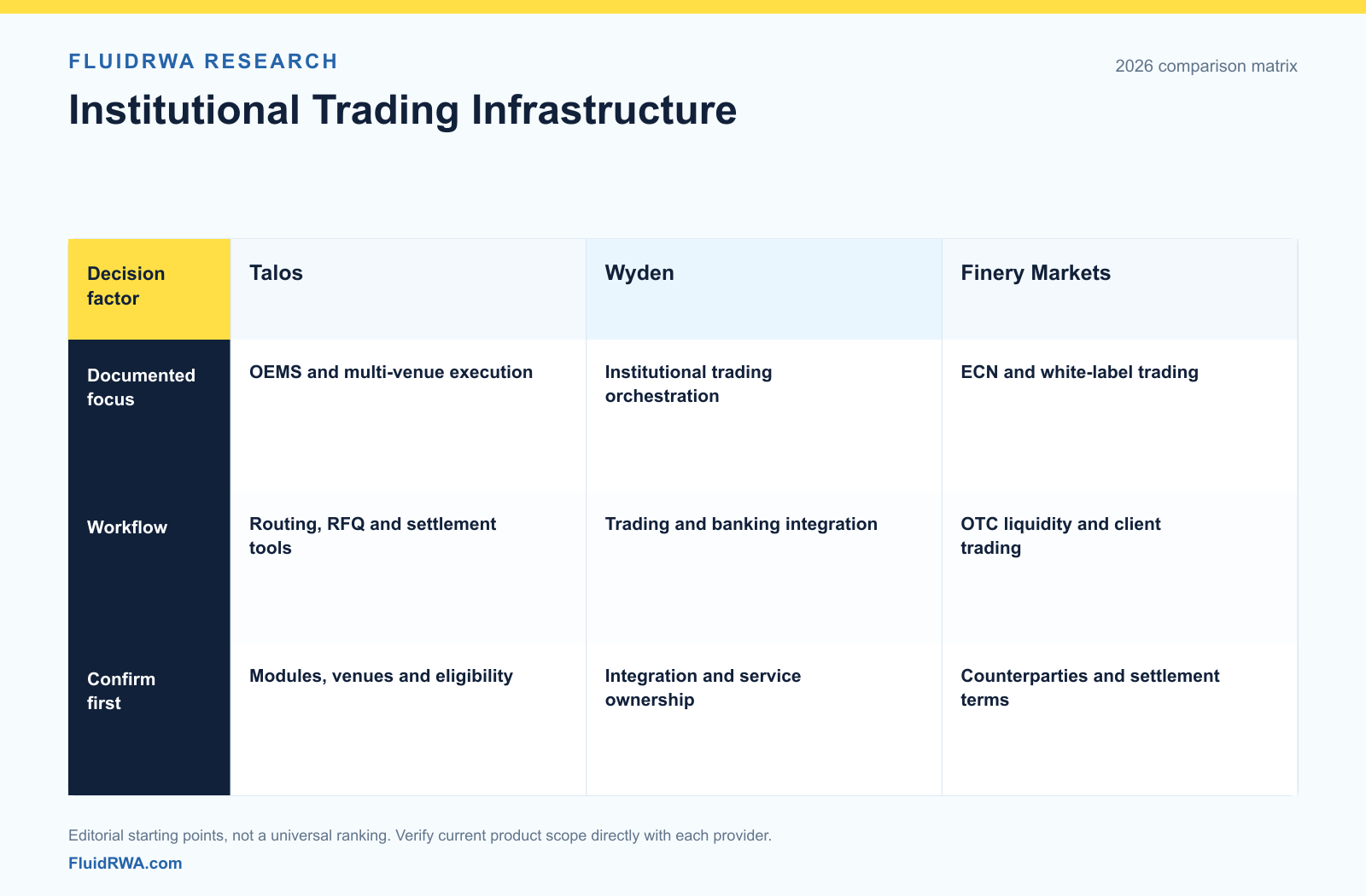
| Decision factor | Talos | Wyden | Finery Markets |
|---|---|---|---|
| Primary orientation | Institutional trading, portfolio, data and settlement technology | Unified trading and operating layer for banks and brokers | Crypto ECN, OTC workflows and trading SaaS |
| Execution | Algorithms, smart order routing, RFQ and multi-venue execution | OEMS, smart order routing and best-execution orchestration | Order book, quote streams and RFQ |
| Lifecycle breadth | Pre-trade through execution, portfolio, treasury and settlement | Front, middle and back office including accounting connections | Trading cycle, liquidity and post-trade workflows |
| White label | APIs and white-label interfaces for client offerings | Retail and institutional brokerage configurations | ECN-as-a-Service and branded trading platform |
| Good fit | Asset managers, hedge funds, brokers, banks and OTC desks | Banks and brokers integrating core banking and custody | Crypto businesses and institutions prioritizing OTC liquidity |
| Main diligence point | Module scope, venue eligibility and total implementation | Bank integration, outsourcing controls and deployment model | Counterparty model, settlement terms and jurisdictional availability |
The table is a starting point. “Supported” can mean generally available, available through a partner, limited to selected chains or entities, or dependent on a separate contract. Turn every important cell into a written acceptance criterion.
Vendor profiles
Talos
Talos presents an institutional platform covering connectivity, smart order routing, execution algorithms, RFQ, portfolio and risk management, treasury, settlement and post-trade analytics. Its breadth makes it relevant to both buy-side and sell-side institutions.
Good fit: Institutions seeking an integrated digital-asset trading stack with broad venue connectivity and capital-markets workflow depth.
Potential limitation: Buyers should avoid assuming every module or provider connection is included. Confirm instrument, venue, jurisdiction, custody and deployment scope in writing.
Wyden
Wyden positions its platform as a unified operating layer for banks and brokers. Public materials emphasize liquidity aggregation, best execution, custody and core-banking integration, settlement, reconciliation, accounting and institutional security controls.
Good fit: Regulated banks and brokers that need crypto trading to fit existing operational, accounting, risk and outsourcing frameworks.
Potential limitation: A crypto-native fund needing a narrower execution terminal may find the bank-grade orchestration scope heavier than necessary.
Finery Markets
Finery Markets describes a non-custodial crypto ECN supporting firm order books, quote streams and RFQ, alongside white-label and OTC-as-a-Service offerings. The emphasis is efficient interaction between institutional liquidity makers and takers.
Good fit: OTC desks, brokers and institutions that prioritize ECN market structure, liquidity distribution and branded trading services.
Potential limitation: Confirm how bilateral counterparties, credit, pre-funding, settlement, custody and legal venue access work for the buyer's entities.
Best fit by buyer scenario
| Buyer scenario | Likely starting point | Reason to investigate |
|---|---|---|
| Global asset manager | Talos | Portfolio, execution, analytics and settlement breadth are likely to matter more than a standalone venue. |
| Bank launching crypto brokerage | Wyden | Core-banking, custody, accounting and auditable orchestration are central to the operating model. |
| OTC desk distributing liquidity | Finery Markets | ECN, quote-stream and white-label workflows map directly to liquidity distribution. |
| Multi-venue hedge fund | Talos or Wyden | Benchmark latency, APIs, derivatives, risk, allocations and venue-specific funding constraints. |
| Regional broker | Wyden or Finery Markets | Choose based on whether full bank operations or market-access and white-label execution are the larger gap. |
These are shortlisting hypotheses. A regulated entity, startup and global institution can reach different conclusions even when they begin with the same use case.
How to validate the shortlist
- Test the hardest production workflow with realistic volume, failure and recovery scenarios.
- Confirm which features are generally available, partner-delivered or dependent on a separate contract.
- Price implementation, usage, support, overages and exit work, not only the subscription.
- Verify security scope, data handling, incident response, service levels and named delivery staff.
- Require usable exports for configuration, records and logs before signing.
Use these checks as procurement prompts, then validate regulatory and contractual conclusions with qualified advisers.
Primary sources
- Talos platform
- Talos trading
- Wyden institutional platform
- Wyden Infinity
- Finery Markets
- Finery Markets white label
FAQ
Which provider is best?
Choose Talos for broad institutional execution, portfolio and trade-lifecycle infrastructure; Wyden for bank and broker orchestration spanning front, middle and back office; and Finery Markets for non-custodial ECN, OTC and white-label liquidity workflows.
Can the providers be combined?
They can sometimes serve complementary layers, but buyers should remove duplicated controls and assign a single owner for each policy, record and incident action.
Is public pricing enough to estimate cost?
No. Request current enterprise pricing for implementation, usage, support, integrations, overages and exit assistance, then add internal operating cost.
What should be tested before signing?
Test the hardest production workflow, prohibited actions, dependency failure, retries, recovery, reporting and data export with realistic scale.
Does vendor use transfer regulatory responsibility?
No. The buyer should obtain advice on its own custody, data, outsourcing, settlement, consumer and compliance obligations.
How should roadmap features be scored?
Treat them as unavailable unless delivery timing and acceptance criteria are contractually committed.
What is the most important exit question?
Ask whether configuration, records, logs and identifiers can be exported in usable formats without losing operational continuity.
How current is this comparison?
The comparison summary and primary references were checked on October 10, 2026. Verify current availability and contracting scope directly before procurement.
Compare institutional trading vendors
Build a shortlist around your architecture, controls and operating model.