Solidus Labs HALO, Eventus Validus and Nasdaq Surveillance publicly describe trade or market surveillance capabilities relevant to digital assets. The decision depends on the buyer's venue, order and trade data, alert investigation workflow and required records. Public product descriptions do not establish detection accuracy or regulatory approval for a proposed deployment.
What should a digital-asset venue compare first?
Define the market being monitored: tokenized securities, spot crypto, derivatives or a combination. A tool cannot reconstruct behavior from data it never receives. Map order entry, amendments, cancellations, executions, account identities and any relevant onchain transfers before comparing alert labels.
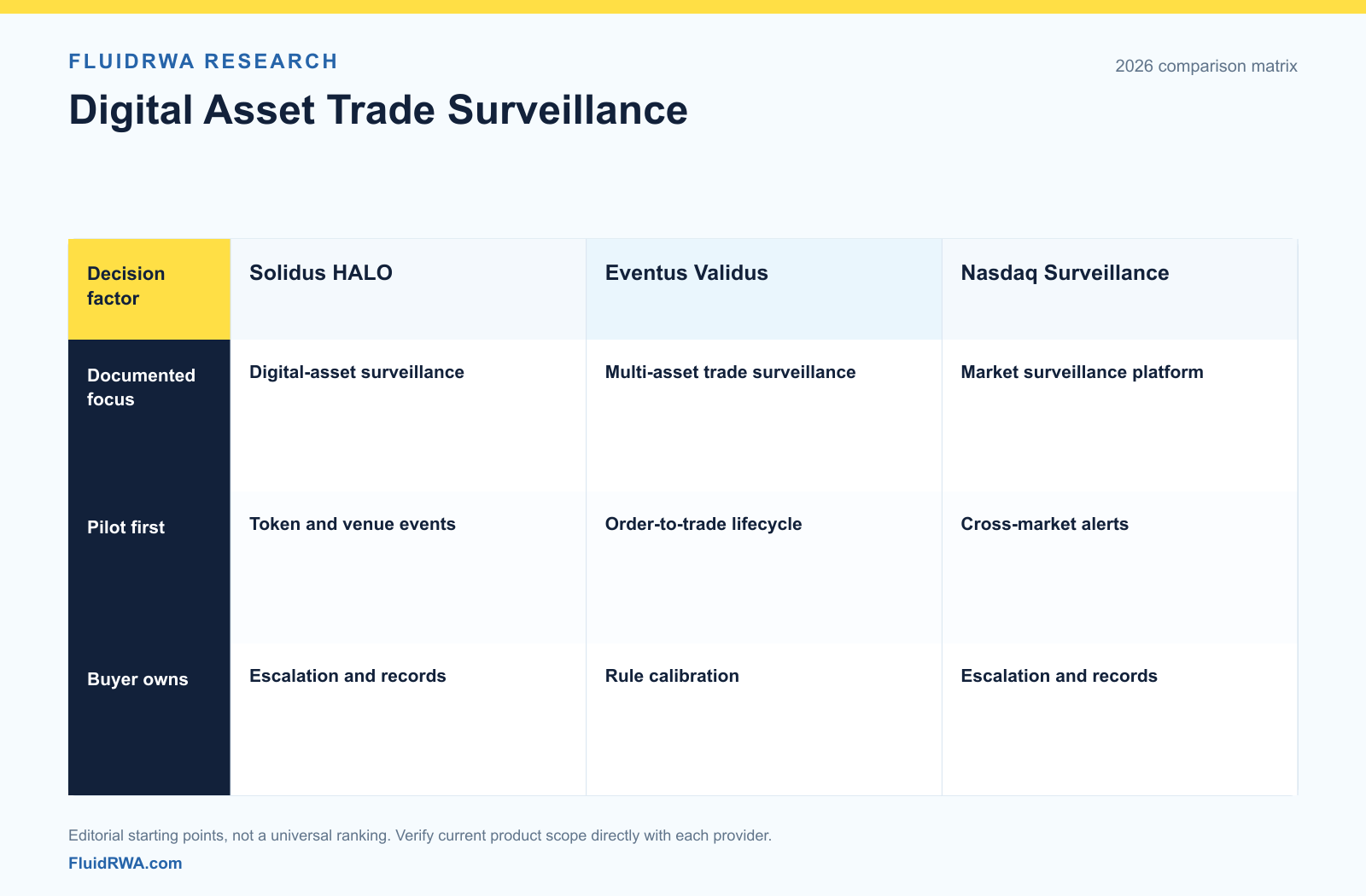
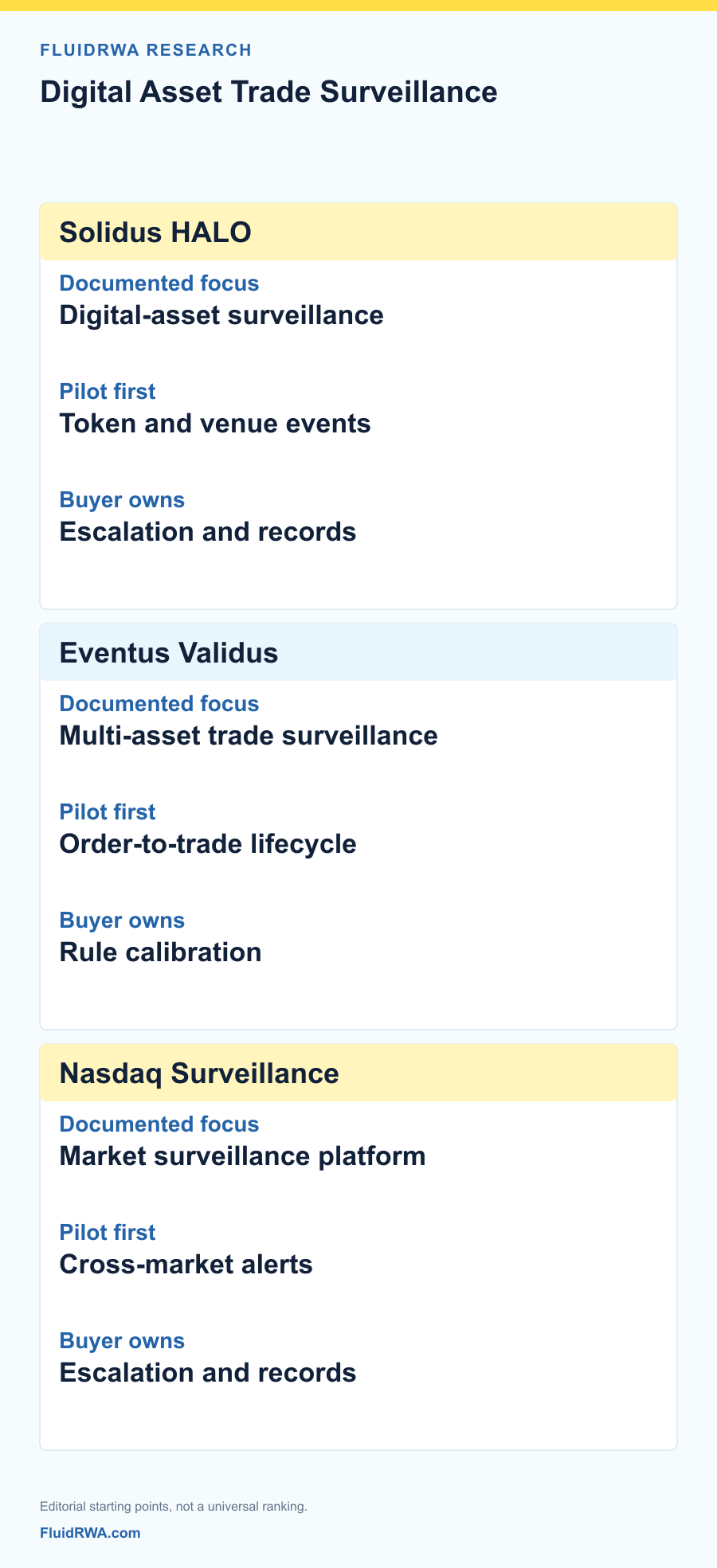
The three providers below have public product documentation relevant to trade surveillance. This is a buyer-workflow comparison, not a ranking, performance test or statement of regulator endorsement. It also differs from blockchain analytics comparisons, which primarily address financial-crime and onchain investigation tasks.
Comparison table
| Buyer question | Solidus Labs HALO | Eventus Validus | Nasdaq Surveillance |
|---|---|---|---|
| Documented starting point | Digital-asset exchange surveillance | Validus multi-asset surveillance | Trade and market surveillance, including digital assets |
| First pilot | Match venue trades to token/account context | Replay order-to-trade lifecycle and case review | Trace alerts across market and participant records |
| Buyer-owned control | Investigation and disposition policy | Rule calibration and case escalation | Investigation, retention and reporting |
| Not verified here | Detection rate in the buyer's venue | Detection rate in the buyer's venue | Detection rate in the buyer's venue |
Public descriptions are not proof that a capability exists in every contracted module or region. “Not verified” is not “not offered.”
Solidus Labs HALO: investigate venue-specific behavior
Solidus Labs describes HALO for digital-asset exchange surveillance, including trade surveillance and investigation. That makes it relevant where a venue must join account activity to orders, executions and possibly token or onchain context. Ask for an exact data dictionary and demonstrate how a flagged sequence becomes a reviewable case. A vendor announcement about a client selection should not be confused with independent proof of detection quality.
Eventus Validus: connect the order lifecycle to cases
Eventus describes Validus across multiple asset classes and the order/trade lifecycle; its crypto exchange materials describe the digital-asset use. A useful pilot deliberately includes amendments, cancellations and executions across related accounts. Verify whether investigators can replay why an alert fired and export the underlying evidence under the proposed contract.
Nasdaq Surveillance: define the product and data perimeter
Nasdaq's surveillance product page includes digital and tokenized assets among the markets addressed. That does not mean a buyer receives every feed or module by default. Ask Nasdaq to show coverage for the exact venue type, asset, jurisdiction and event set. For a tokenized security, distinguish primary issuance events from secondary market orders and off-venue transfers; each may have a different operator and record.
A defensible evaluation
Create a synthetic dataset with normal trading, a suspected wash-trade pattern, a cancellation-heavy sequence and a false-positive example. Give each provider the same event fields, historical window and data-quality gaps. Evaluate: (1) what events were actually ingested, (2) why an alert fired, (3) what an investigator can change, (4) how dispositions are audited, and (5) how retained evidence can be exported. Do not turn a small pilot into a universal accuracy ranking.
| Procurement question | Why it matters |
|---|---|
| Which data fields are mandatory? | Missing client or order identifiers can make patterns uninterpretable. |
| Which surveillance scenarios are configured? | A brochure category is not a tuned production rule. |
| How are rules changed and approved? | A silent configuration change alters the meaning of alert trends. |
| How are alerts linked to an investigation? | Regulators and internal reviewers need an auditable decision trail. |
| What is retained and where? | Market records can contain confidential client information. |
FluidRWA interpretation: the platform should make the venue's judgment explainable; it does not replace that judgment. Last checked October 15, 2026. Company documentation supports product positioning; no detection benchmark or assurance opinion was performed.
FAQ
Is trade surveillance the same as wallet AML screening?
No. Surveillance examines market, order and trade behavior; wallet screening evaluates addresses, counterparties or onchain exposure. Some products may span both, but buyers should test each control separately.
Which platform catches more market abuse?
This review did not run a detection benchmark. Compare against a labeled pilot set, false-positive workload, data quality and the investigation evidence your team needs.
Does a surveillance platform make a venue compliant?
No. A venue remains responsible for its controls, policies, escalation, reporting and jurisdiction-specific obligations.
Define your surveillance brief
Share your market model and data sources, or email contact@fluidrwa.com.