Docusign, OneSpan Sign and Adobe Acrobat Sign document electronic agreement workflows that can support investor subscription processes. Compare the complete evidence trail: signer identity, document version, authorized signature, counter-signature, acceptance, storage and correction. A completed e-signature does not itself establish investor eligibility or issuance of a token.
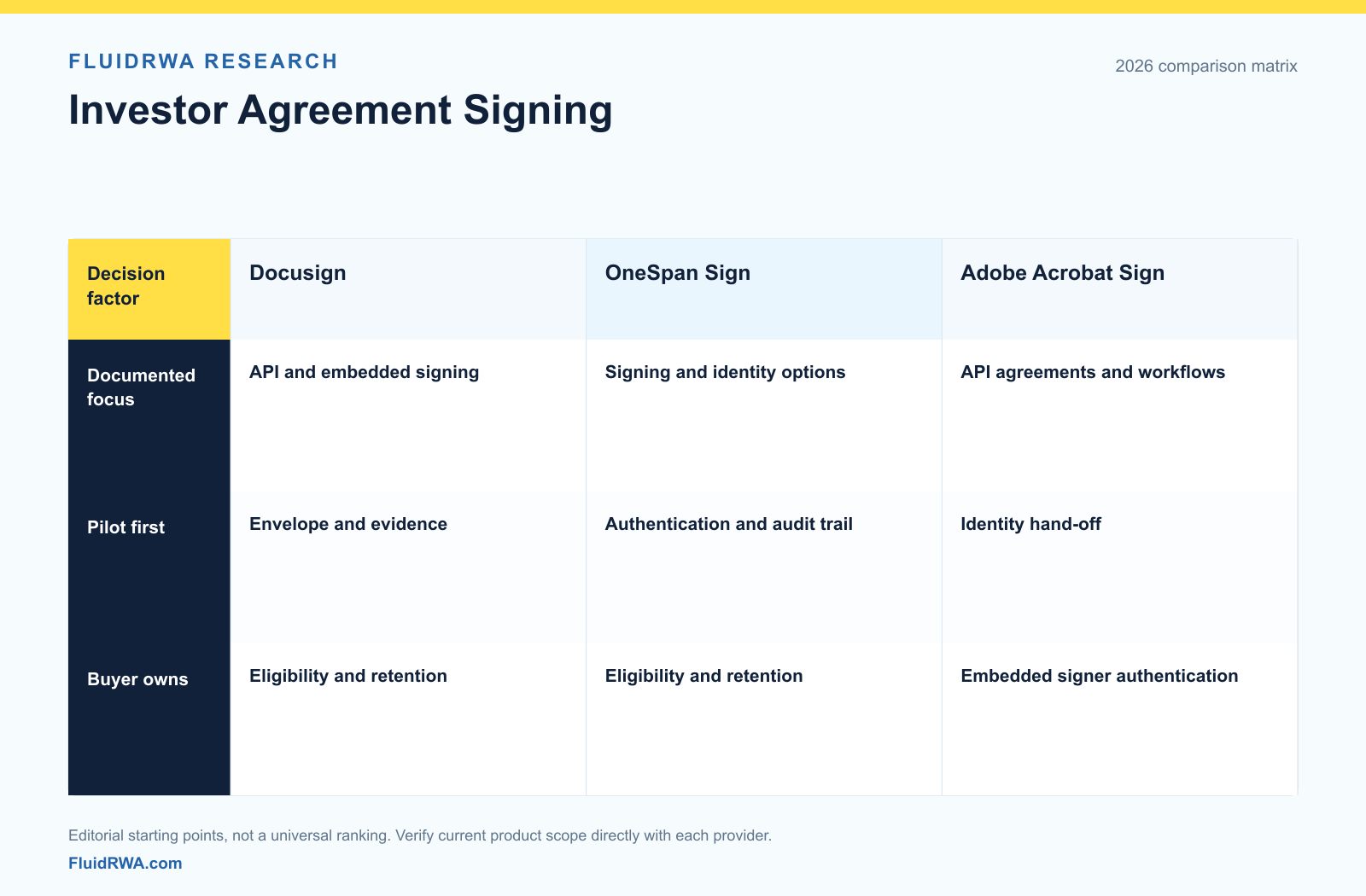
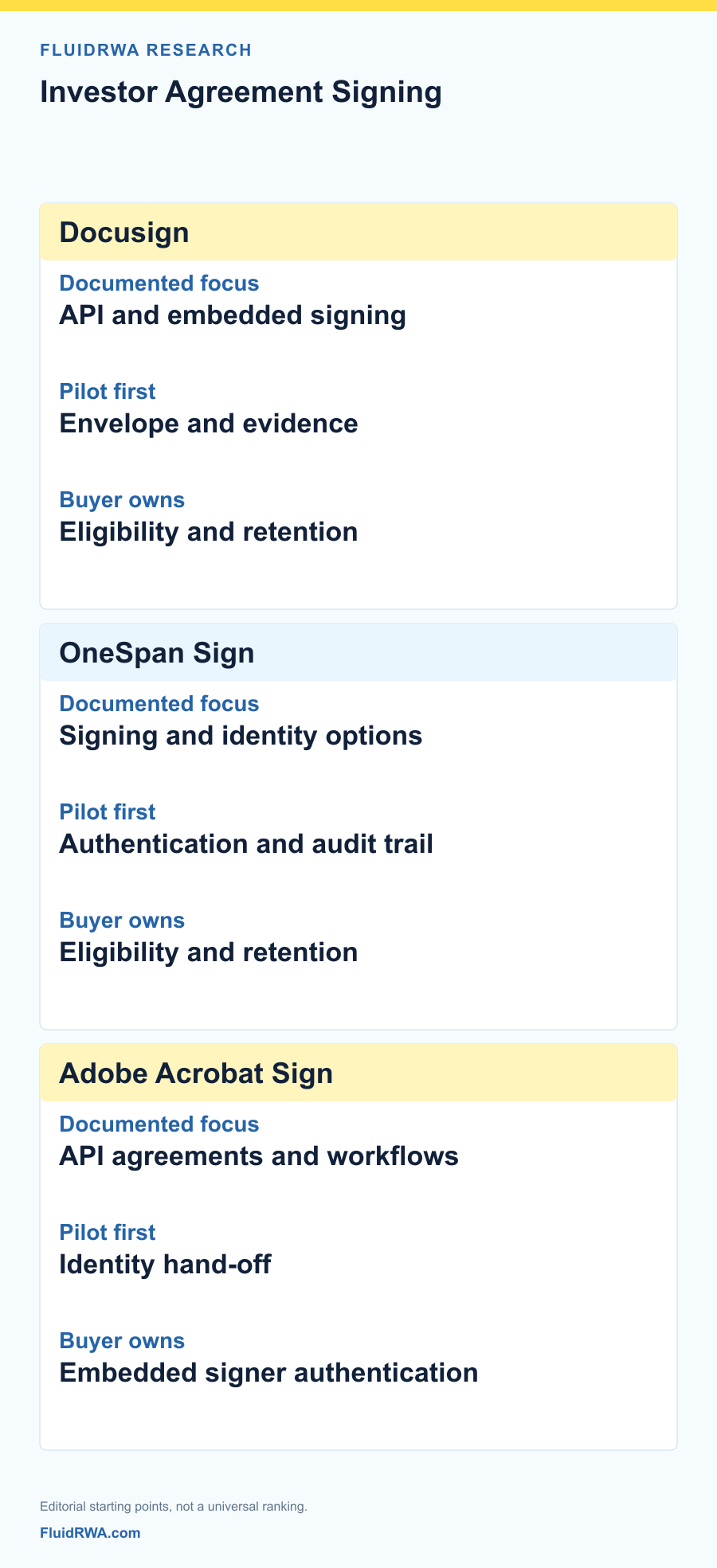
What should a tokenization platform compare in e-signing?
The buyer task is not merely to put a signature field on a PDF. A subscription package can involve an investor application, entity-authority evidence, risk disclosures, suitability or accreditation checks, manager acceptance and a definitive ownership record. Electronic signing covers part of that chain. A signed package should be traceable to the correct investor and document version, including when the application is abandoned or corrected.
These three services have official documentation for agreement workflows. They are not ranked, and this review did not test legal enforceability, completion rates or contractual pricing.
Comparison table
| Buyer question | Docusign | OneSpan Sign | Adobe Acrobat Sign |
|---|---|---|---|
| Documented integration | eSignature REST API and embedded signing | Electronic signature and authentication features | Acrobat Sign API agreements and workflows |
| First pilot | Correct an envelope after a signer exception | Authenticate a signer and export the audit trail | Embed signing and test app-side identity hand-off |
| Buyer-owned control | Eligibility, acceptance and record linkage | Eligibility, acceptance and record linkage | App authentication for embedded signing, plus record linkage |
| Not verified | Customer-specific legal suitability or completion rate | Customer-specific legal suitability or completion rate | Customer-specific legal suitability or completion rate |
The table describes documented starting points. A missing detail is not verified, not proof of an absent feature. Product editions, regions and authentication options should be confirmed in a written proposal.
Docusign: separate embedded signing from investor approval
Docusign's developer guide explains embedded signing and envelope workflows. For a tokenized-fund application, test a signer who is invited, changes documents, requests a correction and completes the package. Record the envelope ID and document version against the investor application, but do not mint or allocate based on a generic “signed” event without acceptance controls. Docusign also markets identity-verification options; verify contracted scope rather than treating every identity method as included.
OneSpan Sign: inspect authentication and evidence
OneSpan Sign's product documentation and feature descriptions discuss signing, authentication and audit evidence. Pilot an entity investor with an authorized signatory and a second approver. Request the resulting document, audit record and event export, and check how the platform handles signatory replacement. Some publicly described features are marked as forthcoming, so confirm actual availability for the proposed edition before contracting.
Adobe Acrobat Sign: define the embedding boundary
Adobe's developer guide describes creating agreements and tracking them via API. Its embedded signing guidance calls attention to signer authentication by the embedding application. This is a concrete integration risk: an application may display a valid signing ceremony to the wrong logged-in person if session and identity controls are weak. Pilot session expiration, shared-device use and a mismatched investor account.
The control sequence to verify
- Match the investor or entity to an authorized signer and applicable offering documents.
- Preserve the exact document version and consent path presented to the signer.
- Record signature, exceptions, counter-signature and final acceptance as separate states.
- Retain the signed package and provider evidence under your retention policy.
- Reconcile acceptance with funding and the authoritative share or token record.
Ask each provider about API permissions, webhook retries, data residency, document export, access revocation and evidence retention. Check what changes when the investor signs on a phone. The final issuance state must be governed by the investment product's documents and operations, not just by an e-sign webhook. For identity checks, see the separate accreditation workflow comparison.
Last checked October 15, 2026. Vendor documentation is treated as company evidence. FluidRWA's pilot prompts are recommendations, not results of a performed test or legal advice.
FAQ
Does a signed subscription agreement mean an investor owns tokens?
No. Acceptance, payment, eligibility, allocation and authoritative ownership records may be separate steps governed by the product documents.
Who authenticates an embedded signer?
It depends on the integration. Adobe's embedded-signing documentation explicitly warns that authentication responsibility can rest with the embedding application. Confirm the exact provider and application boundary in every pilot.
Which signing provider is legally best for tokenized securities?
This review makes no legal enforceability ranking. Counsel must assess document, jurisdiction, consent, evidence and retention requirements for the proposed offering.
Design your subscription workflow
Share the documents, jurisdictions and investor path you need, or email contact@fluidrwa.com.