Rise documents separate contractor, employer-of-record and direct US payroll products. Franklin describes crypto payroll and stablecoin-funded bank payroll. Request Finance documents salary-payment creation and crypto-to-bank disbursement. Compare the employment service and payment rail separately: executing a net salary transfer does not establish that a provider calculates tax, employs the worker or files local payroll returns.
Which crypto payroll model do you actually need?
Start with the obligation, not the token. Paying an approved contractor invoice, calculating employee withholding and legally employing someone abroad are different purchases. A product can support one without establishing the others. This comparison addresses those operating boundaries rather than ranking providers by an untested cost or speed claim.
The cohort comprises three providers with public payroll-related documentation. It is not an exhaustive market survey. Product descriptions below are company evidence reviewed on October 21, 2026; implementation tests are FluidRWA recommendations. No authenticated account, live payroll run or legal eligibility assessment was performed.
Rise vs Franklin vs Request Finance comparison
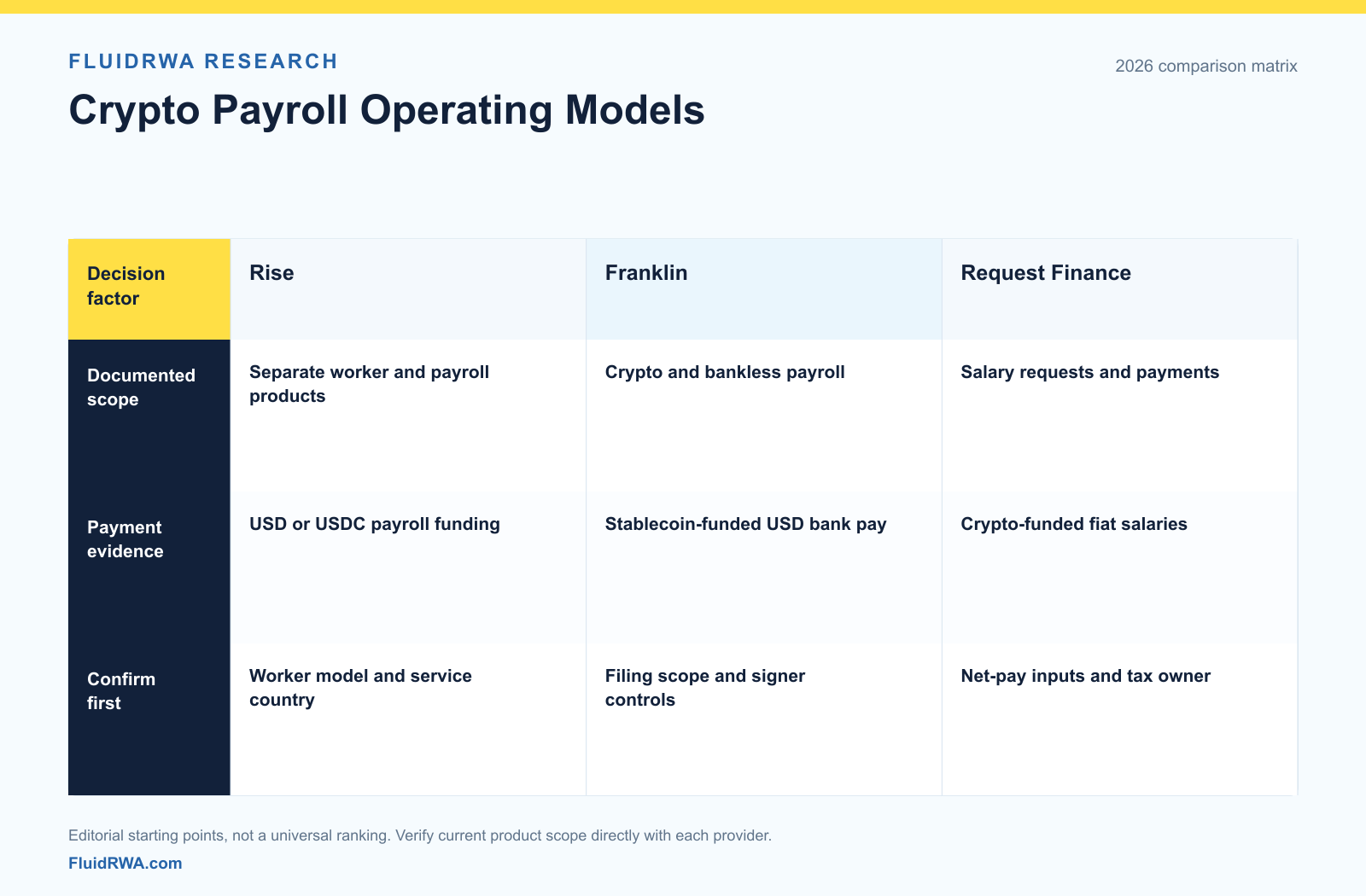
| Buyer question | Rise | Franklin | Request Finance |
|---|---|---|---|
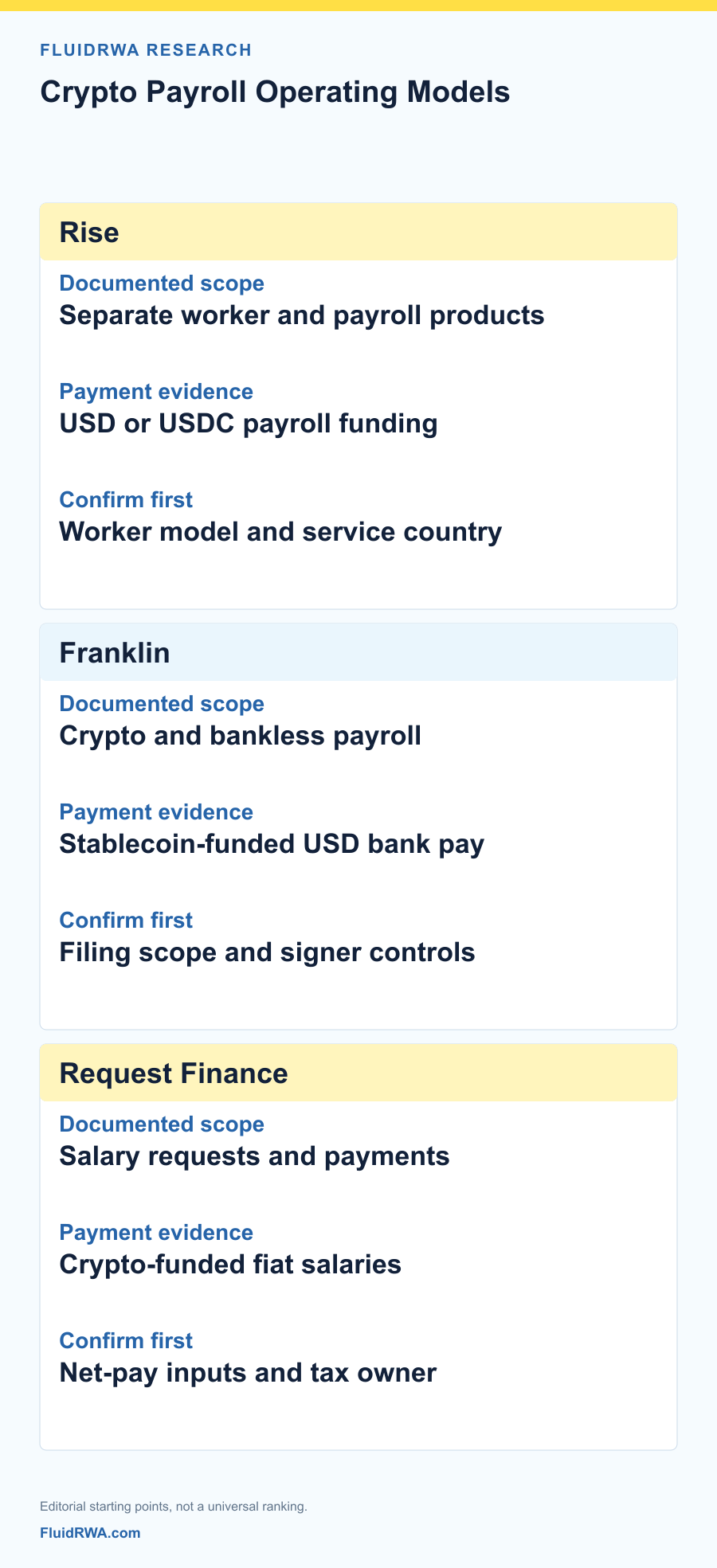
| What is documented? | Separate employment and contractor products, including direct US payroll | Crypto payroll and stablecoin-funded Bankless Payroll | Salary-payment API and payroll disbursement workflows |
| Funding and payout evidence | Direct payroll describes USD or USDC funding and recipient withdrawal choices | Bankless Payroll describes stablecoin funding and USD bank payouts | Help guide describes crypto-funded fiat salary payments |
| Employment boundary | Identify the particular contractor, EOR or direct-payroll contract | Confirm the US payroll service and worker classification | Payment functionality alone does not establish employment or tax filing |
| Technical evidence | Product-level onboarding and payroll workflow | Wallet-signing and batch-payment description | Salary requests use invoice infrastructure with salary-specific metadata |
| Critical diligence | Worker country and contracted employment model | Filing scope, signer controls and payout exceptions | Who supplies approved net pay and owns withholding and filings? |
Rise: separate the worker model from the withdrawal method
Rise's direct US payroll page describes onboarding hires, funding with USD or USDC, payroll execution and tax calculation, filing and payment. The same page describes recipients using a Rise wallet and choosing withdrawals. These are statements about that product, not proof of identical coverage under every Rise service. Rise direct US payroll.
Rise also distinguishes contractor pay, agent-of-record, EOR and direct-payroll products in its solutions material. A buyer should therefore request the named service, legal counterparty and supported worker location before comparing payment preferences. Do not treat an advertised contractor footprint as an EOR footprint. Rise product distinctions.
Request evidence: an onboarding checklist for the actual worker type, a sample pay statement, the service's tax responsibility schedule and a worked example of a failed withdrawal. Those artifacts answer more than a map showing nominal country coverage.
Franklin: examine stablecoin funding and bank payout separately
Franklin's crypto payroll page describes a non-custodial payment experience and batch execution. Its Bankless Payroll announcement describes an employer funding payroll in stablecoins while employees receive USD in bank accounts, with tax withholding and payments included in the described service. That does not establish that every country or worker arrangement is supported. Franklin crypto payroll, Bankless Payroll announcement.
Request evidence: which wallet authorizes funding, when funds leave that wallet, which party converts to bank money, and how payroll is handled if the bank leg is rejected. Ask whether tax-related obligations remain funded and scheduled when one employee payment fails. This is a diligence question, not a statement about Franklin's internal exception handling.
Request Finance: distinguish a salary request from statutory payroll
The salary API explains how to create salary payments through invoice infrastructure using salary-specific metadata. Its help centre separately documents crypto-funded fiat salaries and downloadable payment receipts. These are useful payment and recordkeeping functions, but they do not by themselves prove employer services or global tax calculation. Request salary API, fiat salary payment workflow.
Request evidence: who supplies approved net salary amounts, how payroll identifiers reach the accounting export, what a pending versus completed payout means, and which party corrects rejected beneficiary details. Keep access to payslips, tax returns and payment receipts distinct: they serve different purposes.
What should the responsibility matrix contain?
Name an owner for worker classification, employment contracts, gross-to-net calculation, tax filing, funding approval, beneficiary changes, payment execution, complaints and record retention. Then attach the relevant country and product agreement to each owner. A checkbox marked compliance is not a substitute for that matrix.
Run the same small test batch with each shortlisted service: one supported employee or contractor, a separate approval role and a controlled rejection scenario. Compare complete records and manual interventions, not just whether a transaction hash appears. For a bank payout, reconcile the approved obligation to the final bank outcome as well as the stablecoin funding transfer.
How should you measure the pilot?
- Record the proportion of approved obligations that reach their intended final state.
- Include failures and retries when measuring operational workload.
- Count unmatched payment references at accounting close.
- Check whether a changed beneficiary requires fresh authorization.
- Confirm historical exports remain accessible under the proposed exit terms.
These are proposed procurement measures, not published vendor benchmarks. No universal winner, fixed price or guaranteed settlement time is asserted.
For adjacent infrastructure, review fiat on/off-ramp providers and custody providers. This page covers compensation operations, not a general business-payments ranking. Discuss your specific requirements at contact@fluidrwa.com.
FAQ
Does crypto payroll replace an employer of record?
No. A payment rail, direct payroll service and employer-of-record arrangement address different responsibilities. Require the applicable employment service and countries in writing.
Can stablecoin funding result in bank-account pay?
Franklin describes stablecoin-funded Bankless Payroll with USD bank payouts, while Request Finance documents crypto-funded fiat salary payments. Confirm eligibility, settlement terms and the exact asset and country combination.
Does Request Finance calculate every employee's payroll tax?
The reviewed salary API describes creating and paying salary requests. That does not establish gross-to-net tax calculation or statutory filings for every jurisdiction. Verify the contracted service rather than infer it from the word payroll.
What should a payroll proof of concept test?
Test approval, worker details, funding, a rejected bank payout, duplicate submission, changed wallet, reconciliation and access to historical records after termination.
Define your payroll payment requirements
Specify worker countries, employment model, funding assets, payout currencies and the records finance needs. You can also email contact@fluidrwa.com.