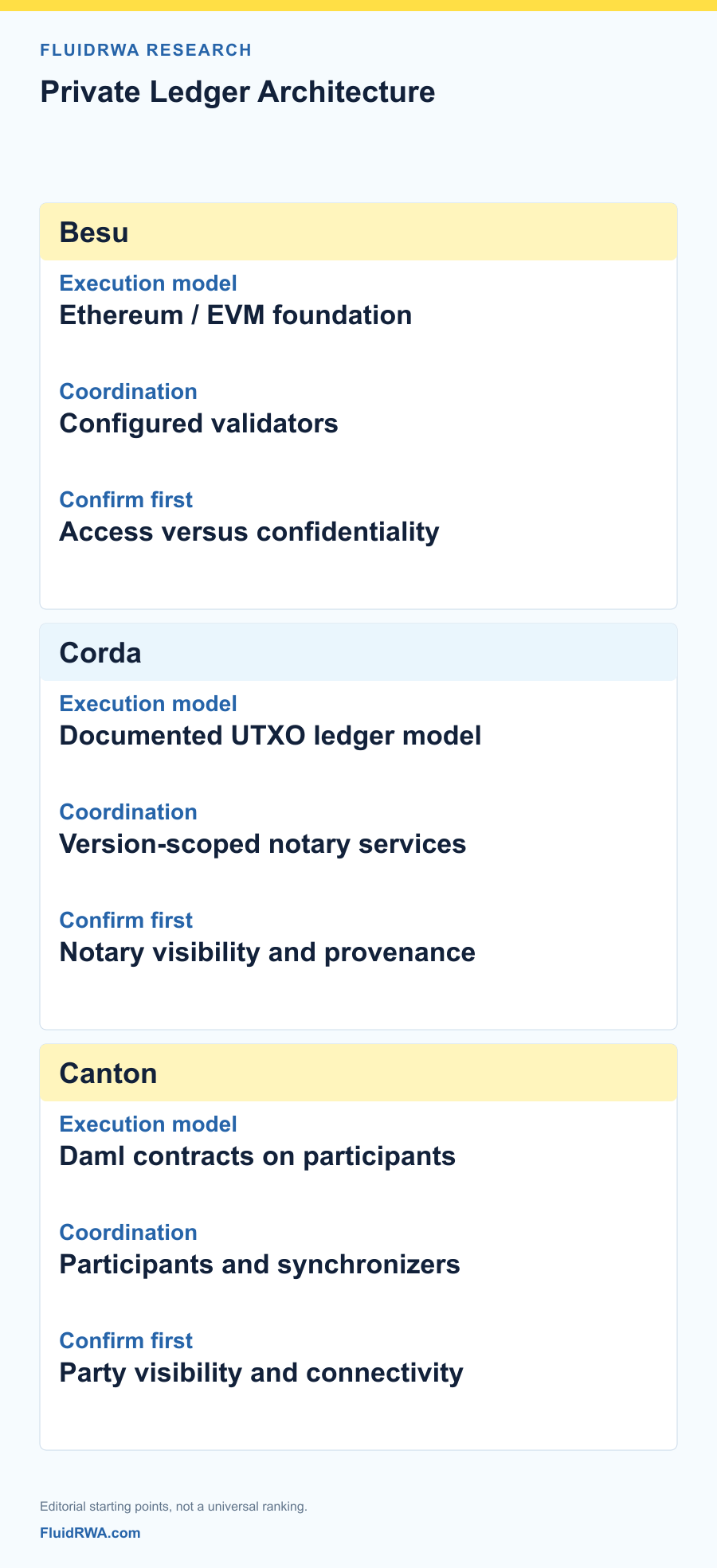
Besu provides an Ethereum execution-client foundation for permissioned networks. Corda's documented UTXO model uses transaction states and notary services. Canton runs Daml contracts through participants and synchronizers with party-specific visibility. Select the execution and trust model first; a permissioned network does not automatically give transaction confidentiality, shared liquidity or legal settlement finality.
What is the real choice between Besu, Corda and Canton?
The choice is how independent institutions execute shared business logic, agree transaction state and control who sees which information. It is not a contest between three identical hosted products. This comparison focuses on private-ledger architecture for financial applications, not the public-chain asset coverage addressed in our Canton, Polymesh and Provenance comparison.
The scope is public Besu private-network documentation, Corda 5.2 notary documentation and Digital Asset's Canton participant documentation. These are version-scoped technical records reviewed on October 21, 2026, not a benchmark or a claim that every deployment uses the same configuration.
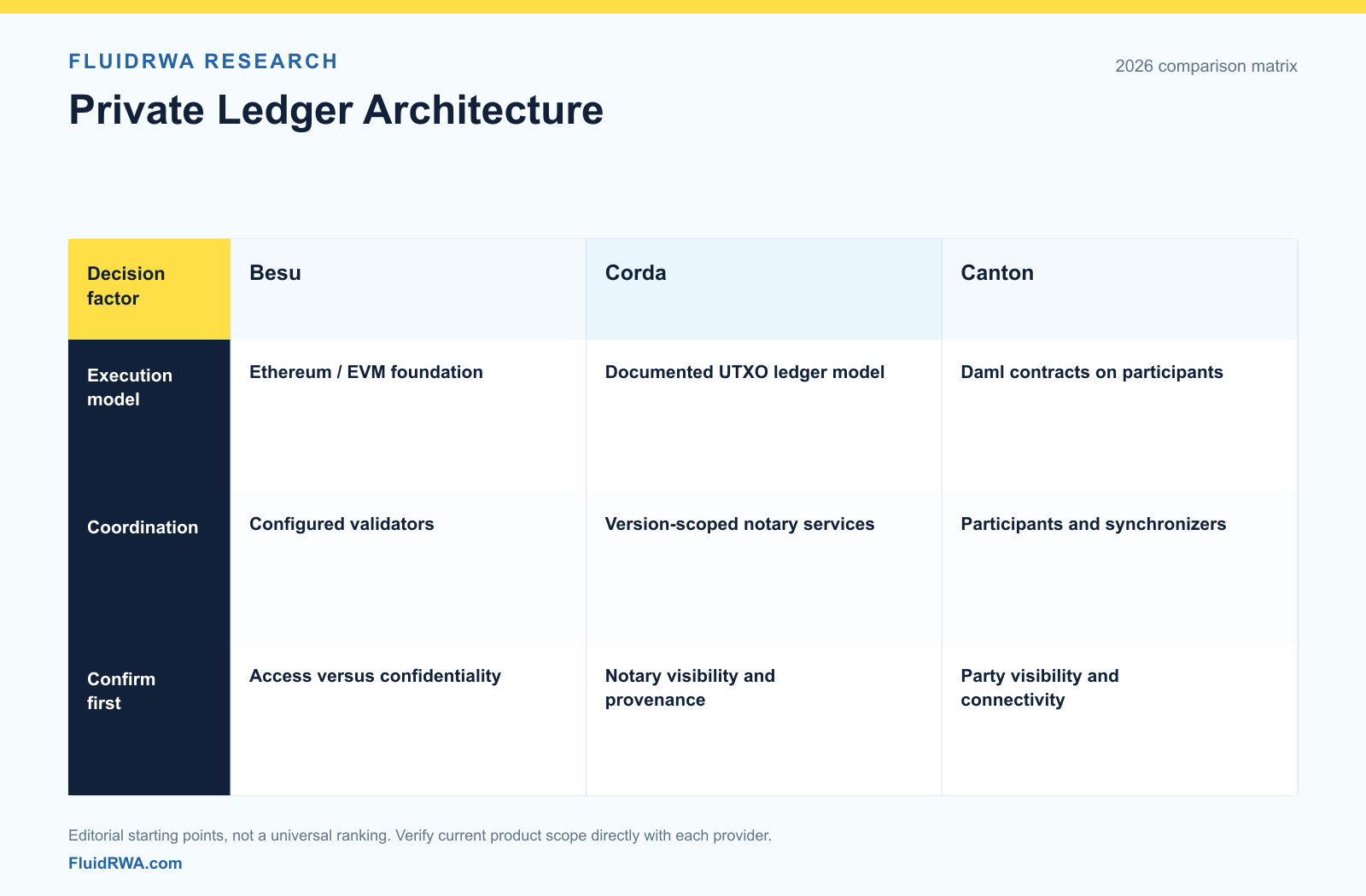
Besu vs Corda vs Canton comparison
| Architecture question | Besu private network | Corda documented UTXO model | Canton |
|---|---|---|---|
| Execution foundation | Ethereum execution client and EVM application model | States, contracts and transaction workflows | Daml contracts executed by participant nodes |
| Coordination | Configured validators; private-network consensus options | Notary services prevent reuse of consumed states | Participants coordinate through synchronizers |
| Visibility question | Define access and transaction confidentiality separately | Privacy and provenance depend partly on notary design | Party-specific contract visibility and authorization |
| Operating decision | Validator governance and client/network configuration | Notary trust, application-network operation and history | Participant operation, synchronizer connections and application access |
| Evidence to request | Exact version, security design and recovery test | Exact ledger/notary protocol and data disclosed to it | Parties, observers, synchronizer scope and failure behavior |
Besu: a permissioned Ethereum foundation is not a complete financial application
Besu's private-network documentation describes configurable private networks using proof-of-authority options. Its developer quickstart creates a local QBFT network and expressly warns that the demonstration is not intended for production. A working local network therefore demonstrates a development environment, not a secure institutional deployment. Besu private networks, developer quickstart.
Buyer test: map validator ownership, membership changes and recovery authority. Show what an ordinary member node can read before assuming that closed membership makes bilateral trades confidential. Ask the implementation provider to explain contract upgrades and how payment and security records remain aligned during a failed transaction.
Corda: specify the notary model, not just the product name
Corda 5.2's non-validating notary documentation describes a protocol that limits the information supplied to that service. Its transaction-privacy enhancement documentation explains an alternative contract-verifying approach with different visibility and provenance trade-offs. It explicitly describes more transaction-content exposure to the notary in that model. Non-validating notary, transaction privacy enhancements.
Buyer test: require a data-flow diagram for the proposed version and protocol. Identify who sees a transaction, its dependencies and any retained history. Ask what changes when a new institution receives a state whose history it does not yet possess. Do not carry assumptions from another Corda release or notary configuration into the proposal.
Canton: participant privacy and network connectivity need separate decisions
Digital Asset describes a Canton participant as a party-specific execution and storage environment for Daml contracts. Participants use synchronizers to exchange and order protocol messages. The documentation distinguishes participant responsibilities from synchronizer coordination, and describes connections to more than one synchronizer. Canton participant architecture, multiple synchronizers.
Buyer test: enumerate parties, observers, hosted identities and the transactions each can initiate. Then test an unauthorized observer, an unavailable participant and the proposed synchronizer failure scenario. Confirm how contracts move between relevant environments rather than assuming every application has access to every asset.
What should the proof of concept demonstrate?
Use one buyer task, such as issuing an entitlement, transferring it between approved parties and settling the cash obligation. Keep the legal and business requirements the same across proposals. The implementation should show both the successful transaction and a controlled failure before commitment.
Define the evidence that each institution needs after a failure: committed state, unspent cash, unchanged ownership, retry authority and the record available to its auditor. Treat these as acceptance criteria written by the buyer, not as advertised features that all providers automatically satisfy.
How should you compare cost and integration effort?
Separate software terms, hosting, node operations, implementation, external connectivity, monitoring, incident response and ongoing application changes. An open-source component does not make operation free, and a shared network does not remove local integration work. This page does not estimate vendor prices or claim a throughput winner.
Ask blockchain development companies for a proposal using the same transaction, participant map and failure tests. Keep smart-contract development, legal structuring and operational support as explicit workstreams. Send the proposed scope to contact@fluidrwa.com when you need help identifying the relevant provider categories.
FAQ
Are Besu, Corda and Canton interchangeable tokenization vendors?
No. They are ledger technologies with different execution, data and operating models. An implementation partner, application and legal framework are separate procurement decisions.
Does a private Besu network automatically hide transactions between members?
No. Network access controls and transaction-data confidentiality are different controls. Define the visibility needed and verify the complete chosen architecture.
Can Corda's notary see transaction data?
It depends on the notary protocol. The reviewed Corda 5.2 documentation distinguishes a non-validating notary from a contract-verifying approach that trades more notary visibility for other privacy and verification properties.
Does using Canton automatically connect an application to all assets?
No. Participation, application permissions, synchronizer connectivity and asset-specific rules must be established. Technology interoperability is not universal access or liquidity.
Define your institutional ledger requirements
Start with participants, privacy, asset rights and the payment leg. Email contact@fluidrwa.com or submit a project brief.