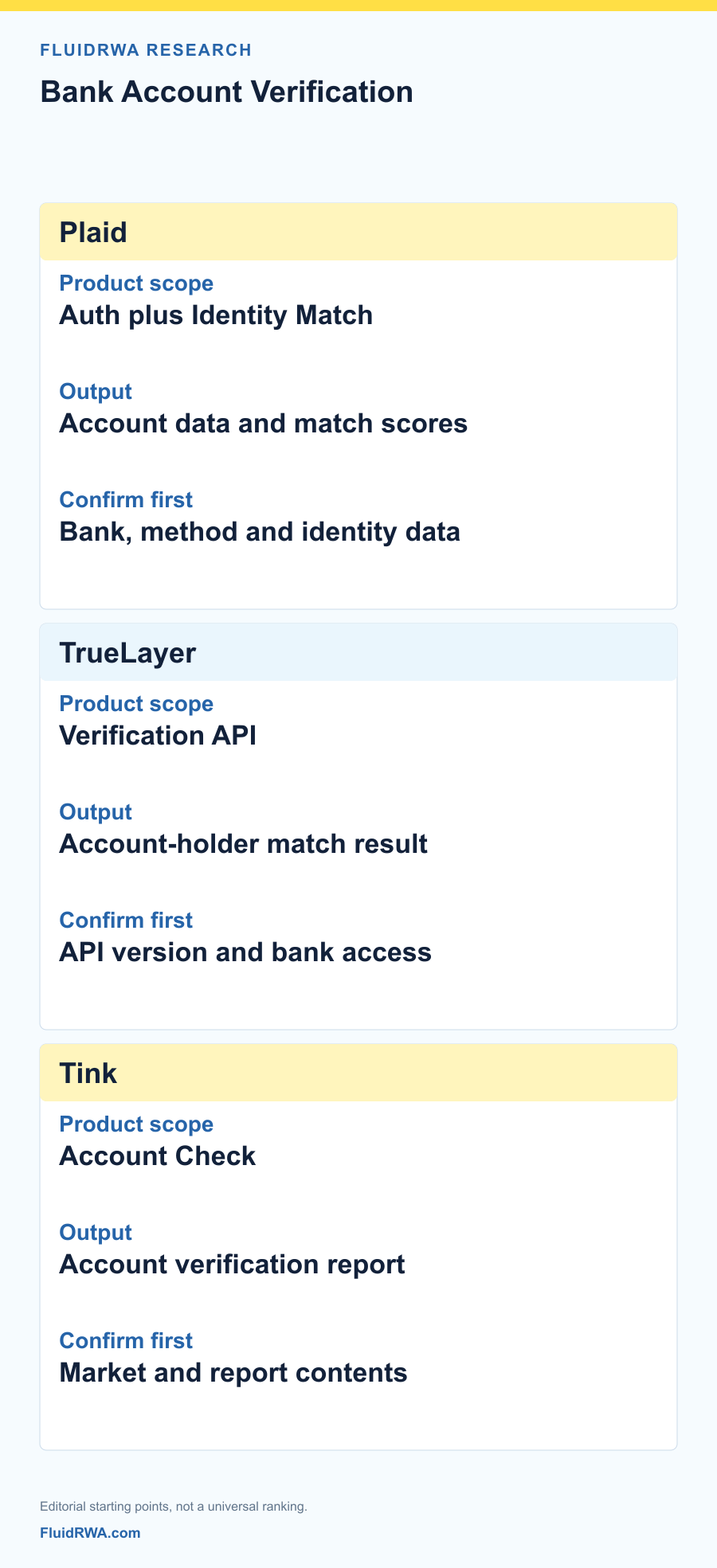
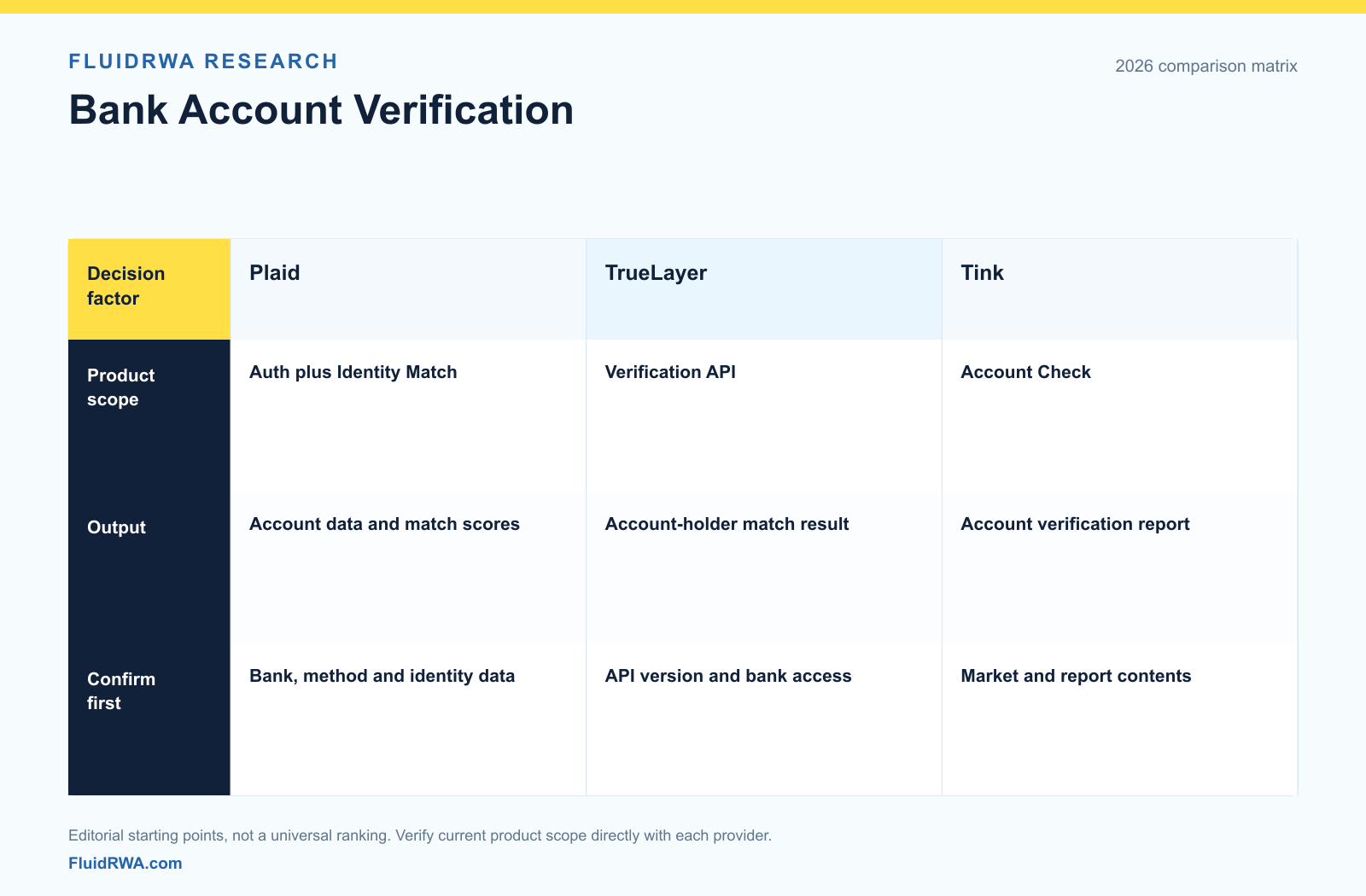
Compare Plaid Auth with Identity Match when account details and ownership matching need to connect to a funding processor; TrueLayer Verification when its bank-consent and account-holder matching flow fits the target providers; and Tink Account Check when a bank-authenticated account report fits the onboarding workflow. Select against the exact country, bank, account type and output required. Verification does not itself move funds or complete KYC.

What should a buyer compare first?
Start with the decision the platform must make: can this customer use this bank account for this funding or payout instruction? That decision needs more than a successful bank-login screen. It may need account identifiers, an ownership match, the customer's permission, evidence of the check and a policy for exceptions.
The three providers below are selected for publicly documented bank-account verification workflows. This page covers that specific layer. For investor funding after verification, use the fiat-to-stablecoin funding and redemption guide. For crypto checkout and KYC hand-offs, use the existing MoonPay, Transak and Banxa comparison.
Research basis: Official documentation checked October 19, 2026. Provider statements describe their products; FluidRWA did not benchmark bank coverage, fraud detection or conversion. Missing public evidence is recorded as a question for procurement.
Side-by-side comparison
| Buyer decision | Plaid Auth and Identity Match | TrueLayer Verification | Tink Account Check |
|---|---|---|---|
| Documented core task | Auth obtains eligible account details; Identity Match compares supplied identity data with institution records [1][2] | Compares a supplied name against names on connected accounts after consent and authentication [3] | Retrieves bank account and holder details through an account-check journey [5] |
| Customer connection | Plaid Link, with product and verification method configuration [1] | Auth link, bank authentication and access token for the documented flow [4] | Tink Link bank selection, consent and authentication [6] |
| Useful output | Account data plus relevant identity match scores; availability depends on configuration [1][2] | Match result and match score in the documented flow [3] | Account verification report identifier returned to the application [6] |
| Coverage check | Country, institution, account type and Auth method | Exact provider, version and production entitlement; the basics page lists UK, Germany and Spain in public beta [3] | Product-specific market and bank capabilities; a market selector alone is insufficient evidence |
| Money movement | Auth needs a processor; Transfer is a separate product [1] | Payment initiation and verification have separate API documentation [7] | Account Check and payment products have different purposes [5] |
| Business-account question | Which holder data and account types are returned? | Does the intended corporate bank and entity type support the selected flow? | Assess the separately documented Business Account Check product [8] |
| Main acceptance test | Unsupported bank, fallback method and incomplete ownership data | Partial match, match unavailable, consent failure and access denial | Report retrieval, user cancellation, bank error and incorrect account selection |
The tests in the final row are FluidRWA's proposed acceptance tests. They are not measured vendor results. The linked evidence is listed under References.
Plaid: account information and ownership matching are separate choices
Plaid's Auth guide describes retrieving details for eligible checking, savings and cash-management accounts, then using a payment processor to move money. That distinction matters when an investor portal wants to connect a bank account: acquiring account details is only one step before initiating and reconciling a payment. [1]
Plaid's Identity documentation separates retrieving institution-held identity information from matching supplied information and receiving scores. It also describes differences in compatibility between login-based and fallback account-verification methods. [2]
When to evaluate it: A team needs bank account details connected to an existing funding processor and wants explicit control over ownership-match policy.
What to ask: Show the exact response for each required account type and verification method. Which fields are absent? Can an account be linked while ownership data is unavailable? Which fallback paths preserve the same level of evidence? Ask operations to demonstrate the review queue as well as the successful journey.
Decision boundary: A usable account number, a strong identity match and a settled payment should have separate statuses in the platform. Combining them into one approved flag makes support and audit work harder.
TrueLayer: verify the product version and supported bank
The Verification API basics page describes obtaining consent, authenticating through the bank and matching a supplied name against account-holder data. At review it listed UK, Germany and Spain in public beta, with more countries on demand. That is a statement about this documented product, not the coverage of every TrueLayer service. [3]
The connection guide documents an auth-link journey and says an existing Data API customer needs a new client ID for the described Verification API flow. The reference also contains a newer account-holder verification endpoint with multiple result states. Buyers should have TrueLayer identify the intended version and migration path in writing. [4][9]
When to evaluate it: A team needs bank-authenticated account-holder matching in a supported production configuration, with an explicit decision on the verification and payment products it will use.
What to ask: Supply examples for a full match, partial match, no match, missing data and pending request. State which names the bank returns for a joint account and how consent cancellation affects a verification already underway. Confirm corporate-bank support separately.
Decision boundary: A product family's broad geographic presence should not be used to populate the bank-verification coverage matrix. Obtain the bank, country and account-type list for the exact contracted API.
Tink: build around the account report and its exceptions
Tink's Account Check page describes obtaining bank account identifiers and holder information. Its Tink Link reference documents a bank-selection, consent and authentication journey that returns an account verification report ID. The same reference describes cancellation and authentication errors, and lists version 1.0 as supported. [5][6]
Tink also documents Business Account Check as a separate way to connect to business accounts and obtain account data. Confirm its actual scope instead of assuming a personal-account setup will cover a company's treasury account. [8]
When to evaluate it: The onboarding process can use a bank-authenticated report and the required European bank and account configurations are confirmed.
What to ask: Demonstrate how the application retrieves the report after the customer returns, how it binds that report to the right user and account, and what happens when a customer closes the tab. Require a clear response when a report exists but does not contain enough ownership information for the platform's decision.
Decision boundary: A redirect containing a report ID is not the platform's final authorization to accept funds. The application needs to inspect the report and apply its own decision policy.
How should a tokenization platform use account verification?
Consider an investor who has passed identity checks and wants to fund a subscription from a bank account. The following is an illustrative design, not a deployment claim about any provider:
- Bind the verification session to the approved investor and a narrowly defined purpose.
- Let the investor choose an eligible bank account and give the required consent.
- Retrieve the result on the server and evaluate identifiers, holder data and match evidence.
- Route an uncertain result to a named reviewer or an appropriate fallback.
- Initiate the payment through the selected payment service after the required checks pass.
- Match the actual cash receipt to the subscription, bank account and verification evidence.
A return from the bank app can fail on mobile even when authentication completed. Preserve enough state to resume safely; avoid telling a customer to submit again before checking whether the original attempt succeeded. A payout bank change should trigger its own review rather than inherit the original funding account's approval.
What should the pilot measure?
Use the same bank and account cohorts across vendors. Record the date and the product configuration so results can be reproduced.
- Connection completion: Completed connections divided by eligible sessions started. Report unsupported banks separately.
- Evidence completeness: Results containing every required ownership field divided by completed connections.
- Decision time: Time from session start to the platform's usable approve, reject or review result.
- Review burden: Manual reviews and support contacts per completed onboarding journey.
- Payment outcome: Settled funding instructions and returned payments after verification, tracked separately from connection success.
These are proposed definitions, with no vendor performance numbers attached. Joint accounts, legal-name variations, unsupported business accounts, user cancellation and an unavailable bank should all appear in the test set. Do not exclude difficult cases merely to improve an aggregate conversion rate.
Which costs and responsibilities belong in the contract?
Ask for the unit charged: a started session, successful report, identity-match request or completed verification can produce different bills. Include retries, fallback methods, production support, data retention, payment processing and staff time. A comparable current price was not verified.
Assign ownership for consent records, deletion requests, false rejection complaints, bank outages and payout-account changes. Confirm which records the team can export if it changes providers. A useful exit package retains the meaning and date of each decision without retaining more bank information than the business is permitted to hold.
References and verification scope
All sources below are official product documentation reviewed October 19, 2026. Availability statements remain specific to the page, version and product described.
- Plaid: Introduction to Auth.
- Plaid: Introduction to Identity and Identity Match.
- TrueLayer: Verification API basics.
- TrueLayer: Connect an account for verification.
- Tink: Account Check.
- Tink: Link reference for Account Check.
- TrueLayer: API reference overview.
- Tink: Introduction to Business Account Check.
- TrueLayer: Get account holder verification, v3 reference.
For related infrastructure, explore fiat on/off-ramp providers and KYC and AML providers. Send a requirements brief or a documented company correction to contact@fluidrwa.com.
FAQ
Is bank account verification the same as KYC?
No. Account verification checks account information and, depending on the product, its relationship to a supplied identity. KYC can require identity documents, business ownership, sanctions screening and other checks beyond a bank connection.
Does Plaid Auth move money?
Plaid's Auth documentation says Auth supplies account information and must be used with a payment processor. Plaid Transfer is a separate money-movement product described as US-only in that documentation.
Are TrueLayer's payment countries the same as its Verification API countries?
Do not assume so. At review, the Verification API basics page specifically listed the UK, Germany and Spain in public beta, with further countries available on demand. Confirm the exact API version, bank coverage and production access.
Can Tink verify business accounts?
Tink documents a separate Business Account Check product. Business eligibility and bank-account ownership should be tested for the required market; a personal Account Check integration is not proof of corporate coverage.
What should happen when a name cannot be matched?
Keep no match, unavailable data and technical failure as separate results. Apply a documented review or fallback process, and prevent a bank change from bypassing the checks required before funding or payout.
Which provider has the lowest price?
A comparable current quote was not verified. Price the full journey, including attempts, retries, fallback verification, payment processing, manual reviews, support and data retention.
Find the right funding and onboarding infrastructure
Share the countries, account types and payment workflow you need. You can also email contact@fluidrwa.com.