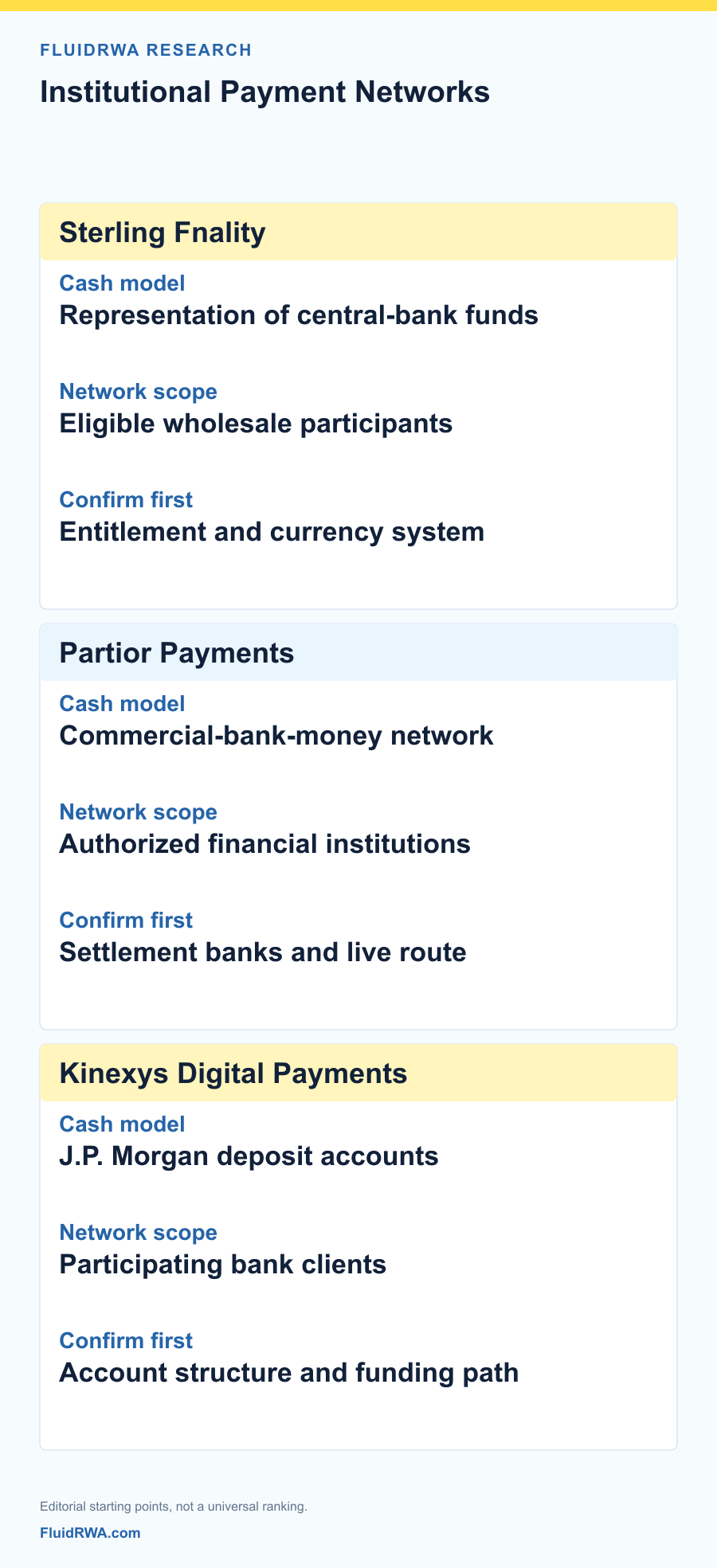
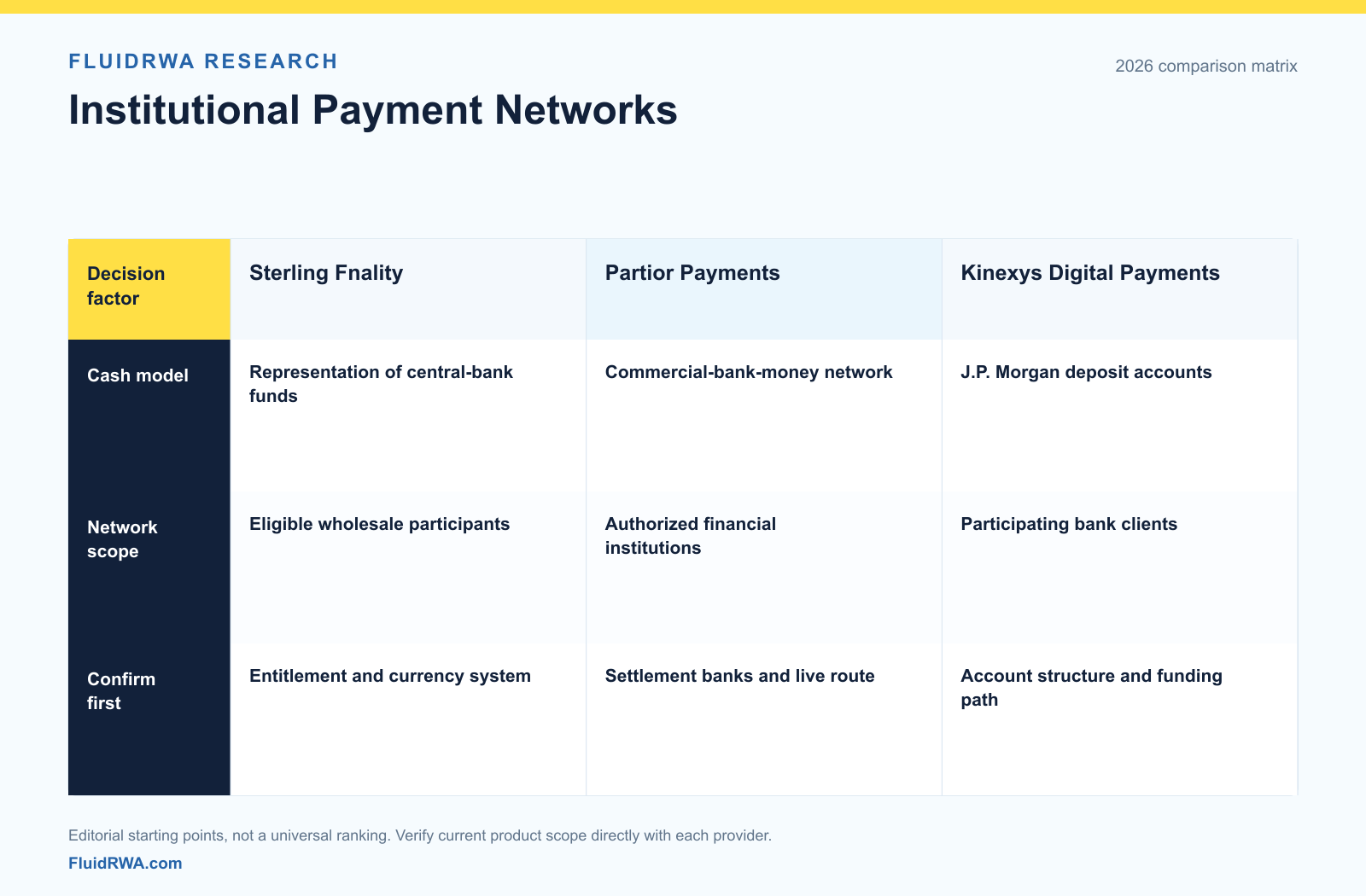
Fnality, Partior and Kinexys Digital Payments solve different institutional cash-movement problems. Sterling Fnality uses a representation of funds held in a Bank of England omnibus account. Partior describes a multi-bank network for commercial-bank-money clearing and settlement. Kinexys Digital Payments provides a permissioned deposit ledger and payment rail for participating J.P. Morgan clients. Choose by the legal cash claim, eligible counterparties, currencies and funding path before comparing integration features.

What is the real comparison?
A treasury team choosing an institutional payment network needs to know what it holds, who can receive it and how it becomes usable cash outside that network. Blockchain throughput is only one part of that decision. A fast transfer between two network accounts does not establish that the next bank, currency conversion or securities venue can complete its part at the same time.
This comparison focuses on Sterling Fnality, Partior Payments and the account-based Kinexys Digital Payments service. It uses publicly available operator and bank records reviewed October 19, 2026. It does not compare every product owned by these organizations or treat their planned expansion as available access.
For a different buyer task, use the stablecoin infrastructure comparison, the bank fiat-rails comparison or the collateral and post-trade infrastructure comparison. This page addresses institutional network participation and the cash settlement model.
Side-by-side comparison
| Buyer decision | Sterling Fnality | Partior Payments | Kinexys Digital Payments |
|---|---|---|---|
| Documented model | Wholesale payment system representing funds at central bank [1][2] | Multi-bank infrastructure for clearing and settlement in commercial-bank money [4][9] | Permissioned bank deposit ledger and payment rail [6] |
| Cash question | What is the participant's entitlement under the omnibus and system arrangements? | Which settlement bank and account supply the relevant currency balance? | Which J.P. Morgan deposit account, entity and product terms apply? |
| Access question | System participation and eligibility under the applicable rulebook | Authorized financial institutions and their participation route [4] | Participating J.P. Morgan clients and approved account configurations [6] |
| Dated evidence | Initial Sterling controlled live payments in December 2023 [1][2] | Standard Chartered reported live EUR transactions in May 2024 [5] | March 2026 Mitsubishi intragroup USD cash-management deployment [7] |
| Funding dependency | Central-bank omnibus funding arrangements; confirm current CHAPS and liquidity windows | Required settlement-bank and currency-account funding; confirm exact route | Transfers between deposit accounts and other bank systems; confirm current schedules |
| Integration priority | System instructions, balances and securities-settlement coordination | Multi-bank routing, account states and network rulebook | Treasury rules, account ledger and payment instruction integration |
| Unverified from this review | Every currency system, current fees and applicant eligibility | Every live corridor, client-specific liquidity need and tariff | Every geography, deposit product and external network connection |
Cash, access and integration questions are FluidRWA's procurement framework. They are not statements that a provider lacks a capability. References identify the evidence behind the factual rows.
Fnality: examine the settlement entitlement first
Fnality's December 14, 2023 announcement describes the first live Sterling transactions involving Lloyds Banking Group, Banco Santander and UBS. It describes a digital representation of funds at central bank. [1]
The Bank of England's RTGS and CHAPS annual report for 2023/24 separately confirms Fnality as the first omnibus-account holder and records the initial payments in December 2023. Its description of pilot mode belongs to that reporting period. It should not be silently rewritten as a current operational restriction. [2]
The Bank's April 2021 policy announcement explains the operator-level omnibus arrangement. A buyer still needs the current system rules and legal documents to understand its own entitlement and participation obligations. [3]
Evaluate when: A wholesale workflow needs the specific settlement model and its eligible participants can join the required system.
Request before selecting: Current currency-system status, membership conditions, legal treatment of participant balances, funding and withdrawal procedures, liquidity limits, finality rules and the exact securities or FX interface to be used. A Sterling deployment record is insufficient evidence that every proposed currency system is operational.
Partior: identify the banks behind each route
Partior's Payments page describes a permissioned network and multilateral rulebook. A June 2025 OSTTRA and Baton announcement describes Partior-connected settlement using tokenised commercial-bank money. [4][9]
For a specific deployment, Standard Chartered's May 15, 2024 release records EUR transactions between Hong Kong and Singapore on May 13-14 involving Siemens and iFAST. It identifies Standard Chartered as the first EUR settlement bank to go live. This dated bank record is more precise than inferring launch status from a general operator timeline. It does not establish availability for every bank pair. [5]
Evaluate when: The buyer needs a bank-network approach and can identify the institutions, currencies and participation route required for its transactions.
Request before selecting: A route diagram showing the originating account, settlement institutions, destination account and final confirmation. Ask who holds each balance, where prefunding is necessary, how an instruction is rejected and how a customer is credited if one participant is unavailable.
The public product page describes operational benefits, but a buyer should measure its own integration result. A shared network record does not, by itself, close the institution's general ledger or resolve an instruction sent with incorrect commercial information.
Kinexys Digital Payments: start with the approved account structure
J.P. Morgan's developer explanation describes Kinexys Digital Payments as a permissioned deposit ledger and payment rail using Blockchain Deposit Accounts. The March 31, 2026 Mitsubishi announcement gives a concrete intragroup USD cash-management example across Singapore, London and New York, with programmable conditions. [6][7]
J.P. Morgan's current Kinexys content hub separately describes account-based services and the JPM Coin deposit token. The terms and interfaces of those products should not be assumed interchangeable. [8]
Evaluate when: A participating J.P. Morgan client's account structure and supported locations fit the treasury instruction, particularly an intragroup movement with explicit conditions.
Request before selecting: An entity-by-entity account map, current currency coverage, permissible counterparties, programmable-rule controls and the bank's supported funding paths. A historic 24/7 transfer description should be accompanied by the current schedule for moving money between the network and other bank systems.
How should finality and liquidity be tested?
Use one real payment obligation with approved synthetic test data. Write down the moment at which each system regards the instruction as accepted, funded, irrevocable and available to the recipient. Ask legal and operations teams to agree the evidence required for each state.
Then test these cases in the provider-approved environment:
- Insufficient funds before submission.
- A response lost after the network accepted the instruction.
- A duplicate instruction with the same business purpose.
- A destination participant or downstream bank unavailable.
- A cross-currency instruction with one leg unable to complete.
- A correction request after final settlement.
These are proposed tests. This article reports no execution results. For each case, assign a party that can investigate, a party that may authorize a response and a record the customer can inspect. Legal finality, network confirmation and availability in a conventional bank account should each be documented.
What should the business case measure?
Measure against the current workflow with the same entity, currency and counterparty scope. A reasonable baseline includes funds held idle, time outside banking hours when the payment cannot proceed, manual interventions and the time to clear an ambiguous status.
- Usable-cash time: From approved instruction to recipient funds available for the intended use.
- Liquidity requirement: Peak and average funded balance needed to meet that workflow's obligations.
- Exception cost: Staff time and external charges for failed, duplicated or disputed instructions.
- Record alignment: Instructions that match treasury, bank and accounting records without manual correction.
- Coverage: The share of actual obligations that can use the approved route, with excluded entities and currencies visible.
These definitions are FluidRWA's proposed evaluation framework. No score or savings percentage is assigned to the providers. Availability to one named customer is evidence of that deployment and should not be used as proof that another organization has the same access.
What belongs in the procurement decision?
First obtain written eligibility and the legal description of the money. Then confirm the required counterparties and funding route. Only after those pass should the team compare interfaces, support, service levels and implementation cost.
Ask for current fees, minimum balances, participation obligations, data exports, outage communications and termination assistance. Comparable public pricing was not verified. Cost can be driven by the capital held in the workflow and internal operations as much as a transaction tariff.
For securities settlement, evaluate the asset leg separately. A cash system's ability to support coordination does not establish that the proposed security register, custodian and trading venue are connected in production. The Kinexys intraday repo case study and DBS treasury-token case study provide related, distinct deployment examples.
References and verification scope
Official records reviewed October 19, 2026. Historical reporting dates remain attached to historical milestones. Operator claims have not been independently performance-tested by FluidRWA.
- Fnality: Initial Sterling payment operations, December 14, 2023.
- Bank of England: RTGS and CHAPS Annual Report 2023/24, omnibus accounts.
- Bank of England: Omnibus-account policy announcement, April 19, 2021.
- Partior: Payments operating model.
- Standard Chartered: EUR cross-border transactions on Partior, May 15, 2024.
- J.P. Morgan: Kinexys Digital Payments developer explanation, January 7, 2025.
- J.P. Morgan: Mitsubishi cash management with Kinexys, March 31, 2026.
- J.P. Morgan: Kinexys product and content hub.
- OSTTRA and Baton: Partior connection and tokenised commercial-bank funds, June 17, 2025.
For a project brief or a source-backed company update, email contact@fluidrwa.com, or explore the FluidRWA vendor ecosystem.
FAQ
Are Fnality, Partior and Kinexys stablecoin providers?
The services compared here use different institutional settlement models. Sterling Fnality represents funds held at central bank; Partior describes a multi-bank payment network; and Kinexys Digital Payments operates a bank deposit ledger and payment rail. They should not be evaluated as interchangeable retail stablecoins.
Does Fnality provide a retail Bank of England account?
No. The Bank of England describes an omnibus-account arrangement for a recognized payment-system operator pooling participant funds. Eligibility, entitlements and the legal structure must be assessed under the specific system's rules.
Is Kinexys Digital Payments the same as JPM Coin on a public blockchain?
No. J.P. Morgan's current materials distinguish Blockchain Deposit Accounts and the permissioned account-based service from the separately described JPM Coin deposit-token product. This comparison focuses on Kinexys Digital Payments' deposit-account rail.
Does a 24/7 network remove bank funding cutoffs?
Not necessarily. Internal transfer availability and moving funds into or out of the network can have different schedules. Ask for the current funding, withdrawal, FX and holiday timetable for every proposed account and currency.
Can any financial institution connect?
No universal access is established by the reviewed records. Ask each provider to confirm the eligible legal entity, participation route, banks, currencies, locations and contractual conditions.
Which network is cheapest?
Comparable current tariffs and implementation costs were not verified. Include prefunding, liquidity buffers, integration, participation, support, bank-account costs and exit work in a current proposal.
Map the cash side of your institutional project
Describe the entities, currencies, counterparties and settlement workflow. Prefer email? contact@fluidrwa.com.