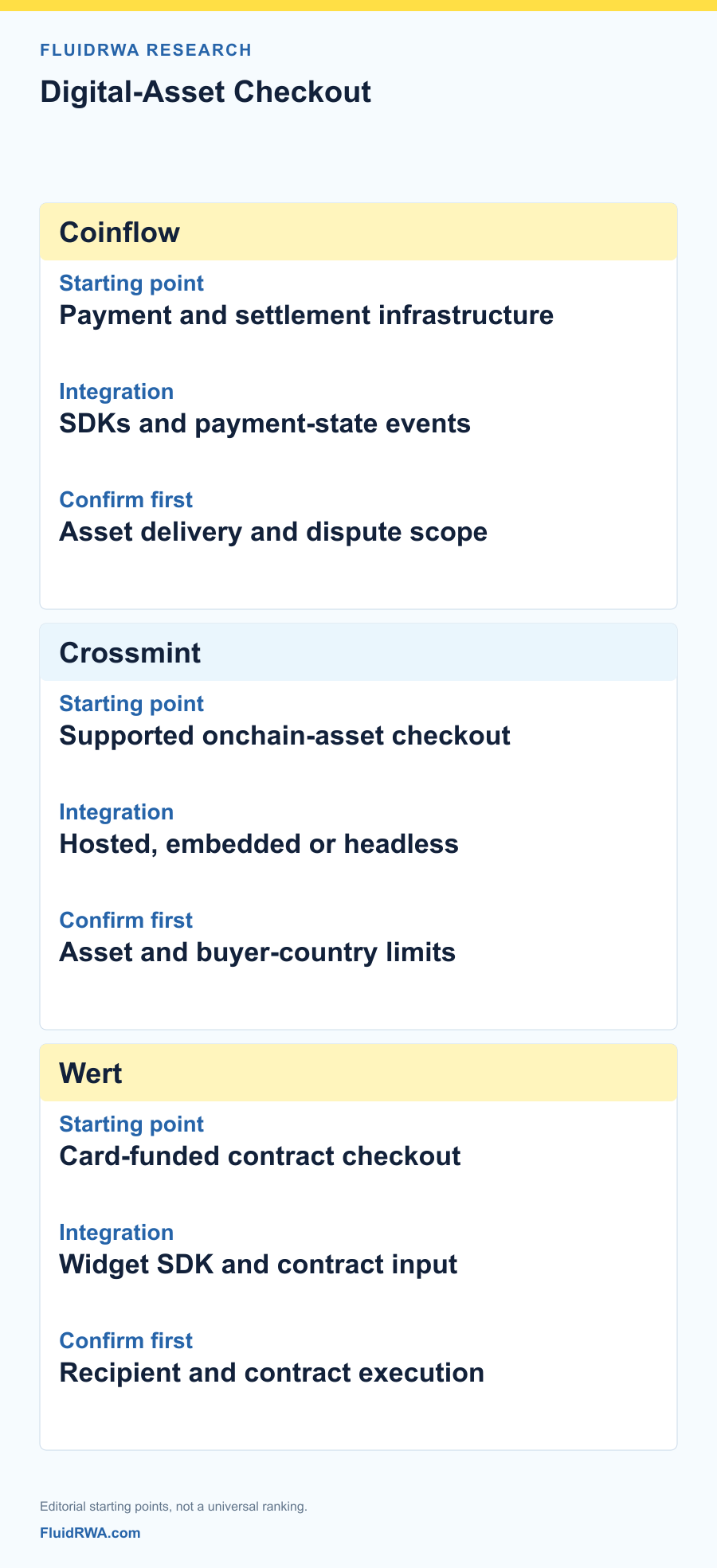
Coinflow documents payment processing, settlement events and dispute operations. Crossmint documents hosted, embedded and headless checkout for supported onchain assets. Wert documents a card-funded smart-contract checkout widget. Compare payment approval, asset delivery and settlement separately; a successful card authorization does not prove that a buyer received the intended token or that the merchant is protected against every dispute.
How do you compare checkout providers without confusing the payment and asset legs?
A digital-asset checkout has at least three outcomes to coordinate: the buyer's payment, delivery of the intended asset and the merchant's settlement. These can occur at different times and fail independently. Procurement should therefore start with a state diagram and responsibility map, not a headline approval-rate claim.
This comparison selects three providers with public checkout documentation. It does not establish that all three support the same asset, network, jurisdiction or business model. Company documentation was reviewed on October 21, 2026; no live payment, asset sale or card dispute was tested.
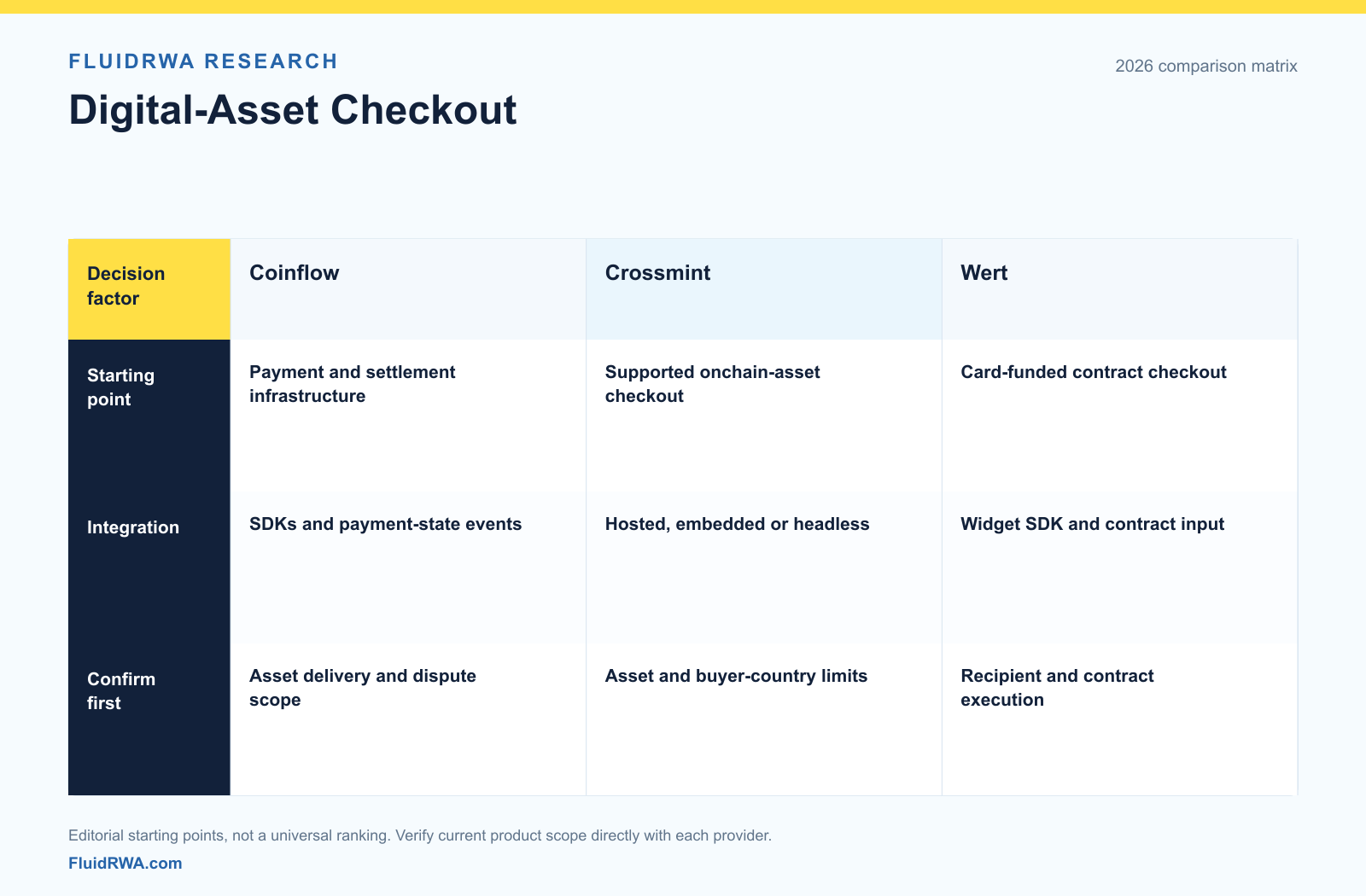
Coinflow vs Crossmint vs Wert comparison
| Decision factor | Coinflow | Crossmint | Wert |
|---|---|---|---|
| Documented starting point | Payment acceptance and settlement infrastructure | Checkout for supported onchain assets | Card-funded smart-contract checkout |
| Integration evidence | SDKs, merchant tools and payment webhooks | Hosted, embedded and headless options | Official widget SDK and encoded contract input |
| Delivery question | How does the application connect payment state to its asset-delivery process? | Is this particular collection or token approved? | Does the contract call deliver to the intended recipient? |
| Exception evidence | Duplicate webhook warning and chargeback-state documentation | Buyer help distinguishes completed delivery from failed or cancelled payment | Sandbox and contract integration guidance |
| Key eligibility check | Merchant approval, settlement rail and protection scope | Asset type and buyer geography, including token-specific restrictions | Contract, network, buyer and production approval |
Coinflow: connect settlement events to your application
Coinflow's documentation covers payment acceptance, merchant tools, settlement and payout functions. Its checkout webhook reference distinguishes authorization, settlement, disbursement and dispute events, and warns that events can be delivered more than once. Coinflow documentation, checkout webhook reference.
Coinflow's chargeback test guide documents sandbox dispute simulation. That provides a concrete diligence path: validate how an order changes when a payment is disputed after delivery. It does not mean every transaction qualifies for protection. Sandbox chargeback testing.
Buyer test: replay a payment notification and verify the application does not deliver twice. Separately test whether a settlement event and a token-delivery event can be reconciled using stable identifiers. Any claim that a provider mints, transfers or guarantees an asset must be tied to the actual contracted integration.
Crossmint: verify the asset type before applying a geography statement
Crossmint documents hosted, embedded and headless checkout, and explicitly separates purchasing a particular asset from topping up a wallet. Its current introduction also contains a material restriction: effective July 1, 2026, fungible-token checkout is unavailable to buyers in the EEA, UK and Brazil, while NFT checkout remains available. A general global-coverage statement should not override that product-specific qualification. Crossmint checkout overview and restrictions.
Crossmint's buyer refund guidance distinguishes completed token delivery from failed or cancelled payments and associated bank holds. Do not promise a card refund simply because a customer wants to exit a delivered asset. The asset's own rights and the application's refund policy require separate evaluation. Crossmint buyer refund guidance.
Buyer test: take the actual asset and target country list to onboarding. Document which team owns a declined payment, a delivery problem and an asset-related complaint; these are not necessarily the same support queue.
Wert: inspect the contract call and recipient controls
Wert distinguishes a general fiat on-ramp from its NFT or smart-contract checkout. The input-data guide describes execution through encoded contract input and requires a transfer argument that sends the purchased asset to the user. Wert product introduction, contract input requirements.
The widget guide requires the supported SDK integration rather than a direct redirect. Mobile teams should examine the documented WebView approach and confirm their app-store and jurisdiction requirements separately. Wert checkout integration.
Buyer test: use an explicit recipient and a controlled contract failure. Verify what happens to payment authorization, delivery status and support records when the contract cannot complete. Do not infer securities eligibility from the technical ability to call a payable function.
What evidence should a merchant require?
Ask for a worked lifecycle covering order creation, payment approval, contract execution, merchant settlement, reconciliation and dispute handling. Require the identifiers and finality definitions for each step. A transaction hash is useful evidence of a chain event, but it is not a full commercial receipt or an unconditional card-liability release.
Agree how refunds are funded when the merchant has already received settlement. Ask which protection exclusions apply to the asset, buyer location and sales model. Test an abandoned checkout, delayed delivery, duplicate event and disputed completed order before exposing the experience to customers.
How is this different from the ramp comparison?
The MoonPay, Transak and Banxa comparison addresses wallet funding and ramp onboarding. This page addresses a specific purchase and its delivery obligations. Teams designing branded payment operations can also use the white-label gateway buyer guide. For a shortlist tied to your actual checkout, email contact@fluidrwa.com.
FAQ
Is checkout the same as an on-ramp?
No. Checkout purchases a specific item or executes a defined asset transaction. A general on-ramp funds a wallet for later use. Crossmint explicitly distinguishes those products.
Does Crossmint offer the same token checkout everywhere?
No. The reviewed documentation states that, effective July 1, 2026, fungible-token checkout is unavailable to buyers in the EEA, UK and Brazil, while NFT checkout remains available. Confirm current product and country eligibility before launch.
Can Wert call my smart contract?
Wert documents smart-contract checkout using encoded input data and a recipient-transfer requirement. Contract and network compatibility must be tested and approved for the specific integration.
Are card payments irreversible when a token is delivered?
Onchain token delivery and the card dispute process are different systems. Review chargeback coverage, exclusions, evidence deadlines and refund handling in the applicable agreement.
Map your checkout-to-delivery workflow
Share the asset, network, buyer countries and settlement model you need. Or email contact@fluidrwa.com.