Regula documents document-reading and authenticity components across several deployment options. Incode organizes capture and verification through configured modules and workflows. Jumio distinguishes government-ID verification, supporting-document checks and biometric checks. For investor onboarding, compare the exact document, device, decision record and exception process; an ID result alone does not establish investment eligibility.
Check the document and the decision it supports
An investor photographs a passport, gets a green check and then waits while someone asks for another document. This often happens because the team has not separated document capture, identity assessment and investment eligibility. The comparison should begin with the decision you need to make and the evidence that supports it.
This guide focuses on the document stage of investor onboarding. It does not rank complete AML programmes or replace legal advice on who may invest. We selected three providers already represented in FluidRWA's coverage and reviewed their public documentation on October 29, 2026. We did not run an accuracy benchmark or verify a common commercial quotation.
| Decision | Regula | Incode | Jumio |
|---|---|---|---|
| Documented approach | Document Reader SDK and related components | Modules assembled into configured flows or workflows | ID verification, supporting-document and biometric services |
| Important distinction | Mobile capture, server processing and specialist readers have different capabilities | Capturing an input and making a verification decision are separate steps | Government-ID checks differ from proof-of-address document checks |
| Configuration to confirm | Processing scenario, hardware, document and licence | SDK version, enabled modules and supported deployment | Selected service, capture channel and decision outputs |
| First buyer test | Trace one document's extracted data and authenticity findings | Follow capture through server processing and final decision | Reconcile ID and supporting-document results to one investor case |
| Comparable accuracy, cost and eligibility coverage | Not verified | Not verified | Not verified |
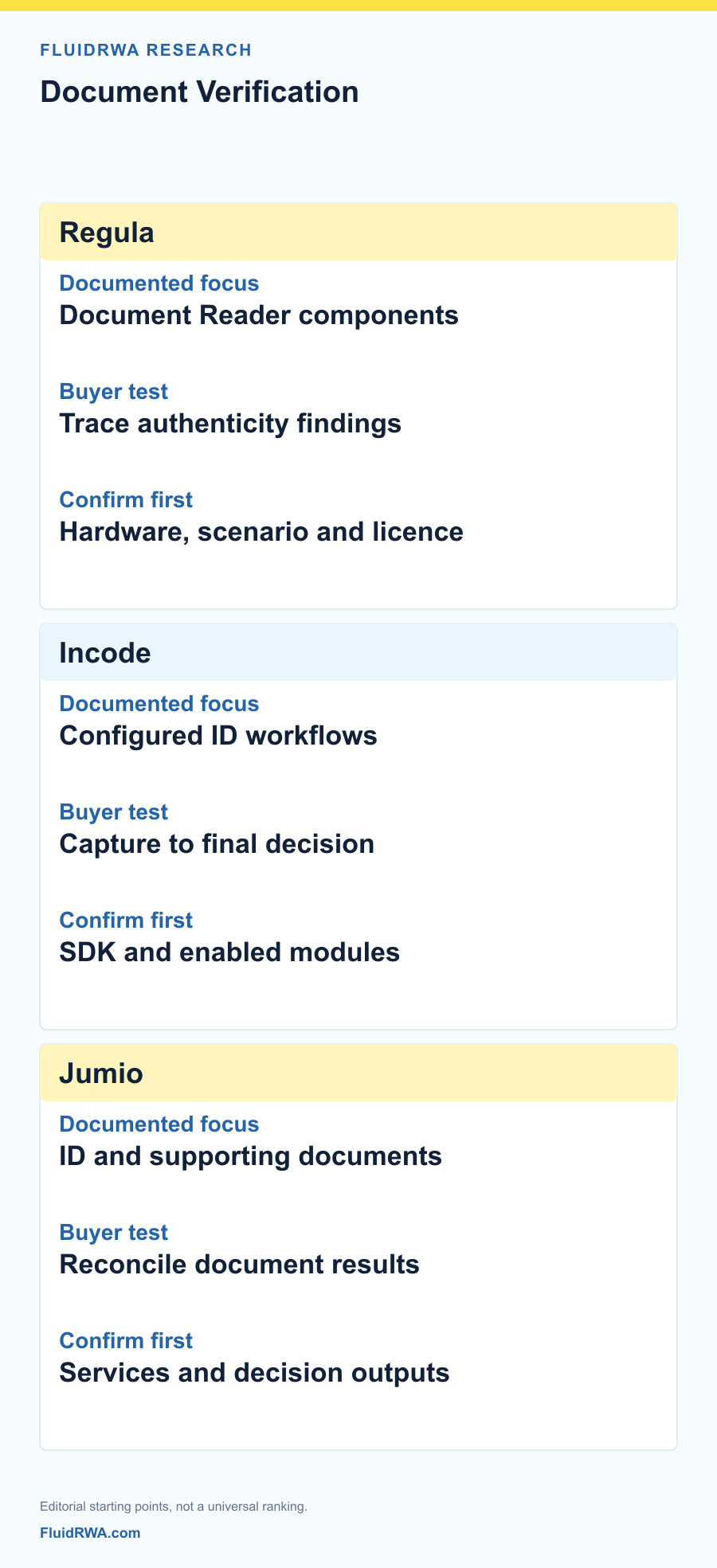
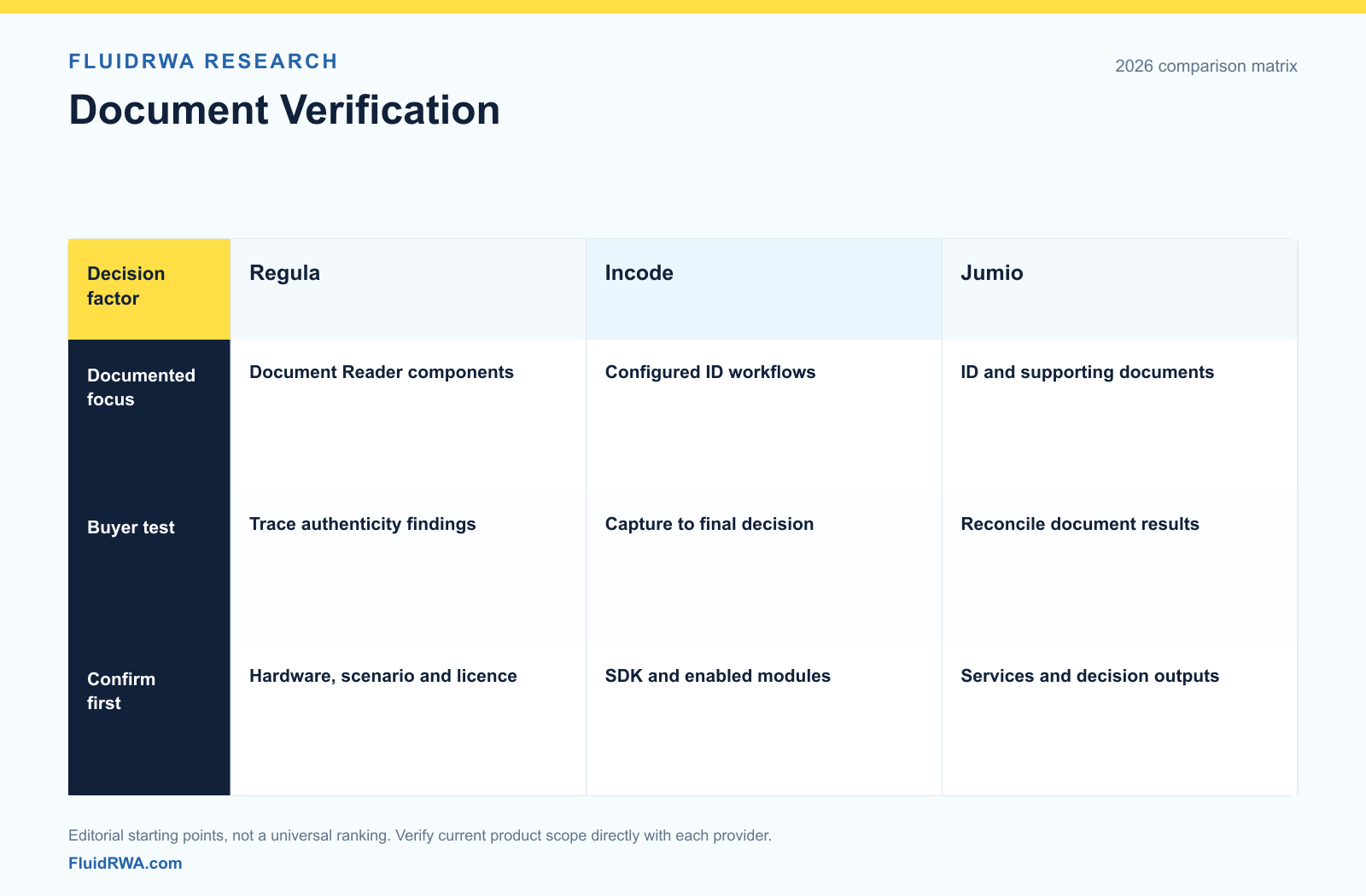
The proposed tests are FluidRWA buyer recommendations. A capability not established by our reviewed evidence should be investigated, not treated as absent.
Regula: select the processing components deliberately
Regula's Document Reader documentation covers mobile, web-service and reader-related implementations. Its authenticity documentation explains checks that depend on the document and capture conditions. That distinction matters when comparing a phone camera flow with an office using specialist document hardware.
Ask the supplier to map each claimed check to the actual deployment. Which fields come from printed text, a machine-readable zone, a barcode or a chip? Which findings require another image or reader? Do not accept a long combined feature list as proof that every check runs on every device.
For a customer-controlled deployment, allocate responsibilities for updates, security, monitoring and retention. Request a sample decision record that shows what was inspected, what could not be inspected and which component produced the result. A missing chip read should be distinguishable from a failed authenticity check.
Incode: follow capture through the configured workflow
Incode's module overview separates inputs from verification processes and says available modules depend on an organization's configuration. The Web SDK 2 ID Capture guide describes front and back capture with quality checks. It also explicitly warns customers to confirm upgrade or implementation support with their representative.
This is a version-specific procurement issue. Ask which SDK and workflow the demo uses, whether that version is supported for your account and which steps run after capture. An image being accepted by the interface does not mean the investor has passed every required check.
Test a user who resumes an unfinished session, changes devices or uploads the wrong side of a document. Your support team should be able to identify the current state without collecting another copy by email. Request the migration and rollback process if your planned deployment depends on a newer SDK.
Jumio: keep the document products separate
Jumio's identity-verification page distinguishes government-issued ID checks from supporting-document checks, with selfie and liveness capabilities described separately. Its terminology matters: proof of address and a passport do not answer the same question.
Build the product scope around the investor case. If the fund needs identity, residence and a current address, identify the evidence and freshness rule for each. Ask which documents the selected service accepts, what output explains a rejection and whether a human can review an exceptional case under the proposed arrangement.
Do not let separate checks create duplicate investor records. A corrected address document should attach to the same case, with a history explaining what changed. Confirm the webhook or retrieval process, final-state definition and export format rather than relying on the appearance of a dashboard badge.
Build an evaluation set that resembles your applicants
Use consented, appropriately protected test material with known expected outcomes. Include your main countries, document versions, scripts, low-end phones and browser environments. Add poor lighting, expired documents, name variations and interrupted sessions. Synthetic examples can test workflow behavior, but they do not establish real-world fraud detection performance.
Agree the denominator before reporting completion rates. Separate people who abandon before capture, images rejected for quality, checks awaiting review and final decisions. A provider can appear to have a high success rate simply because difficult cases are excluded from the calculation.
Measure time to an explainable decision alongside friction. Report median and slower-case times for the same population, with manual-review cases included or clearly separated. Never compare one vendor's straight-through response time with another's full onboarding process and call it an equivalent benchmark.
Design the handoff to compliance and fund operations
Your case record should preserve the evidence reference, decision, version, time and authorized reviewer. Avoid copying sensitive documents into every downstream system. Give teams the minimum access they need and define retention, deletion and correction procedures before launch.
Identity evidence then feeds other decisions. An individual might be correctly identified but outside the fund's permitted jurisdiction or investor category. A company investor needs an ownership and authority workflow that a director's passport does not complete. Wallet screening also answers a different question from document authenticity.
Specify how changed facts reopen a case. An expired document, corrected name or changed company representative needs a controlled path back to review. Do not allow an old successful response to remain an unconditional investment permission forever.
Questions to put in the proposal
Ask each provider for the exact supported configuration, data-processing locations, subprocessors, retention controls, incident notification terms and support responsibilities. Request sample outputs for approval, rejection, review and technical failure. Commercial comparisons should include retries, manual services and any separate document or biometric products.
The KYC and AML directory can help with the wider programme. Keep this document evaluation narrow enough that your engineering and compliance teams can test the same workflow and agree what passing it means.
FAQ
Does passing document verification make someone eligible to invest?
No. Document verification supplies evidence for identity checks. Investor category, residence, sanctions, beneficial ownership and product-specific eligibility require their own rules and evidence.
Can a phone photograph perform every document authenticity check?
No. Checks depend on the document, capture method, hardware and enabled component. A visible-light image does not automatically supply an ultraviolet, infrared or chip-based inspection.
Is Incode Web SDK 2 available to every existing customer?
Its ID Capture guide explicitly says to contact an Incode representative before upgrading or implementing. Confirm your supported SDK version, module configuration and migration path.
What is the difference between Jumio ID Verification and Doc Proof?
Jumio describes ID Verification for government-issued identity documents and Doc Proof for supporting documents such as proof of address. Confirm which checks and decision outputs your contract includes.
Map your investor onboarding checks
Tell us which investors, documents, countries and systems you support. Prefer email? contact@fluidrwa.com.