Galxe documents credential-based quests and eligibility checks; Zealy documents community quests, submission review, XP and integrations; Layer3's builder tools organize campaigns as Activations with actions and incentives. Choose around the behavior you can verify and the users who return after rewards end, rather than headline participant counts.
Start with the action you would pay to keep
A campaign can produce thousands of completions while leaving the product almost unused a week later. Before comparing platforms, decide what successful participation means for your business. For an infrastructure product, it might be a developer completing an integration. For an application, it could be a second genuine transaction after the incentive has ended.
These three platforms appear in FluidRWA's existing vendor coverage. We selected them to compare campaign operations, not to rank every growth service. The table separates documented product descriptions from the tests we recommend buyers run. Current plan access, reward arrangements and exact integrations require confirmation.
| Decision | Galxe | Zealy | Layer3 |
|---|---|---|---|
| Documented campaign model | Quests, credentials and eligibility groups | Community quests, reviews and XP | Activations containing actions and incentives |
| Useful operational evidence | Eligibility and quest-status results | Submission decisions and review history | Configured action, audience and reward rules |
| Integration evidence reviewed | Quest discovery, eligibility and points queries | Review API and webhook administration | Builder guide for creation, preview and review |
| First buyer test | Eligible and ineligible wallets attempt the same quest | A disputed submission is rejected, explained and reviewed | One intended product action reaches its completion condition |
| Common-scope retention and acquisition cost | Not verified | Not verified | Not verified |
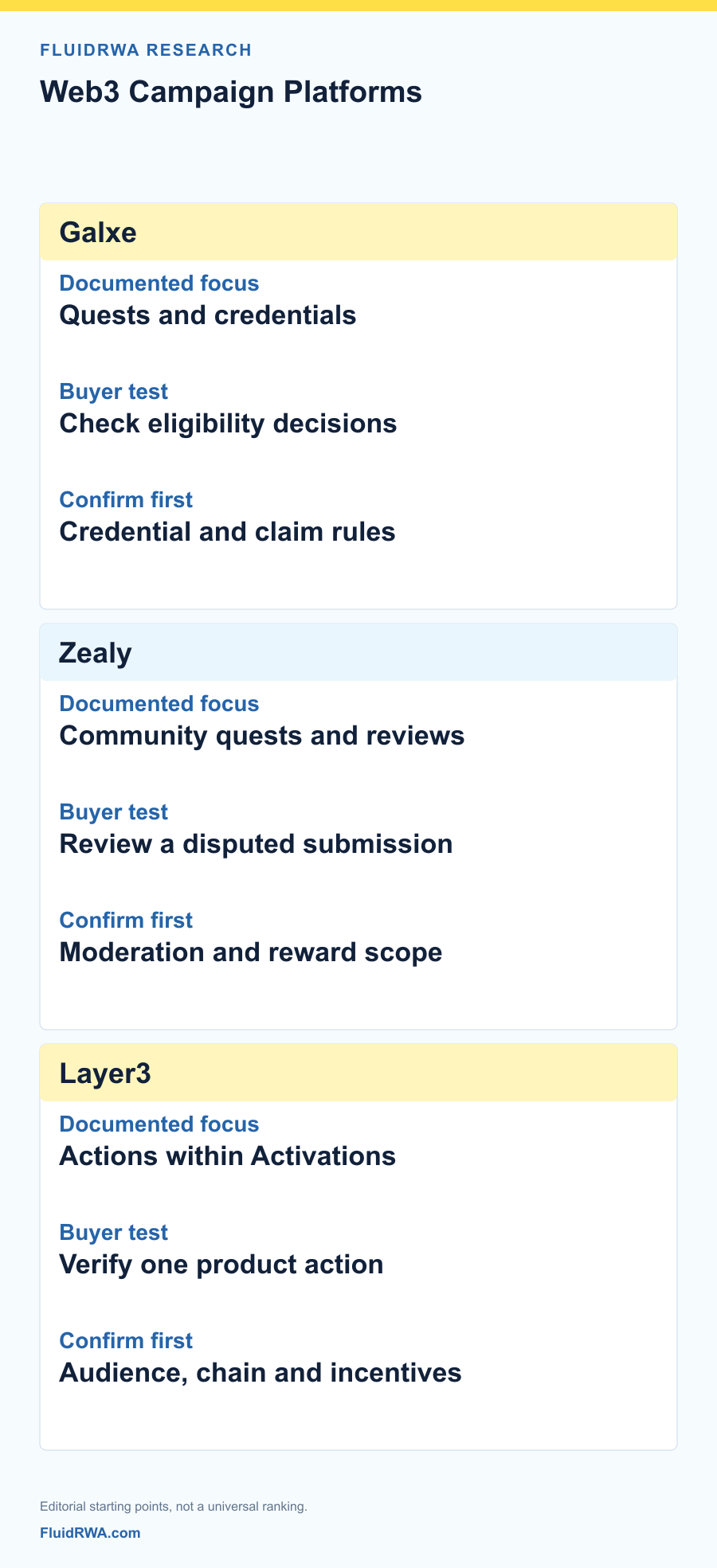
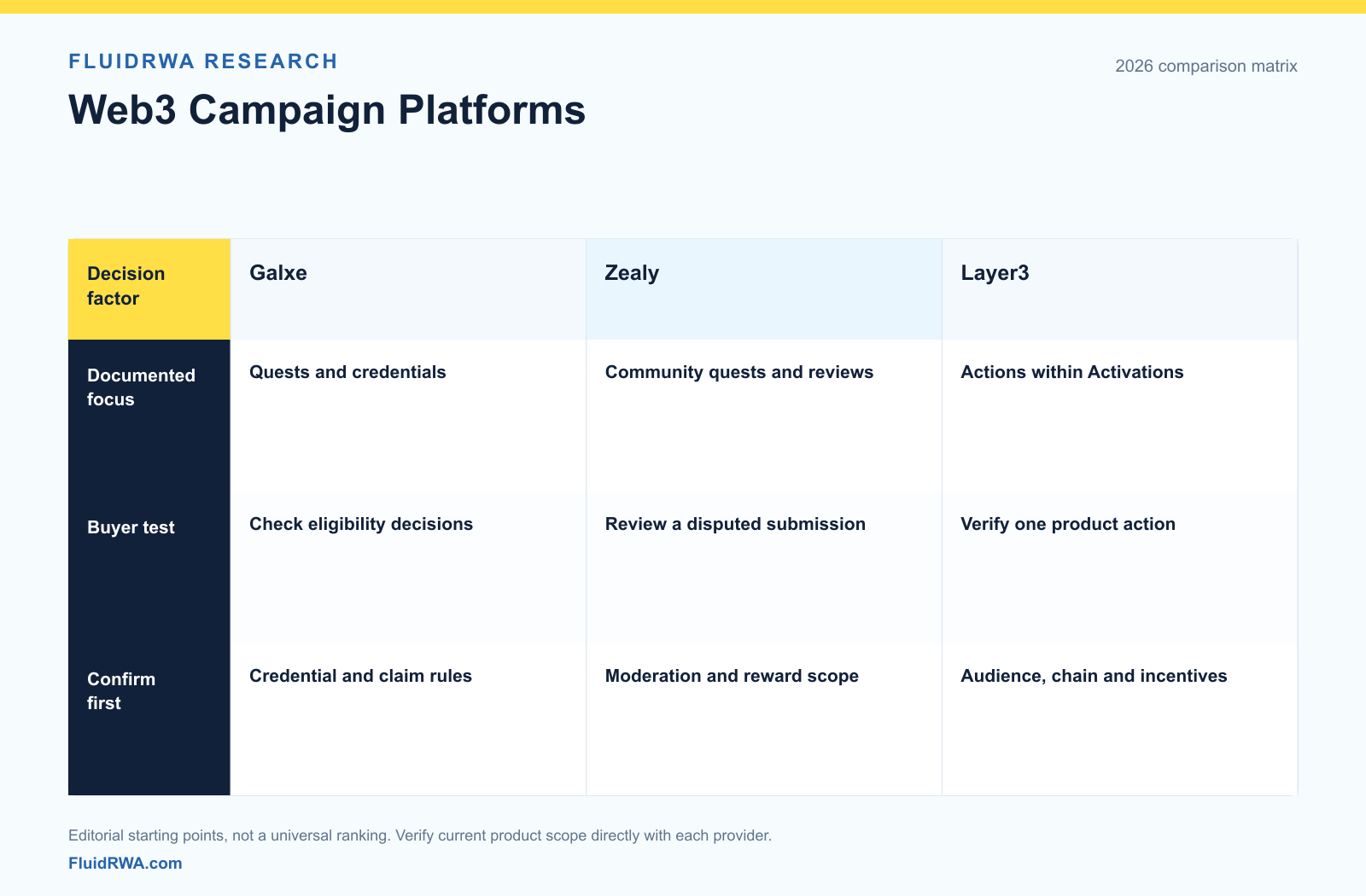
The first-test row is a proposed evaluation, not a claim that we ran these campaigns. "Not verified" means there is no common-scope result in the evidence reviewed.
Galxe: make the eligibility rule explicit
Galxe Quest describes a no-code approach to reward-based community programmes. Its quest integration guide documents eligibility through credential groups, discovery, status queries and loyalty-point information. That is useful when the campaign depends on proving a defined condition before participation or a reward claim.
The condition still needs careful specification. "Used our product" could mean connected a wallet, submitted a transaction or successfully completed a particular operation. Those events are different. Write down the qualifying contract, chain, time window and final state, and ask what happens after a transaction fails or is reorganized.
For an offchain action, establish who supplies the evidence and how often it updates. Test an eligible user who initially receives an incorrect result. The support team needs a way to explain the decision without asking the participant to repeatedly submit the same information.
Zealy: review work and manage community progression
Zealy's documented use cases include connecting leaderboards with an application, combining campaign and product data, awarding XP and unlocking features based on progression. Its submission-review endpoint supports decisions on claimed quests. Its webhook documentation describes managing subscriptions to available event types.
This makes moderation a procurement issue. If a task requires judgment, estimate the review workload and identify who can approve, reject or reconsider a submission. A poorly specified writing or social task can create a large queue of low-value work that still needs an answer.
Ask for a demonstration with an ambiguous submission. Preserve the reason for a decision, the reviewer and any change to awarded XP. Points should have a clear purpose inside the programme. Do not let participants infer a financial entitlement or future token allocation that your terms do not promise.
Layer3: build an Activation around product use
Layer3's documentation uses the term Activations for its campaign experience and describes CUBEs as activity records. The builder's first-Activation guide covers the action sequence, audience, incentives, chain selection, preview and submission for review. It also states that the token reward and CUBE credential must use the same chain in that documented setup.
Work backward from the product action. An educational card or quiz may help users understand it, but the useful result is whether they successfully reach the intended application state. Confirm the current action types and approval requirements before committing to a launch date.
An activity credential is not proof that every wallet belongs to a different person. Decide how much identity assurance your reward budget needs, and test the configuration rather than assuming the platform's overall audience has already been screened to your requirements.
Budget for failed claims and support
Set the reward exposure before the announcement goes out. Record the funding asset, distribution network, fee owner, claim window and treatment of unclaimed balances. Define what participants see if the reward pool is exhausted or the connected application is unavailable.
Give support staff a campaign reference, a safe way to collect relevant identifiers and a decision history. They should never request seed phrases or private keys. A participant with a legitimate failure needs a usable appeal route; repeated resubmissions create noise for the participant and the team.
During procurement, ask which controls are included in the proposed plan and which depend on another service. The existence of an API or a credential feature does not establish your entitlement, rate limit or supported production configuration.
Measure retention without confusing wallets and people
Use a small set of defined measures. Track eligible participants, completed qualifying actions, rewards actually claimed and a meaningful later action. Report the time window and denominator for each. If you count addresses, label the result as addresses; do not rename it users without a defensible identity method.
One useful calculation is reward cost per retained qualifying participant = campaign rewards paid divided by participants who meet the follow-up rule. State whether fees and platform costs are included. If nobody meets the rule, report no retained participants rather than forcing a flattering ratio.
Compare rewarded and unrewarded cohorts cautiously. Different launch dates, audience sources and product changes can explain the difference. A campaign report should describe those limitations instead of claiming that incentives caused every subsequent transaction.
What to ask in the demo
Bring a successful action, a failed action, a repeat account and a support appeal. Ask each provider to show the eligibility decision, completion record, reward state and export. Then ask how your own analytics will connect those records to later product activity while respecting your privacy policy.
Choose the platform whose demonstrated workflow fits your campaign and operating capacity. For an agency to design or run that programme, browse the separate growth and marketing category. An acquisition campaign and an ongoing communications programme need different briefs; our PR comparison explains the distinction.
FAQ
Do quest completions prove real user growth?
They show completion under the campaign's rules. They do not alone prove unique people, sustained use or revenue. Measure a later product action and define how repeat accounts are handled.
Are XP, CUBEs and token rewards interchangeable?
No. XP is a platform-specific progression measure; Layer3 describes CUBEs as records of activity; token rewards involve separate funding and distribution terms. State exactly what a participant earns.
Can these platforms guarantee a bot-free campaign?
The reviewed documentation does not establish such a guarantee. Test eligibility, repeat-account behavior, manual exceptions and appeals under your intended configuration.
What is the best first campaign?
Pick one useful product action, specify its evidence and cap the reward exposure. Then check whether eligible users perform a meaningful follow-up action after the incentive ends.
Choose a campaign around a business goal
Share the action you want users to take, your reward budget and how you measure retention. Or email contact@fluidrwa.com.