Circle is a natural starting point for businesses building around USDC, EURC, Circle Mint and USDC-backed branded stablecoin infrastructure; Paxos for enterprises seeking a regulated white-label issuer with reserve management, attestation, redemption and distribution experience; and Brale for organizations evaluating custom branded stablecoins, managed reserves, native multi-chain issuance and API-led payment or payout workflows. The key decision is not the token contract alone but the legal issuer, reserve structure, redemption promise, distribution plan and operating responsibilities.


How to use this comparison
This guide is written for a buyer selecting stablecoin issuance or branded digital money infrastructure covering legal issuance, reserves, minting, redemption, chains, APIs and distribution. It compares public product information, operating models and procurement implications. It is not a ranking, certification or claim that one provider is universally better. Capabilities, integrations, commercial terms and geographic availability change, so the final decision should be based on a current proposal, technical validation and legal review.
The useful question is not “which brand is biggest?” It is “which operating model fits the system we are actually accountable for?” Start by documenting users, assets, jurisdictions, transaction volume, trust assumptions, internal owners, recovery requirements and the consequences of failure. A provider that looks feature-rich in a demo can still be a poor fit if it creates an unclear custody position, weak exit path or operational process the team cannot staff.
Decision criteria
- Legal issuer and regulatory perimeter.
- Reserve assets, custody and bankruptcy treatment.
- Minting, redemption and banking rails.
- Brand, token ownership and economics.
- Supported chains and interoperability.
- Wallet, API, payout and treasury workflows.
- Attestation, reporting and operational controls.
- Liquidity, listings, distribution and exit.
Side-by-side comparison
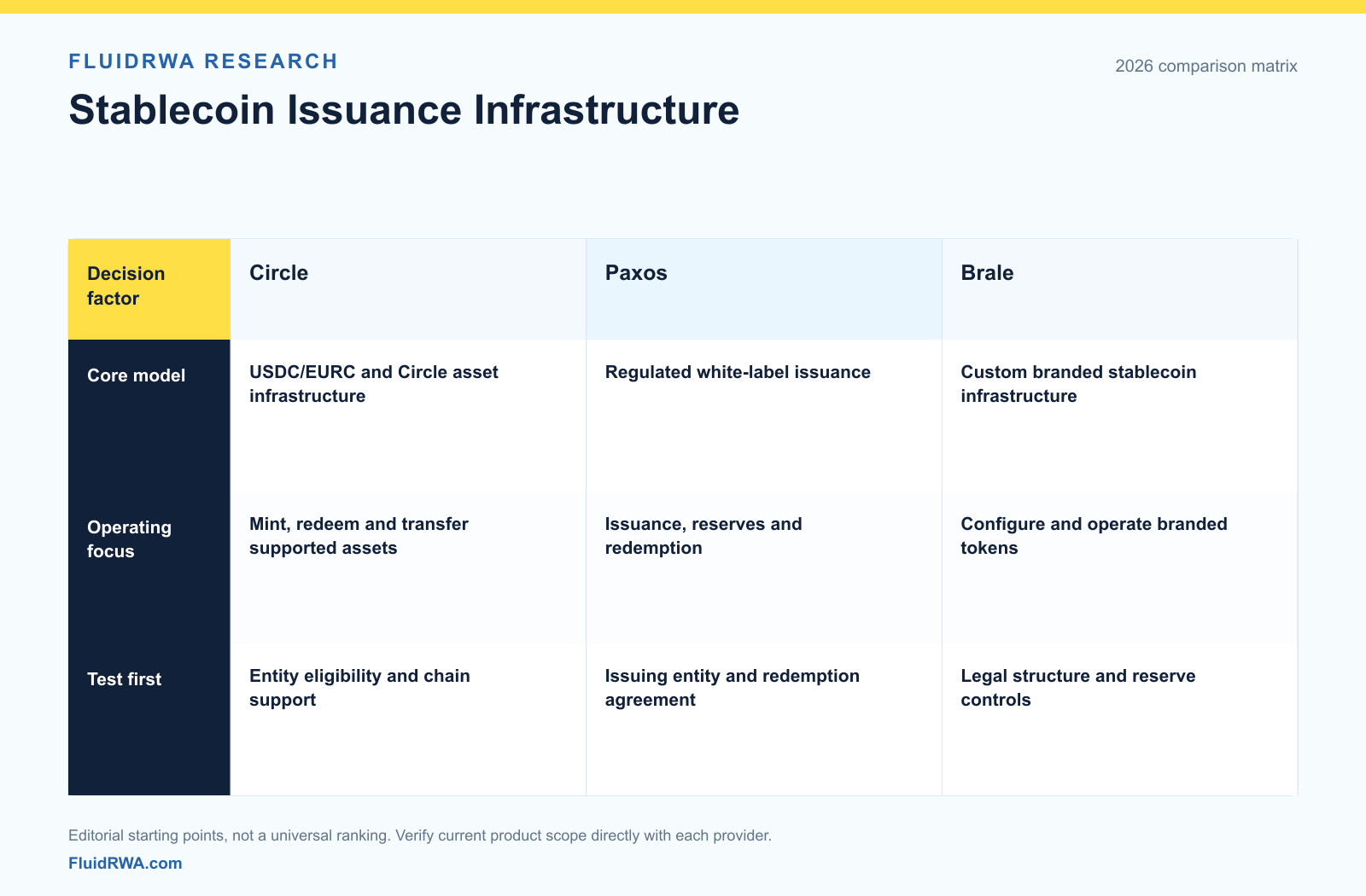
| Decision factor | Circle | Paxos | Brale |
|---|---|---|---|
| Primary orientation | USDC and EURC infrastructure, Circle Mint and USDC-backed branded assets | Regulated white-label issuance and managed tokenized assets | Custom branded stablecoins with reserve, issuance and API infrastructure |
| Natural buyer | Fintech or institution building on established Circle-issued assets and APIs | Bank, payment company or platform seeking a regulated issuing partner | Business launching a branded stablecoin or programmable settlement product |
| Issuer question | Is the product using Circle-issued USDC or EURC, or a branded asset backed through a Circle model? | Which Paxos regulated entity issues the asset and stands behind redemption? | Which legal and reserve structure applies to the branded asset and target jurisdictions? |
| Operating focus | Mint, redeem and transfer supported stablecoins across supported rails and chains | Issue, manage reserves, attest, redeem and support distribution for partner assets | Configure, issue and operate branded stablecoins with multi-chain and automation tooling |
| Evidence to request | Account eligibility, rail and chain matrix, redemption flow, limits, compliance and incident process | Issuer agreement, reserve policy, attestation, redemption SLA, market support and economics | Issuance structure, reserve accounts, chain contracts, controls, APIs, payout flow and wind-down plan |
| Do not assume | Broad USDC availability means every Circle service is available to every entity or country | A regulated issuer guarantees exchange listings, adoption or liquidity | Deploying a branded token creates trusted reserves, redemption demand or distribution by itself |
The table is a starting point. “Supported” can mean generally available, available through a partner, limited to selected chains or entities, or dependent on a separate contract. Turn every important cell into a written acceptance criterion.
Vendor profiles
Circle
Circle provides infrastructure around USDC and EURC, including Circle Mint for eligible institutional minting and redemption, supported-chain transfers and additional programmable-money products. Circle documentation also describes xReserve as infrastructure for USDC-backed branded stablecoins.
Good fit: Organizations that want to build payment, treasury or settlement products around established Circle-issued assets and a documented set of institutional APIs and supported rails.
Potential limitation: Confirm business eligibility, supported country, bank rail, chain, account structure, transfer controls, Travel Rule requirements, limits, fees, redemption timing and how the branded-asset model changes issuer or reserve responsibility.
Paxos
Paxos presents regulated stablecoin issuance for white-label partner assets, with the issuer managing reserves, attestations and redemption. Public materials position Paxos as the issuer behind assets including PYUSD and describe regulated structures across the United States, Singapore and Europe.
Good fit: Large payment companies, banks and platforms that want a regulated partner to issue and manage a branded asset and can support a substantial distribution and integration program.
Potential limitation: Verify the specific issuing entity, permitted markets, reserve composition, attestation scope, redemption process, token governance, chain roadmap, distribution commitments, economics, customer ownership and termination treatment.
Brale
Brale presents infrastructure for creating custom branded stablecoins, with Brale-managed reserves, native issuance across supported chains and APIs for minting, redemption, payouts and treasury automation.
Good fit: Fintechs, payment companies and digital businesses exploring a configurable branded stablecoin and operational workflows without building reserve and issuance infrastructure alone.
Potential limitation: Confirm legal issuance structure, supported jurisdictions and chains, reserve custody, attestation, mint and redeem eligibility, banking partners, contract controls, liquidity plan, fees, service levels and wind-down mechanics.
What buyers should understand before shortlisting
The issuer is the core product
The token contract records balances, but the issuer creates the legal claim, holds or arranges reserves, performs minting and redemption, and establishes governance. Buyers should diligence the issuer entity and redemption terms with the same care they apply to the software and blockchain.
Reserve and redemption testing
Trace one unit from customer fiat to reserve receipt, token mint, transfer, redemption request and fiat payout. Identify cut-off times, minimums, fees, screening, failed payments and insolvency treatment. Reconcile on-chain supply to reserve and liability records using the evidence available to the buyer.
Distribution is not infrastructure
A technically sound stablecoin can remain unused. Define who needs the asset, where it will be held, which wallets and venues support it, how market makers access minting and redemption, and why users will choose it over an established asset. Treat distribution as a funded workstream.
Best fit by buyer scenario
| Buyer scenario | Likely starting point | Reason to investigate |
|---|---|---|
| Business settling in USDC across several chains | Circle after eligibility and chain validation | The business may not need a new branded asset if established USDC rails solve the requirement. |
| Global payment company launching a consumer-facing branded dollar | Paxos after regulatory and distribution diligence | Issuer credibility, redemption, market support and the commercial relationship are central to the launch. |
| Fintech testing a programmable branded stablecoin | Brale after reserve and jurisdiction review | API-led issuance can accelerate a pilot, but legal structure and distribution still determine viability. |
| Closed-loop B2B settlement network | Compare an existing stablecoin with a branded token | A new token adds governance, liquidity and redemption work that should be justified by a real control or economic benefit. |
| Cross-border payouts | Design fiat rails, recipient access and compliance before the token | The best stablecoin layer cannot compensate for unavailable bank endpoints, unclear customer treatment or weak reconciliation. |
These are shortlisting hypotheses. A regulated entity, startup and global institution can reach different conclusions even when they begin with the same use case.
How to validate the shortlist
- Test the hardest production workflow with realistic volume, failure and recovery scenarios.
- Confirm which features are generally available, partner-delivered or dependent on a separate contract.
- Price implementation, usage, support, overages and exit work, not only the subscription.
- Verify security scope, data handling, incident response, service levels and named delivery staff.
- Require usable exports for configuration, records and logs before signing.
Use these checks as procurement prompts, then validate regulatory and contractual conclusions with qualified advisers.
FAQ
Which provider is best?
Circle is a natural starting point for businesses building around USDC, EURC, Circle Mint and USDC-backed branded stablecoin infrastructure; Paxos for enterprises seeking a regulated white-label issuer with reserve management, attestation, redemption and distribution experience; and Brale for organizations evaluating custom branded stablecoins, managed reserves, native multi-chain issuance and API-led payment or payout workflows. The key decision is not the token contract alone but the legal issuer, reserve structure, redemption promise, distribution plan and operating responsibilities.
Can the providers be combined?
They can sometimes serve complementary layers, but buyers should remove duplicated controls and assign a single owner for each policy, record and incident action.
Is public pricing enough to estimate cost?
No. Request current enterprise pricing for implementation, usage, support, integrations, overages and exit assistance, then add internal operating cost.
What should be tested before signing?
Test the hardest production workflow, prohibited actions, dependency failure, retries, recovery, reporting and data export with realistic scale.
Does vendor use transfer regulatory responsibility?
No. The buyer should obtain advice on its own custody, data, outsourcing, settlement, consumer and compliance obligations.
How should roadmap features be scored?
Treat them as unavailable unless delivery timing and acceptance criteria are contractually committed.
What is the most important exit question?
Ask whether configuration, records, logs and identifiers can be exported in usable formats without losing operational continuity.
How current is this comparison?
It was reviewed on September 9, 2026 using publicly available primary vendor materials. Verify current availability directly before procurement.
Move from comparison to a qualified shortlist
Share your project requirements and use FluidRWA's vendor ecosystem to identify providers that fit your architecture, controls and operating model.