Blowfish is strongest for pre-signing transaction simulation and wallet warnings. Blockaid covers a broader application and wallet security surface, including scam detection and threat intelligence. Hypernative is designed for continuous protocol, treasury and transaction monitoring with automated response. None replaces secure engineering or an independent smart contract audit.


Short Answer
Blockaid, Blowfish and Hypernative overlap around transaction risk, but they are not interchangeable security products.
- Blockaid covers a broad surface spanning transactions, dApps, tokens, scams, fraud and onchain threat detection.
- Blowfish is focused on making wallet signing safer through simulation, previews and warnings before a user approves a transaction.
- Hypernative combines pre-transaction simulation and policy enforcement with continuous production monitoring and automated response for protocols, treasuries and operational teams.
None replaces secure engineering, an independent audit or a tested incident plan.
Is Blowfish a Blockchain Scam-Monitoring Platform?
Blowfish is best understood as a pre-signing transaction-security layer for wallets. It simulates a proposed transaction and helps the wallet explain risky approvals, transfers or interactions before the user signs. That is narrower than continuous protocol monitoring and different from proving that smart-contract code is correct.
| Buyer need | Natural starting point |
|---|---|
| Explain a transaction before the user signs | Blowfish |
| Screen dApps, tokens, entities and transactions across an application | Blockaid |
| Monitor protocol or treasury risk and trigger governed responses | Hypernative |
| Prove smart-contract correctness before deployment | None of these; commission an independent audit and testing program |
For a serious evaluation, build one labeled corpus containing confirmed malicious transactions, difficult legitimate interactions and ordinary user activity. Run the same corpus through each shortlisted product and compare misses, false positives, response time and the clarity of the warning shown to a real user.
Comparison Table
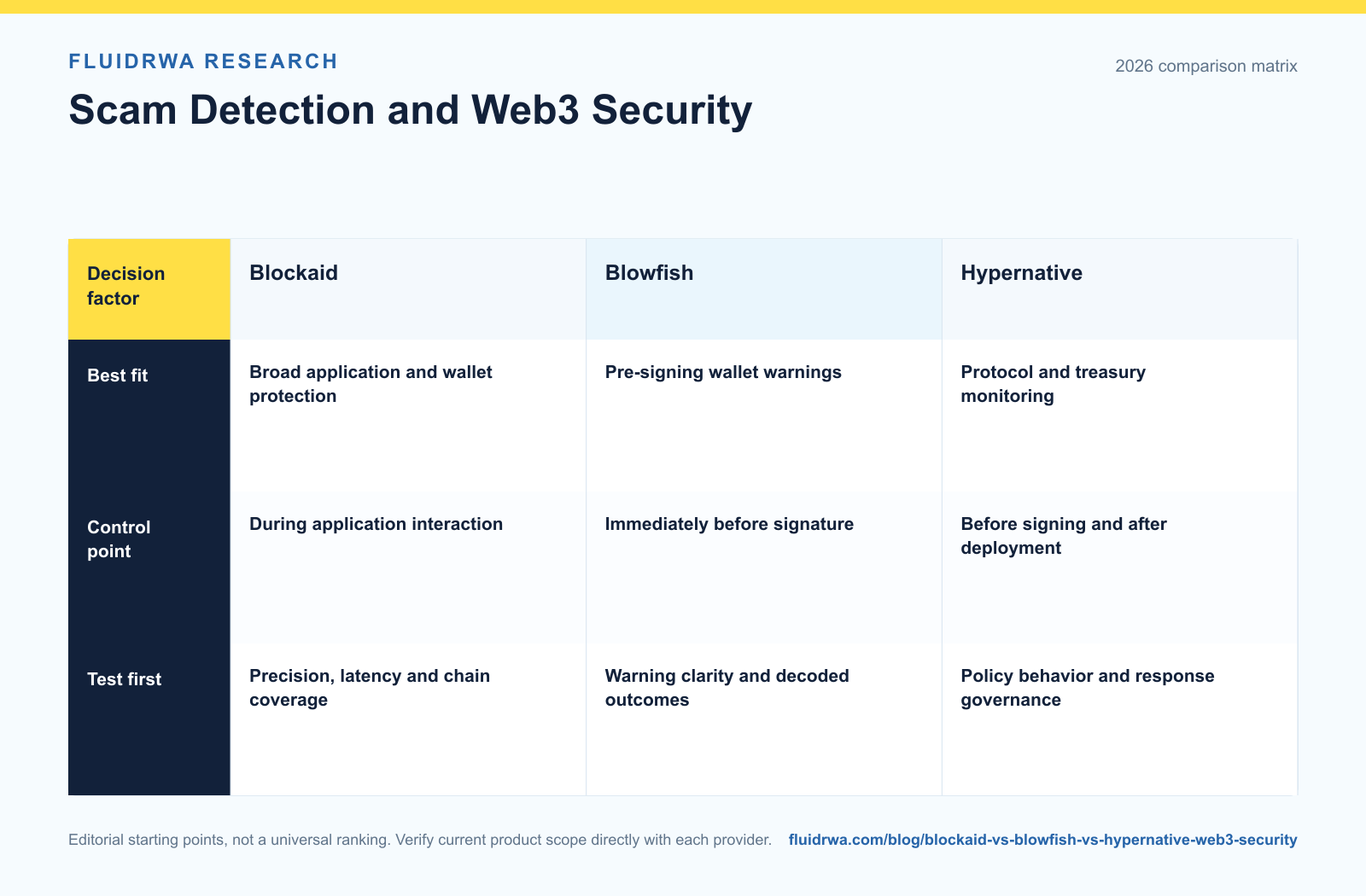
| Decision factor | Blockaid | Blowfish | Hypernative |
|---|---|---|---|
| Natural buyer | Wallets, exchanges and applications needing broad user protection | Wallets prioritizing clear pre-signing risk warnings | Protocols, treasuries and institutions needing monitoring and response |
| Core control point | Before and during user interaction | Immediately before wallet signature | Before institutional signing and continuously after deployment |
| Public product emphasis | Transaction preview, security assessment and entity evaluation | Wallet-facing simulation, previews and warnings | Transaction Guard plus real-time monitoring and response |
| Main proof required | Precision and latency across the buyer's chain and user mix | Warning clarity, decoded outcomes and low-latency wallet integration | Policy behavior, monitored risk coverage and governed response actions |
| Primary watch-out | Broad coverage still requires buyer-specific tuning and outage behavior | It is not a complete protocol security or incident-response program | Automated blocking or pausing can disrupt valid operations if governance is weak |
Choose the security layer before the vendor
Buyers commonly combine four different controls under the phrase "transaction security":
- Entity and dApp intelligence assesses an address, token, contract or interface before interaction.
- Transaction simulation predicts state changes and asset movement before signature.
- Policy enforcement decides whether a transaction should proceed, stop or require review.
- Continuous monitoring and response detects threats after deployment and triggers an operational action.
A wallet may prioritize the first two. A treasury may require simulation plus policy enforcement. A protocol may need all four, alongside secure development and independent audits. Score the providers against the specific control point rather than a generic security feature count.
Where Blockaid Fits
Blockaid positions its platform around protecting users and applications from scams, fraud, malicious dApps, unsafe tokens and transaction threats. That breadth can suit wallets, exchanges and consumer-facing applications that need one security intelligence layer across several interaction types.
Good for: broad threat coverage, dApp scanning, token security, transaction simulation and user-facing protection.
Not sufficient for: proving contract correctness, securing privileged keys or replacing a protocol's emergency process.
Buyers should measure precision by transaction type. A false positive that blocks a legitimate institutional transfer has a different cost from an extra warning in a retail wallet.
Where Blowfish Fits
Blowfish focuses on the moment a wallet asks a user to sign. It simulates transactions and presents previews or warnings intended to reveal malicious approvals, asset transfers and unsafe interactions.
Good for: wallets that want intelligible signing screens, proactive transaction defence and low-latency warnings.
Not sufficient for: continuous protocol monitoring, governance-risk detection or post-exploit automated response.
The key evaluation is not the number of supported threat labels. It is whether users understand the warning, whether developers can tune the experience, and whether simulation remains accurate across the target chains.
Where Hypernative Fits
Hypernative's platform is oriented toward continuous detection and response. Its current Transaction Guard materials describe pre-signing simulation, independent verification and customizable policy enforcement, while its broader platform monitors onchain, offchain and mempool signals to detect threats and trigger operational action.
Good for: protocols, bridges, treasuries and institutions needing production monitoring, transaction policies and automated defence.
Not sufficient for: eliminating the need for human incident ownership or safe governance. Automated responses can limit damage, but poorly designed automation can also halt valid activity.
Three Buyer Scenarios
A consumer wallet
Start with Blowfish and Blockaid. Run the same malicious and legitimate transaction corpus through both, then compare latency, decoded state changes, warning clarity and false-positive rates.
A DeFi protocol
Hypernative is the natural lead candidate because continuous monitoring and response are central. Add wallet-level protection if the protocol controls its own interface.
An institutional treasury
Evaluate Hypernative Guardian for transaction policies and simulation, then compare its controls with existing custody or MPC approval policies. Avoid creating contradictory policy layers.
A proof of concept that produces useful evidence
Build a labeled test set before inviting vendors to demonstrate. Include ordinary transfers, contract interactions, approvals, batched operations, newly deployed threats, address poisoning, unusual but legitimate treasury movements and transactions that should be held for review.
Measure detection rate by threat type, false-positive rate, median and p95 response latency, decoded outcomes, warning comprehension, policy consistency, outage behavior and audit records. Do not accept a vendor-curated attack demo as the only test corpus.
Evaluation checklist
- Which chains and transaction types are supported?
- What is the median and p95 decision latency?
- How are false positives reviewed and tuned?
- Can policies vary by wallet, role and transaction value?
- Are warnings explainable to end users and operators?
- What happens when the service is unavailable?
- Can the system block, pause or only alert?
- How are emergency actions authorized and audited?
- Does the vendor support historical replay for testing?
- What evidence supports detection claims?
Failure-mode matrix
| Failure | Required design decision |
|---|---|
| Security API is unavailable | Decide whether each workflow fails open, fails closed or routes to manual review |
| Simulation and wallet preview disagree | Define which system blocks signing and how the discrepancy is investigated |
| High-value legitimate transaction is flagged | Require independent override approval, reason capture and post-event review |
| Threat is detected after execution | Assign pause, revoke, communication and recovery authority before launch |
| Vendor misses an incident | Preserve internal monitoring, logs and escalation rather than outsourcing all ownership |
Verdict
Choose Blockaid for broad application and user protection, Blowfish for focused wallet signing safety, and Hypernative when pre-transaction institutional policy or continuous protocol monitoring is central. Many high-risk products will use more than one layer, but each additional control should have one clear owner and a tested failure mode.
Primary Sources
- Blockaid transaction security
- Blowfish
- Blowfish developer documentation
- Hypernative Transaction Guard
- Hypernative platform
- Hypernative security for financial institutions
FAQ
Which is better: Blockaid, Blowfish or Hypernative?
Blockaid suits broad application and wallet protection, Blowfish specializes in pre-signing wallet safety, and Hypernative focuses on monitoring and automated response for protocols, treasuries and transactions.
Do these tools replace a smart contract audit?
No. Audits review code before deployment, while these platforms primarily help detect, simulate, block or respond to threats during user and production activity.
Which provider is best for a wallet?
Blowfish and Blockaid are natural wallet candidates. The decision depends on chain coverage, simulation accuracy, warning UX, latency and the types of scams the wallet must detect.
Which provider is best for protocol and treasury monitoring?
Hypernative is the natural lead candidate for continuous protocol and treasury monitoring with automated response. Buyers should separately test Transaction Guard for pre-signing policy and the monitoring platform for post-deployment detection.
Can transaction simulation guarantee safety?
No. Simulation can expose expected state changes and known threats, but it cannot prove that code, governance, keys or external dependencies are safe.
What should be tested during evaluation?
Test false positives, missed attacks, supported chains, simulation latency, decoded transactions, policy controls, incident escalation and response automation.
Is public pricing available?
Enterprise security pricing is often quote-based and changes with volume, chains and products. Request a scoped proposal after a proof of concept.
Should a project use more than one security layer?
Often, but every layer needs a distinct purpose. Mature programs combine secure development, independent audits, signing controls, monitoring, incident response, key security and user protection without creating contradictory policies.
Compare Web3 security providers
Shortlist security, audit and monitoring providers by threat model, integration point and response workflow.