A practical 2026 shortlist for issuer-side RWA tokenization is Securitize, Tokeny, Zoniqx, Brickken, DigiShares, Polymath, ADDX, Taurus, InvestaX and Libre. This is an editorial shortlist, not a universal ranking: buyers should compare the legal operating model, asset-class fit, transfer controls, custody, servicing and distribution required for their project.

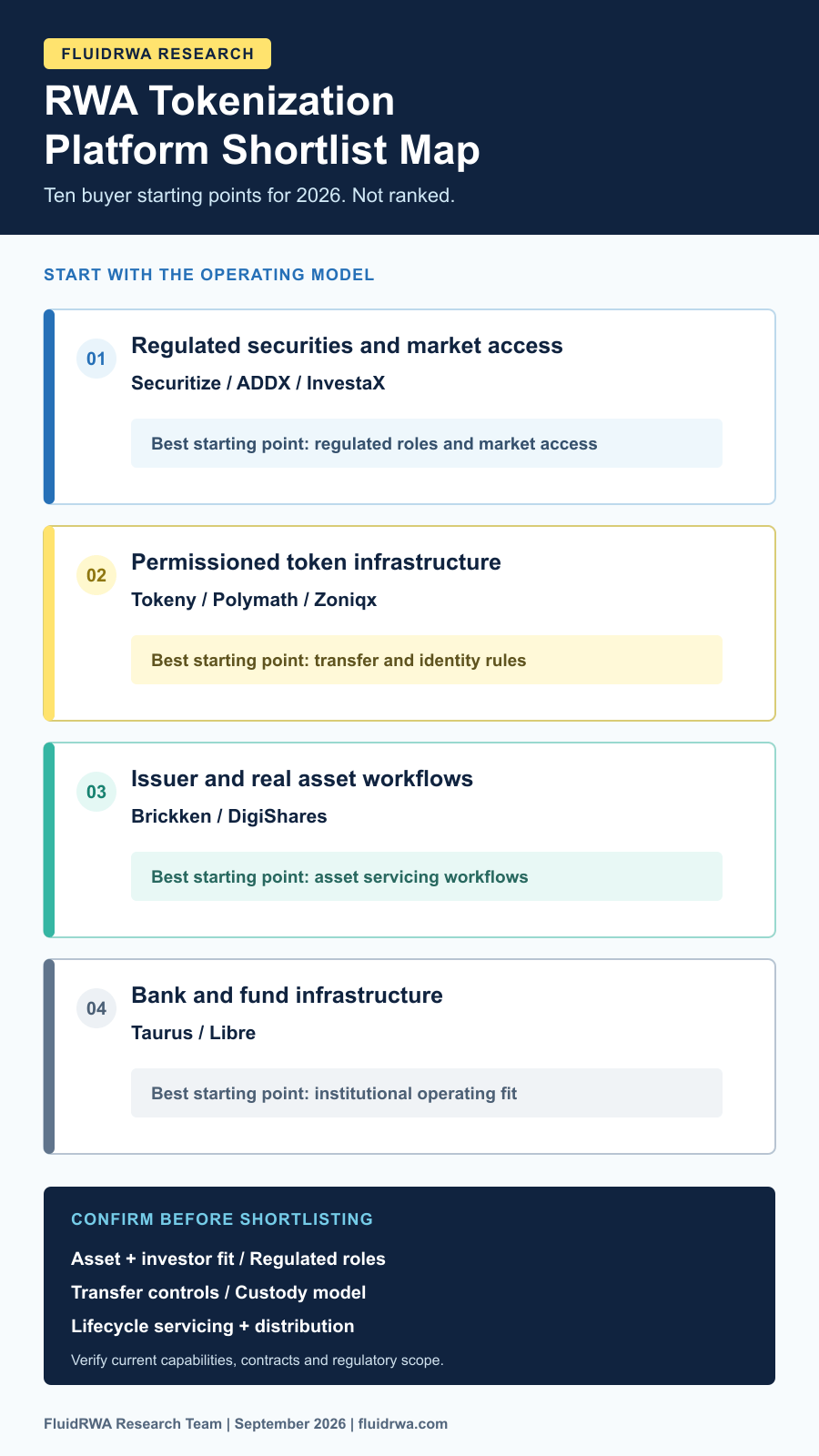
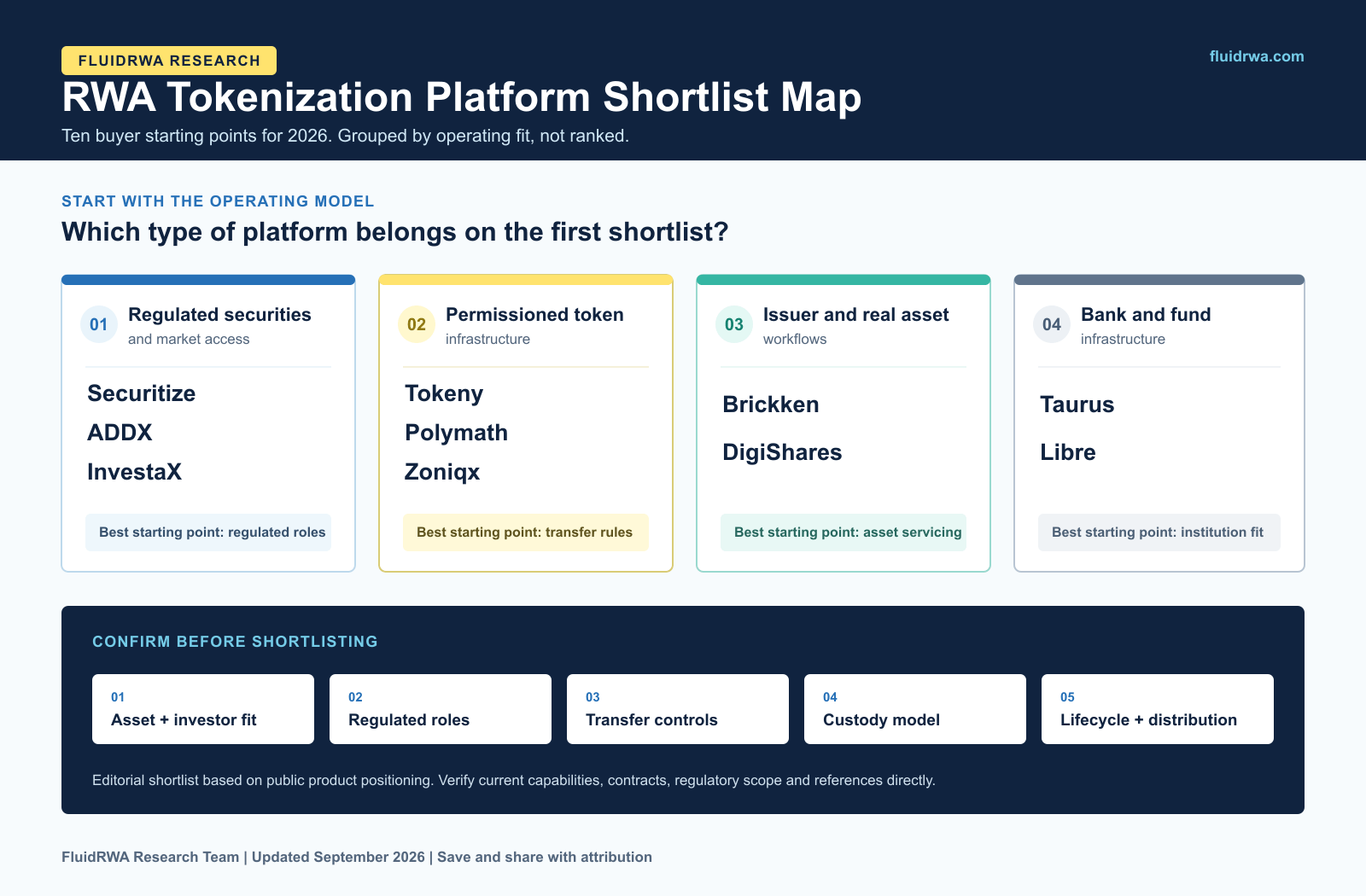
FluidRWA research brief
Tokenization vendor comparison snapshot
Tokenization vendor selection should start with asset class, regulated activity, investor workflow, custody model and distribution needs. The strongest provider for a tokenized Treasury product may not be the strongest fit for private credit, real estate, enterprise issuance or institutional settlement.
| Buyer need | Provider types to compare | Example companies |
|---|---|---|
| Regulated issuance | Tokenization platforms, transfer controls, investor onboarding and lifecycle management | Securitize, Tokeny, Zoniqx, Brickken |
| Tokenized investment products | Treasury, fund, money market and securities product issuers | Ondo, Superstate, Hashnote (acquired by Circle), Backed, Midas |
| Credit and lending | Private credit, asset-backed lending and borrower workflow infrastructure | Centrifuge, Maple Finance, Figure, Provenance |
| Custody and operations | MPC wallets, qualified custody, policy controls and settlement operations | Fireblocks, Taurus |
| Connectivity and networks | Oracles, proof of reserve, interoperability, institutional blockchain and settlement layers | Chainlink, Canton Network, Hedera, Ripple, R3 |
Top Tokenization Companies in 2026: Short Answer for Buyers
The best tokenization company in 2026 is not the company with the loudest market narrative. It is the company whose infrastructure matches your asset, investor base, regulatory model, custody workflow and distribution plan.
That is why a serious comparison should separate tokenization companies into functional groups:
- Issuance and lifecycle platforms: Securitize, Tokeny, Zoniqx, Brickken, Polymath, DigiShares and ADDX
- Tokenized investment product issuers: Ondo Finance, Superstate, Hashnote (acquired by Circle), Backed Finance and Midas
- Private credit and lending infrastructure: Centrifuge, Maple Finance, Figure and Provenance Blockchain
- Custody and wallet infrastructure: Fireblocks and Taurus
- Institutional blockchain and interoperability infrastructure: Chainlink, Canton Network, Hedera, Ripple and R3
- Regulated marketplaces and private market access: Archax, ADDX and Libre
This guide is designed for issuers, funds, family offices, banks, broker-dealers, private market platforms and fintech teams that are evaluating tokenization vendors. It is not a universal ranking that claims one company is best for everyone. Tokenization has become a stack, not a single product.
If you are still deciding whether your asset is ready, start with the FluidRWA Tokenization Readiness Assessment. If you already know the asset class and need vendors, compare enterprise-grade tokenization platforms, institutional crypto custodians, fiat on/off-ramp providers, KYC and AML providers and compliance infrastructure providers.
For architecture diligence, use the dedicated guides to wallet APIs for asset tokenization, custody insurance coverage and exclusions and the 25-question stablecoin provider RFP. These address control boundaries that a platform shortlist alone cannot resolve.
Top 10 RWA Tokenization Platforms: Buyer Shortlist
This shortlist focuses on providers that an issuer, fund, asset manager or regulated market participant may evaluate for token creation, investor controls, lifecycle administration or distribution. It does not rank tokenized investment products, blockchains or oracle networks as if they were interchangeable software platforms.
| Platform | Natural starting point | Confirm before shortlisting |
|---|---|---|
| Securitize | Regulated US digital securities and fund workflows | Contracting entity, regulated roles, asset eligibility and distribution scope |
| Tokeny | ERC-3643-based permissioned token infrastructure | Jurisdiction fit, implementation ownership, integrations and distribution model |
| Zoniqx | Modular issuance, identity, lifecycle and distribution infrastructure | Licensed intermediaries, production references and the status of any standards relied upon |
| Brickken | Issuer-oriented tokenization tooling for a broad range of asset projects | Legal structuring, investor eligibility, custody and secondary transfer model |
| DigiShares | Configurable real estate and private-market tokenization workflows | Market coverage, servicing depth, integrations and implementation support |
| Polymath | Permissioned securities infrastructure and institutional blockchain tooling | Current product scope, network choice and operating partners |
| ADDX | Regulated private-market issuance and investor access | Issuer eligibility, geography, product admission and distribution reach |
| Taurus | Bank-oriented tokenization, custody and digital asset infrastructure | Modules required, custody model, chain support and integration effort |
| InvestaX | Digital securities issuance and investment infrastructure | Jurisdiction, regulated functions, asset scope and investor access |
| Libre | Tokenized fund issuance and distribution infrastructure | Eligible investors, fund-administration dependencies and redemption model |
For a closer enterprise comparison, read Securitize vs Tokeny vs Zoniqx. Teams considering Zoniqx's DyCIST model should also read the ERC-7518 explainer because ERC-7518 remains an Ethereum proposal in Review, not a finalized standard.
Why Tokenization Vendor Comparison Is Harder in 2026
Tokenization used to be described as a technology question: can a real-world asset be represented as a blockchain token?
That question is now too narrow. In institutional markets, the harder question is whether the tokenized asset can be legally issued, compliantly distributed, safely custodied, transferred under the right restrictions, serviced over time and integrated into existing financial infrastructure.
Citi argued in its tokenization research that blockchain adoption is moving toward an inflection point where tokenized financial and real-world assets could become a major use case for mainstream blockchain infrastructure. McKinsey has also framed tokenization as a shift from experimentation toward practical deployments where adoption depends on operational value, regulatory clarity and market infrastructure. The Financial Stability Board has separately warned that tokenization can introduce financial stability considerations when scale, leverage, interconnectedness or liquidity transformation become meaningful.
Those points matter for vendor selection. A vendor that can mint tokens may still be weak at investor onboarding. A platform with strong compliance controls may not solve custody. A product issuer may not be a platform you can use for your own asset. A custody provider may be essential to the project but not responsible for legal structuring, investor eligibility or secondary-market rules.
Before comparing vendors, decide which problem you are solving:
- Are you issuing a fund, security, note, real estate interest, credit asset, commodity product or treasury product?
- Do you need software, a regulated issuer, a transfer agent, a broker-dealer, a marketplace, a custodian or a blockchain network?
- Are investors retail, accredited, professional, institutional, DeFi-native or existing clients?
- Will tokens be transferable, locked, allowlisted, marketplace-traded or redeemable only with the issuer?
- Which jurisdiction controls offering rules, investor eligibility, custody and reporting?
Those questions determine whether a company belongs on your shortlist.
How to Evaluate Tokenization Companies
Use this framework before choosing any provider.
1. Asset Class Fit
Tokenized real estate, private credit, fund interests, tokenized Treasuries, carbon credits, commodities and private company equity have different requirements.
For example:
- A tokenized Treasury product needs fund administration, custody, redemption, yield handling and investor restrictions.
- A real estate tokenization project may need SPV structuring, property cash-flow reporting, investor documents and transfer limitations.
- A private credit product needs borrower data, collateral reporting, servicing workflows and default handling.
- A digital securities product may need transfer agent workflows, broker-dealer support and securities-law compliance.
Do not choose a vendor only because it says "RWA tokenization" on its website. Ask what asset classes it has actually supported.
2. Compliance and Transfer Controls
Institutional tokenization is not only about creating a token. The system must know who can buy, hold, redeem and transfer the asset.
Evaluate:
- KYC, KYB, AML, sanctions and PEP screening
- Investor accreditation, suitability or professional-investor workflows
- Jurisdiction-based restrictions
- Transfer restrictions and allowlists
- Wallet screening and transaction monitoring
- Audit trails and regulator-ready records
- Data privacy and evidence retention
If compliance is still unclear, use FluidRWA's KYC provider comparison guide and Web3 compliance guide before selecting a platform.
3. Custody and Wallet Model
Custody is one of the most important decisions in tokenization. Some projects use qualified custody. Others use MPC wallet infrastructure, embedded wallets, issuer-controlled wallets or investor self-custody with allowlisted addresses.
Evaluate whether the tokenization company integrates with custody providers such as Fireblocks, Taurus, Anchorage Digital, BitGo or other regulated custody and wallet infrastructure providers. For financial institutions, custody and authorization controls may matter as much as token issuance.
4. Distribution and Liquidity
Many tokenization projects fail because they issue the token before solving distribution.
Ask:
- Who will actually buy the asset?
- Can the platform connect issuers with broker-dealers, wealth managers, institutions or marketplaces?
- Is there a secondary market?
- Are transfers legally permitted?
- Are buyers eligible in the target jurisdictions?
- What happens after issuance if there is no liquidity?
Recent research on tokenized RWA markets has emphasized that tokenization and liquidity are separate outcomes. A token can exist on-chain and still trade rarely, remain concentrated among a small number of holders or be restricted by compliance rules.
5. Lifecycle Management
A tokenized asset has a life after issuance. It may need distributions, redemptions, reporting, corporate actions, NAV updates, investor communications, tax documents, proof of reserves, governance actions or servicing workflows.
Strong vendors support the full asset lifecycle. Weaker fits may only support initial token creation.
6. Interoperability
Institutions do not want trapped assets. They need infrastructure that can work across custodians, wallets, blockchains, reporting systems, fund administrators and market venues.
That is why providers such as Chainlink, Canton Network, Ripple, R3, Hedera and Provenance matter even when they are not traditional tokenization platforms. They support connectivity, settlement, messaging, data or blockchain infrastructure that can make tokenized assets more usable.
Wider Tokenization Ecosystem: Platforms and Supporting Providers
The ten-platform shortlist above compares issuer-facing starting points. The companies below also include product issuers, networks, custody and connectivity providers. They serve different roles and are not an expanded platform ranking.
1. Securitize
Securitize is one of the most recognized institutional tokenization platforms for regulated digital securities and fund tokenization. It supports issuance, investor onboarding, compliance, transfer management and asset servicing for tokenized securities and funds.
Best for: large asset managers, regulated issuers, alternative investment firms and enterprise fund tokenization.
Strengths: institutional credibility, regulated-market experience, asset servicing, compliance workflows and high-profile partnerships.
Watchouts: smaller issuers may find the operating model more enterprise-oriented than they need.
Useful next step: compare Securitize with other tokenization platforms and confirm whether you need issuer technology, regulated services, transfer agent support or marketplace access.
2. Tokeny
Tokeny is a Luxembourg-based provider focused on regulated digital securities and enterprise tokenization infrastructure. It is often evaluated by banks, asset managers and financial institutions that need compliant issuance, transfer restrictions and lifecycle tools.
Best for: banks, fund administrators, asset managers and regulated issuers that want modular tokenization infrastructure.
Strengths: compliance automation, institutional positioning, digital securities focus and multi-jurisdiction capabilities.
Watchouts: buyers should evaluate distribution options and the broader operating stack around the software.
Useful next step: read the FluidRWA comparison of Tokeny vs Securitize for a deeper decision framework.
3. Zoniqx
Zoniqx positions itself as an end-to-end tokenization and institutional digital asset infrastructure platform. Its model focuses on issuance, identity, compliance, lifecycle management and institutional distribution through a more complete operating environment.
Best for: asset managers, banks, private equity firms, real estate issuers, fund managers and institutional issuers that need lifecycle and distribution support.
Strengths: broad asset class support, integrated identity and compliance workflows, lifecycle management and institutional distribution focus.
Watchouts: enterprise deployments usually require planning, implementation work and clearer operating requirements.
Useful next step: run the Tokenization Readiness Assessment before comparing Zoniqx with other enterprise platforms, because fit depends heavily on asset class and launch model.
4. Ondo Finance
Ondo Finance is one of the most visible companies in tokenized U.S. Treasuries and institutional yield products. Its strength is not generalized tokenization software for issuers; it is productization of familiar financial exposures for eligible investors.
Best for: institutional investors, treasury managers, digital asset funds and platforms seeking tokenized Treasury exposure.
Strengths: clear product positioning, strong market awareness, tokenized Treasury focus and distribution momentum.
Watchouts: Ondo is more relevant as a tokenized product provider than as a general-purpose tokenization platform for arbitrary assets.
5. Brickken
Brickken provides enterprise tokenization tools for companies, SMEs and asset issuers. It is often relevant for teams that need a more accessible tokenization platform rather than a highly bespoke institutional deployment.
Best for: SMEs, private companies, real estate sponsors and issuers exploring digital securities or asset tokenization.
Strengths: issuer-focused platform, practical tooling and accessible go-to-market positioning.
Watchouts: buyers should validate jurisdictional compliance, transfer rules, custody and distribution partners for their specific asset.
6. Centrifuge
Centrifuge is a major name in tokenized private credit and asset-backed financing. It connects real-world credit assets with on-chain capital markets and has long been associated with the RWA lending category.
Best for: credit funds, asset originators, trade finance providers and institutional lending workflows.
Strengths: private credit specialization, early category leadership and on-chain credit infrastructure.
Watchouts: it is more specialized than a general issuance platform.
7. Superstate
Superstate focuses on tokenized funds and investment products that bring regulated asset management workflows on-chain. It is relevant for institutions evaluating tokenized fund access and blockchain-native fund administration models.
Best for: institutional investors and digital asset allocators seeking regulated tokenized funds.
Strengths: asset management focus, tokenized fund positioning and institutional product design.
Watchouts: it should be compared as a product issuer and fund platform, not simply as issuer software.
8. Hashnote (acquired by Circle)
Hashnote (acquired by Circle) is relevant in tokenized money market and institutional yield products. It belongs in the comparison set for buyers evaluating tokenized cash management, treasury and yield-bearing instruments.
Best for: institutional treasury, cash management and yield-oriented tokenized products.
Strengths: focused product strategy and institutional Treasury relevance.
Watchouts: product availability and investor eligibility depend on structure and jurisdiction.
9. Fireblocks
Fireblocks is not a tokenization platform in the narrow sense. It is a major custody, wallet and digital asset operations infrastructure provider used by institutions that need secure transaction authorization and wallet operations.
Best for: banks, fintechs, exchanges, payment companies and institutions that need secure wallet and custody operations.
Strengths: MPC wallet infrastructure, policy controls, operational security and institutional integrations.
Watchouts: Fireblocks is usually part of the tokenization stack, not the entire stack.
10. Taurus
Taurus provides digital asset infrastructure for banks and financial institutions, including custody and tokenization-related capabilities. It is especially relevant where bank-grade infrastructure and regulated financial operations are central.
Best for: banks, broker-dealers, financial institutions and regulated infrastructure buyers.
Strengths: institutional custody, bank focus and digital asset infrastructure depth.
Watchouts: fit depends on whether the buyer needs custody, issuance, marketplace connectivity or all three.
11. Chainlink
Chainlink provides oracle and cross-chain infrastructure that can support tokenized assets through data, proof-of-reserve, interoperability and connectivity layers.
Best for: projects that need asset data, reserve verification, cross-chain messaging or connectivity between tokenized assets and external systems.
Strengths: oracle infrastructure, proof-of-reserve tooling and broad ecosystem connectivity.
Watchouts: Chainlink is an infrastructure layer, not an issuer or full tokenization platform.
12. Canton Network
Canton Network is designed for institutional financial markets that need privacy, synchronization and interoperability across regulated participants.
Best for: banks, market infrastructure providers and institutional networks.
Strengths: financial-market design, privacy-aware workflows and institutional interoperability.
Watchouts: it is more relevant to institutional market infrastructure than smaller issuer launches.
13. Ripple
Ripple is relevant for institutional payments, settlement and tokenization infrastructure, particularly where cross-border value movement and financial institution connectivity are important.
Best for: banks, payment companies and institutions evaluating tokenized settlement or asset mobility.
Strengths: financial institution relationships, payments infrastructure and enterprise blockchain positioning.
Watchouts: tokenization use cases should be evaluated separately from payments and settlement use cases.
14. R3
R3 and Corda remain relevant for enterprise blockchain and regulated financial workflows. R3 is often considered where privacy, permissioned networks and financial institution integration matter.
Best for: banks, capital markets infrastructure, trade finance and regulated enterprise workflows.
Strengths: enterprise architecture, permissioned-network experience and institutional focus.
Watchouts: buyers should compare whether a permissioned model or public-chain model better fits the use case.
15. Hedera
Hedera is an enterprise-grade public network used for digital assets, identity, provenance and institutional applications. It can be relevant for tokenization projects that want predictable fees, governance and enterprise ecosystem support.
Best for: enterprises, financial institutions and projects needing scalable public-network infrastructure.
Strengths: enterprise governance, performance and practical tokenization tooling.
Watchouts: the network choice still needs to match custody, compliance and distribution requirements.
16. Provenance Blockchain
Provenance Blockchain is associated with financial asset workflows, lending, private markets and institutional financial services infrastructure.
Best for: lending institutions, private market workflows and financial asset settlement.
Strengths: financial-services focus and asset-backed transaction relevance.
Watchouts: buyers should validate ecosystem depth and integrations for their specific asset type.
17. Figure
Figure is relevant for lending, private credit and blockchain-enabled financial asset workflows. It is strongest where the use case is connected to credit, loan origination, loan trading or financial asset infrastructure.
Best for: financial institutions, lenders and credit platforms.
Strengths: credit-market experience and institutional financial workflow focus.
Watchouts: it is not a generic tokenization platform for every asset class.
18. Maple Finance
Maple Finance is a major on-chain credit marketplace that supports institutional lending and credit strategies. It is relevant in tokenized private credit comparisons because credit is one of the most important RWA categories.
Best for: institutional credit, digital asset lenders and on-chain private credit strategies.
Strengths: credit specialization and lending-market infrastructure.
Watchouts: credit risk, borrower quality, liquidity and investor eligibility need close diligence.
19. DigiShares
DigiShares is focused on real estate tokenization and investment management workflows. It is often relevant for property sponsors, real estate funds and developers exploring fractionalized real estate investment products.
Best for: real estate developers, property investment platforms and real estate fund sponsors.
Strengths: real estate specialization, investor management workflows and asset-specific tooling.
Watchouts: real estate tokenization requires local legal structuring, investor documentation and realistic liquidity planning.
20. ADDX
ADDX is a private markets platform focused on access to alternative investments for eligible investors. It is relevant where tokenization intersects with regulated private market distribution.
Best for: accredited investors, private market products and alternative investment access.
Strengths: regulated private markets positioning and investor access model.
Watchouts: issuers should evaluate market access, eligibility and jurisdictional constraints.
21. Polymath
Polymath has long been associated with security tokens and regulated asset issuance. It remains relevant in discussions about digital securities infrastructure and token standards.
Best for: regulated issuers and security-token workflows.
Strengths: security-token focus and category history.
Watchouts: buyers should evaluate current product maturity, ecosystem activity and implementation fit.
22. Libre
Libre focuses on tokenized access to alternative investments and private markets. It is relevant for wealth management, alternative investment distribution and institutional fund access.
Best for: wealth managers, private banks and alternative investment platforms.
Strengths: alternative investment focus and distribution-oriented model.
Watchouts: product availability and investor eligibility are central diligence items.
23. Backed Finance
Backed Finance offers tokenized securities linked to traditional financial assets. It is relevant for investors and platforms looking at regulated tokenized exposure to familiar instruments.
Best for: eligible investors, DeFi integrations and tokenized listed-asset exposure.
Strengths: regulated product orientation and bridge between traditional securities and blockchain rails.
Watchouts: geographic availability and investor restrictions matter.
24. Archax
Archax is a regulated digital asset exchange, broker and custodian based in the UK. It is relevant for institutional trading, custody and tokenized asset market infrastructure.
Best for: institutions that need regulated trading, custody or market access.
Strengths: regulated-market positioning and institutional digital asset services.
Watchouts: buyers should separate exchange, custody and issuance needs.
25. Midas
Midas offers tokenized investment products and is relevant for buyers evaluating regulated, blockchain-based investment exposure, particularly in Europe.
Best for: digital wealth platforms and investors seeking tokenized investment products.
Strengths: product simplicity, European positioning and tokenized investment focus.
Watchouts: it is more of a product provider than a complete enterprise tokenization platform.
Best Tokenization Companies by Use Case
Best for Large Asset Managers
Shortlist Securitize, Tokeny and Zoniqx when the priority is regulated issuance, lifecycle management and institutional credibility. Add Fireblocks or Taurus if custody and transaction governance need a dedicated institutional layer.
Best for Tokenized Treasuries and Money Market Products
Evaluate Ondo Finance, Superstate, Hashnote (acquired by Circle), Backed Finance, Midas and Securitize. Compare product structure, investor eligibility, redemption model, underlying assets, fees, reporting and custody.
Best for Private Credit
Evaluate Centrifuge, Maple Finance, Figure and Provenance Blockchain. Focus on borrower underwriting, collateral reporting, servicing, default procedures, liquidity, investor disclosures and compliance.
Best for Real Estate Tokenization
Evaluate DigiShares, Zoniqx, Brickken and specialist real estate tokenization providers. Real estate tokenization requires careful SPV structuring, title review, income distribution, tax handling and investor communications.
Best for Banks and Financial Institutions
Evaluate Taurus, Fireblocks, Tokeny, Securitize, R3, Canton Network, Ripple and Hedera depending on whether the need is custody, issuance, settlement, enterprise blockchain, interoperability or distribution.
Best for Smaller Issuers
Evaluate Brickken, DigiShares and accessible tokenization platforms first, then add legal, KYC, custody and payment providers as needed. Smaller issuers should avoid overbuying enterprise infrastructure before validating investor demand and compliance requirements.
Buyer Checklist Before Contacting Vendors
Before booking demos, document these requirements:
- Asset type and legal wrapper
- Target investor type and geography
- Primary market and secondary transfer model
- KYC, KYB, AML, sanctions and wallet-screening needs
- Custody model and wallet policy
- Blockchain preference or constraints
- Distribution strategy
- Reporting, servicing and redemption workflow
- Budget and implementation timeline
- Internal owner for legal, product, compliance and technology decisions
If several of these are unresolved, run the Tokenization Readiness Assessment before speaking to vendors. It will help clarify whether you need a tokenization platform, custody provider, KYC provider, compliance vendor, legal advisor, smart contract auditor or a more complete implementation partner.
Common Mistakes When Choosing a Tokenization Provider
Mistake 1: Treating tokenization as minting
Minting is only one step. The real work includes rights, compliance, custody, onboarding, transfers, servicing and investor trust.
Mistake 2: Ignoring distribution
An asset can be tokenized and still fail commercially if the issuer has no qualified buyer channel.
Mistake 3: Buying a platform before confirming legal structure
Technology cannot fix an unclear legal claim, weak investor documentation or unresolved jurisdictional issues.
Mistake 4: Assuming liquidity is automatic
Tokenization may improve transferability, but liquidity depends on market access, eligible buyers, pricing, disclosure, trading venues and compliance rules.
Mistake 5: Choosing one vendor for every layer
Some projects need one integrated partner. Others need a modular stack. The right answer depends on the asset and operating model.
Final Recommendation
If you are evaluating tokenization companies in 2026, start with the use case, not the vendor list.
Choose Securitize, Tokeny, Zoniqx or Brickken when you need issuance and lifecycle infrastructure. Choose Ondo, Superstate, Hashnote (acquired by Circle), Backed or Midas when you are evaluating tokenized investment products. Choose Centrifuge, Maple, Figure or Provenance for credit-oriented workflows. Choose Fireblocks or Taurus when custody and digital asset operations are central. Choose Chainlink, Canton, Ripple, R3 or Hedera when interoperability, settlement, oracle data or institutional network architecture are the core problem.
The strongest tokenization projects do not simply pick a brand name. They map the asset, compliance obligations, investors, custody, distribution and lifecycle requirements first. Then they choose the vendor stack that fits.
FluidRWA can help with that process. Start with the Tokenization Readiness Assessment, compare tokenization platforms, or submit your requirements if you want a guided shortlist.
FAQ
What are the best tokenization companies in 2026?
The best tokenization company depends on the use case. Securitize, Tokeny, Zoniqx and Brickken are often evaluated for issuance and regulated asset workflows; Ondo, Superstate, Hashnote (acquired by Circle), Backed and Midas are relevant for tokenized investment products; Centrifuge, Maple and Figure are stronger for credit; Fireblocks and Taurus support custody and wallet infrastructure; Chainlink, Canton, Hedera, Ripple, R3 and Provenance support connectivity, settlement or blockchain infrastructure.
Which tokenization company is best for regulated securities?
For regulated securities, buyers often compare Securitize, Tokeny, Zoniqx, Polymath, ADDX, Archax and related compliance infrastructure providers. The right choice depends on jurisdiction, asset type, investor eligibility, transfer restrictions, transfer agent needs, custody and secondary trading requirements.
Which tokenization providers are best for tokenized Treasuries?
Ondo Finance, Securitize, Superstate, Hashnote (acquired by Circle), Backed Finance and Midas are relevant to evaluate for tokenized Treasury, money market or yield-bearing products, depending on jurisdiction, investor type, redemption model, custody and distribution requirements.
Should I choose one tokenization platform or a full vendor stack?
Most serious tokenization projects need a vendor stack rather than one platform. A project may need tokenization software, legal structuring, KYC and AML, custody, wallet infrastructure, smart contract audits, payment rails, transfer agent workflows, oracles and distribution partners.
How should issuers compare tokenization platforms?
Issuers should compare tokenization platforms by asset class support, regulatory workflow, investor onboarding, KYC and KYB integrations, transfer controls, custody integrations, lifecycle servicing, reporting, APIs, jurisdiction coverage, distribution channels, implementation timeline and total cost.
What is the difference between a tokenization platform and a custody provider?
A tokenization platform issues and manages tokenized asset workflows. A custody provider safeguards digital assets, private keys and transaction authorization. Some projects need both because issuance, compliance and asset servicing are separate from custody and wallet operations.
Can small issuers use tokenization companies?
Yes, but small issuers should be careful about scope and cost. Some enterprise platforms are designed for large asset managers or banks, while others are more accessible for SMEs, real estate sponsors, private companies and early-stage issuers.
When should I run a tokenization assessment?
Run a tokenization assessment before contacting vendors if you are unsure about asset structure, investor eligibility, compliance obligations, custody, blockchain selection, launch budget or required operating partners.
Need help choosing a tokenization provider?
Use FluidRWA to compare tokenization platforms by asset class, compliance model, custody workflow, distribution requirements and launch readiness.